A KNOWLEDGE SHARPER THAN FLINT- pt 2
A KNOWLEDGE SHARPER THAN FLINT- pt 2, by Adrian Simmons, art by Simon Walpole
Selu, a shaman of the First Tribe, following a vision from the spirit world, travels with Kiptum, a hunter of the Red Wasp Clan seeks, a man who is not a man. Together they travel to the Seer Folk, where they hear a tale of a dangerously intelligent woman, Mukali, who has been possessed by a strange entity and wandered alone into the wilderness. With Mukali’s sister, Clauviku, they track the possessed woman to her camp on the river, there they discover Mukali has made uncanny alliances with the eerily intelligent Marsh Elephants, and promises the three travelers that she’ll return with them to their tribes with gifts and wisdom. Selu sensing a trap of colossal proportions enters the spirit world to find Mukali—the real Mukali.
- A Woman of the Seer-Folk Gambles Upon the Future
In a way, one is always lost in the spirit world, but Selu not only saw nothing familiar around him, the spirit world seemed utterly and completely wrong. He gazed up at the incredible ferns around him. They rose like trees with thick barrel bodies, crowned with long fronds of leaves. For a moment his own body seemed alien to him. Was he tiny, like an ant? Such a thing could happen to a shaman, but no… no, he was not small, these things were huge.
Other things grew here, full and horrid. He reached a hand to the hut-bird nest at his chest it was shockingly light. A few moments of investigation revealed what he feared: empty. He had come into the spirit world with nothing but his wits. He gathered a bit of wood, thick but obviously soft, and found a fist-sized stone. He walked through the great fronds.
The logic of the spirit-world was a dream-logic: when he had held the neck-breaker’s tooth it had taken him to a place where the neck-breaker had the advantages. He had Mukali’s hair, he was in a place advantageous to her, or at least familiar.
There were other trees here, trees he knew, and smaller plants and vines, mixed in among the alien foliage. A result of his will or Mukali’s or simply the way of the spirit world he did not know.
It was dark, the moon, crescent, seemed to glow too bright and too big in the sky. The night here was hot. The air seemed to burn his lungs. He checked the ground for tracks, found none, and continued.
A small stream cut the ground, too small for a crocodile and he walked to a fallen tree with a strangely braided trunk to cross it. Something slithered in the moonlight, yellow and red, and as long as a man—a great salamander of a thing. A salamander that dreamed of being a crocodile? The two looked at one another for a moment. Then Selu threw his stone, using the true sorcery of man, and the thing fled.
He crossed the stream, found another stone—smaller than he wanted—and walked a bit further, then froze. Something was moving along the ground in front of him; at first he thought it was a snake, but then he realized it was a great centipede. As long as his leg, black bodied and yellow-legged, it flowed in front of him, huge and horrible as it crossed a dappled bit of sunbeam.
Heart hammering, he walked on. As in a dream, it was daylight, and the sun seemed weak, casting hazy shadows from plants both alien and familiar.
He pushed through the fronds and discovered a great pile of stones—a tall wall of them, laid together just so, each one bigger than a hut, bigger than an elephant. It stretched away to both sides and rose above him higher than the Ridge of Dreams.
It was something beyond his ken, like Mukali’s sky-hut, but greater. It was like a mountainside, but who would build a mountainside? He stood for a moment, unsure of what to do—never a good thing in the spirit world. He breathed the thick humid air, focused his will, strained his hearing. The rhythmic chirping of huge insects sounded about him—and in a moment he realized something more. A kind of clacking, insect-like, but not rhythmic like an insect. It stuttered in starts and stops.
He risked putting down his stone and stick and cupped his hands behind his ears to try to find the direction of the sound and realized there must have been hands of them.
Stick and stone in hand, he pressed his way toward the sound. Another small creek, another great salamander, and then something else—an arch of the queerly laid stones went over this creek. He went toward it and found a great odd track through the underbrush, wide enough for five men to walk side by side. He looked for tracks and found nothing, save the soft-toed prints of the crocomanders in the creek, and a few others that he could not recognize.
He followed the track, wound around the strange woods on it, and crossed another odd bridge. He could hear the clacking, louder now, and closer, and as he came around a wide curve in the trail he knew whatever it was could not be far. Ducking off the path he pressed himself to the braided bark of one of the barrel-trees. He peeked around and froze at what he saw.
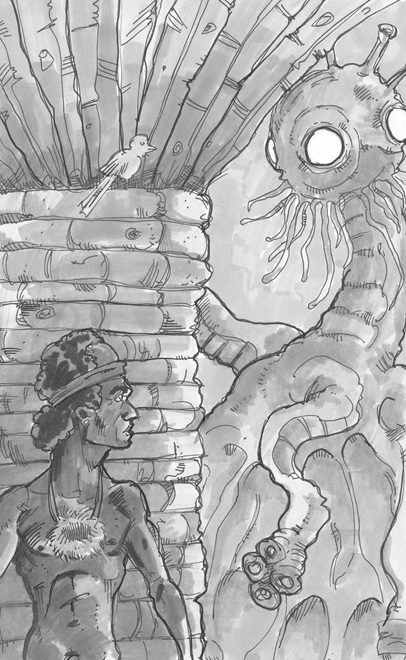
Three things, looking like nothing so much as giant fist-of-nothing plants, seemed to glide down the path. But they were animals. But they were plants. Fear gripped him, paralyzed him, sank his feet deep as a tree root into the ground. They were huge, twice the size of a man, where the bloom of a fist-of-nothing would be was an orb, a tuber of some kind, with three eyes, and above them sprang sprouts like flowers. The clicking came from a pair of great crayfish like claws that snapped and clicked, while a fourth stalk ended in what looked like a cluster of cone-mushrooms.
Two of the things were making the noises, the third, between them, slid silently. The eye-tubers of the two loud ones swung around on their stalks, looking into the odd forest with unblinking eyes. Those two carried things, disconcertingly like a hut-bird nest across their bodies—but they were made of some strange material, unnaturally colored, like polished wood, but with no grain, no texture.
The third’s eye-tuber swayed back and forth for a bit, it raised its claws and Selu saw they were bound—the same odd kind of material in three bands wrapped around them, so that it could make only the slightest clack in answer—and he knew, in the way of the spirit world, that they were speaking to each other. Like the clans of the Hyena-Ear Tribe would drum on a hollow log to call to each other.
The two outside creatures abruptly left, spinning like leaves in a breeze, before gliding away down the path. The third stood alone for long moments in the clearing and then, to Selu’s horror, began to easing down the path toward him.
He oozed back around the tree, pressing his back against the hot leathery trunk. He gripped his club, formed and shaped by his will when he wasn’t looking into something heavier than he had originally picked up: a wrist-thick branch with a burl and sharp broken root at the end. He could swing at it the eye-tuber as the living fist-of-nothing came past… swing it and run. Run where? Perhaps up a tree? Could it climb? It didn’t look like it could climb, but… it didn’t look like anything. Fist-of-none was the closest thing it could be. It could not be anything.
It slid along the path, a dry rustle like a snake or the undulation of the great centipede. He looked down at the thing’s shadow as it approached and in the way of the spirit world, the hazy-edged shadow was nothing like the creature that cast it, it was the shadow of a person, a woman.
There are moments in both the flesh and the spirit world where hesitation could be deadly, where one must move like one has touched a hot branch in a fire.
“Mukali!” he barked.
The scraping stopped as did the human shadow.
He licked his lips. “Mukali!” he shouted again, “of the Seer Folk, wife of Wafulu, sister of Clauviku.”
The odd rustling clicks sounded, sounded far too close, and he heard in his mind “Yes! I am Mukali.” Then, each word-shadowed echoed by the thudding of the bound claws into the ground. I! Am! Mukali!”
It was right behind him, just to the other side of the tree. He could hear a strange kind of breathing, deep long gulps of air. “Who are you?” she demanded.
One had to be cautious in the spirit world, names being one of the things that had to be guarded and traded to other spirits, but in this place… “I am Selu of the First Tribe. The spirits have guided me here to find a person who is not a person, and at the banks of the Ollisim river I found her, I found you. But it was not you, so I have come to the spirit world to find you. To find answers.”
“Show yourself! The very outline of a man has become a memory to me.”
Every instinct warned him not to do it, not to step out from behind the braided bark of the tree. But men were more than instinct, and after a long breath he stepped out, atop her human shadow and made himself look. The thing, loomed over him, the thigh-thick stalks wound through the air, the head-bulb dipped low, almost at face-level, and the eyes, if they could be called that, looked at him. The claws, still bound in the odd material, reached out for him and the long cilia that sprouted from their tips touched his arm, his chest, like the feet of spiders. There was a strange palsy to the limbs, that spread through the entire massive body. It was incredible. It was pitiable.
He bore it until the spidery-cilia reached his neck and began to touch his face, then he ducked away.
“Tell me,” she said, “tell me what I—what my body does—in the world of men?”
“You have left the Seer Folk, and gone to the Ollisim River. There you have built both a hut and a hut that stands high in the sky.” Secrets were valuable in the realm of the spirits, but he felt there was nothing to be gained from holding anything from her. “And you have bent marsh-elephants to your will and they have built a great hedge of broken trees about it.”
The palsy stopped. The great claws flexed in their bands. “Are there monkeys?”
“Yes. You have used many new tricks to lure monkeys to you. Collared monkeys.”
The great mound of a body slid back, and the eye-tuber swung around and the stalk connecting it to the body grew long and thin and for long heartbeats she looked back to where the other two monsters had retreated. Then like a whipping branch, the eye tuber snapped back, lowered to his face level.
“Selu of the First Tribe, I need you to listen very carefully. As shamans go into the spirit world, the Yith, this thing whose skin I now wear, go into the days yet to come, into generations yet to come. But they do not go into the spirit world, they go into the minds of… of … people. Do you understand?”
He did not really, but he nodded. “Yes.”
“Have you ever been on a hunt and realized that you missed a spore or a sign and that the prey got away?”
“Who hasn’t?”
“Did you realize that if you had looked left instead of right you would have caught the prey? But you cannot turn back the sun in the sky to do it? Imagine that you have a dream of the future. A vision that allows you to know that if you look left instead of right, you would catch what you hunted. That is what the tribe of the Yith do. Do you understand?”
He perhaps did. Other shamans sometimes had dreams of the future, but he never had. He had his doubts that others did, honestly. But the Seer Folk were good at predicting the weather, and from there they knew what new water holes would appear and what would be drawn to them.
The claws continued their weak clicking, and the voice continued in his head—a voice strained with desperation. “Have you ever put a bundle of straight grass where a hut-bird can get it? And the hut-bird will make a nest that you can carry as a basket?”
“Of course. Who hasn’t?”
The fourth stalk, the one with the cluster of tube-mushrooms at its end, slithered, almost touching his ear, and the eye-tuber loomed closer where the single great eye turned toward him almost touched his forehead. “Listen to me,” the ghost-voice said. “Listen as if your life depends upon it. To the tribe of the Yith the tribes of men are the straight grass. But instead of building a nest, they are building the marsh-elephants, forcing them over long generations from the woods to the swamps. They are so close to being as wise and cruel as we ourselves. They have lit the fire in the head. But it burns slow, and for the marsh-elephants to thrive they need the land to be empty of the tribes of men. This is what the Yith want. This is why they have sent one of themselves forward through uncountable years. That is the nest they want to build.”
It made no sense! “Why would they want such a thing?”
“Because in uncountable generations the marsh-elephants will be far stronger tools for the tribe of the Yith than we could ever be.”
A bound claw fumbled forward and the tips opened enough to catch and hold his forearm in a toad-cold grip. “You must stop her! You must stop me in the waking world. She will promise knowledge, she will want to be taken back to the Seer Folk and the Red Wasp Clan, and the Hyena-Ear Tribe. She will carry monkey dung and monkey brains and it will carry a …an… an evil-spirit, and it will spread like a fire among all the people and all the nations. The Yith will destroy the race of man and the marsh-elephants shall be their new straight grass.”
Then she began to laugh, an unhinged sound in his head. “General Tuowlu, who walks upon the dust of my bones, Nug-Soth, with your glittering cities and sorceries, James Woodville with your caravels and coffee-shops, Estee Jozee, who walks beneath a plastic sky in the canyons of the hunters’ star, how you will remember the names of Mukali of the Seer Folk and Selu of the First Tribe!”
Then as quickly as her mad laughter started it stopped and the woods were deathly quiet, far too quiet. “They are coming!” she whispered in his mind. “Run!”
And he did, his legs exploding beneath him, and he crashed through the underbrush. He saw them, the two other Yithians surging down the path and Mukali’s long bound claws lashing out at them. One of them swung the odd thing up from its body and pointed it at him.
A sound like all the fat of an elephant’s body sizzling at once, and a smell like the moment before lighting on the plains, and behind and around him the fronds and limbs of the trees lashed and burned. Then Mukali’s voice in his mind turned to a scream.
Selu plunged ahead, heedless of the strange fronds and soft branches. Something, some great huge shadow fell atop him; he looked up and saw an impossible thing, a canoe made of the strange clay floated in the sky above him, it tilted far too one side and in it were easily two hands of Yithains.
He ran through the shallow streams, he ran and ran, ran until his legs screamed and his lungs burned, and the limbs and leaves he crashed through became, in the way of dreams, those he knew.
He stopped, stooped and gasped for air. He looked up and the flying canoe was nowhere to be found in the bits of sky he could see through the trees. He trudged through the mud. He needed to find… what? A place to rest. A place to sleep, and to wake back into the world of flesh. Find some tongue-cutter and eat it, that would work, too.
He strained his ears listening for the neck-breaker. It would be in its nature to seek him out and avenge itself on him. The slow wide creek eased past and brambles and vines grew thick at the bank. It was the same bank where he had outsmarted the neck-breaker, the mud and broken branches were still stirred up. The soggy, sagging trunk still crossed the water and looked as if it could bear his weight. He picked his way through the broken branches where the top of the tree rested on the muddy bank. He took a step onto the trunk and froze. Something was wrong, something was very wrong, something was out of place.
Selu looked behind quickly, since it was the way of the neck-breaker to leap from behind. The open space behind him was empty, just leaves and small trees, less than a stone’s throw away was the thicker wall of the forest. An easy enough jump for the neck-breaker. But there was nothing that he could see. He turned back to the fallen tree.
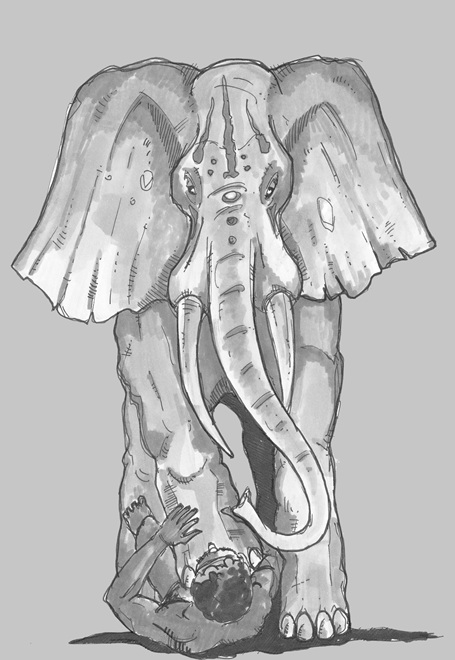
Two steps and the tree burst up from the creek, mud and water flailed up into the sky as a marsh-elephant surged up from beneath the water. Selu fumbled back and the creature’s thin trunk slapped into his chest and he flew backward. The great hard foot of the marsh-elephant thumped down on top of him, not hard enough to crush him, as it easily could. Instead, it pressed him into the mud, inexorably down. Light, as great as the laughing sun at noon, poured out of the great split that ran down the creature’s face. The great grey-green eye looked into his.
Then it spoke. Slow slurred words. “A gift!”
The creature pushed him down. “As great as pulling up the hollow stump. As great as shaking the tree. A gift so that the name of Tears-the-Vine will be trumpeted in awe the same as the name of the running apes!”
He pounded his fists against the creature’s hard horny foot and might as well have been striking a stone. His vision blurred, and yet the great blue-green eye that floated in the fire in her head did not blink and the voice of Tears-the-Vine slopped out its demand.
“Give me the true sorcery of man.”
- A Hunter Sees His Stalker
In the waning darkness of the night, Kiptum snapped awake. Something outside was not right.
Beside him Selu seemed to struggle to breathe. Beside the shaman, Clauviku slept dead to the world. Kiptum drew his flint knife and crept out of the tent.
A marsh-elephant—the male that carried the hollow stump—stood right outside the fence. Another was further away, further into the woods. He could hear it move through the underbrush.
The marsh-elephant was a sacred animal, they could make baskets like a man, or at least hollow out a stump with their tusks. They were not to be hunted. It was said, among the Hyena-Ear tribe, that if you left a sweet-tuber in the crotch of a tree, a marsh-elephant would take it and leave a bird-egg in its place. But the Hyena-Ear tribe also claimed that one night a group of marsh-elephants had destroyed their camp, tearing up their tents, and marsh-elephants could not do such a thing; they might blunder through a camp and tear up things by accident, but not purposefully.
There were collared-monkeys here as well, travelling through the trees by the light of the fitful crescent moon. He could see them, dark little shadows in the high trees. The crocodiles were still in the river—that was normal, at least.
At last he realized it. What bothered him were the two monkeys trapped in their baskets. These two should have been active in the cool of the night, just like those that ran through the trees. In the flickering light of the fire he could see that were not drunk on fire-tadpole poison, they were sick, almost like they had been left out in the hot sun too long. They rarely moved, and when they did they swayed, and drooled. His hand itched to pick up his spear and grant them mercy. Mukali’s cruelty did not sit well with him.
Instead, he put more wood on the fire, building it to a solid blaze. Over the crackle of the fire he heard a moan from their shelter. He pulled the flap aside and peered in.
Clauviku was sitting up, looking at Selu. A gleam of sweat stood out on the shaman’s body. Outside of his ragged gasping breath he did not seem to move.
Clauviku looked from the shaman to the hunter in the guttering firelight. “He has been like this, sweating and trembling, for almost the entire night.”
Selu shuddered suddenly, his free hand, spasming.
The ways of a shaman were odd to him, and Kiptum did not even pretend to understand them. “Has he done that often?”
“Yes.”
“Is he supposed to?”
“No.”
Outside they heard the marsh-elephant pacing along the perimeter.
Clauviku looked up at him. “Are they supposed to do that?”
“No.”
- A Shaman Amok in the Dreamworld
Selu was soaked in mud. His side throbbed when he breathed. He was sure the marsh-elephant matriarch had broken a rib.
Teaching her to throw was a long endless nightmare. She kept him close, wedged between her down-curving tusk and her trunk, so when she heaved her head and threw something he jarred against his aching side and dragged his leg across the ground. But worse were the horrid moments when the two of them seemed to merge and melt together. Those horrid flashes when he was a marsh-elephant and she was a human.
There was a great riddle, a great conundrum in her massive head—a kind of rage so strong that it defeated the plan. Like being caught in a lion’s charge, a man could stand there to scared to even lift the spear that would save his. But for her it was more like trying to throw a spear, but not being able to take your eye off the spearpoint. The very simplicity of the act—to throw with intention—made it difficult. It was like teaching breathing, or how to hear.
Again, he was Selu, again he was a man: feet with toes, hands with fingers, arms out of his shoulders and not that horrid limb springing from his mouth and lip. Again, the massive head shook, and held by the trunk against the tusk, his side shrieked in pain, and he shrieked as well.
“No tricks!” Tears-the-Vine bellowed. “Show me the true sorcery of man!”
“You have to look at what you are throwing at!” he yelled, as he had uncountable times before. “You can’t look at the stone, you have to look where you throw!”
It made no sense to her and he knew it, knew it because for the briefest of seconds he had been her. There was too much to explain.
The massive head forced him down, kneeling in the mud. “It cannot be done!” she growled.
It was almost too much for him. She didn’t throw with a shoulder and an arm, she threw with her neck and her trunk. She had to turn her head, she couldn’t look.
“You have to look as you turn your neck!” he said, pleading. “You can only look for the last bit, before you let go, but it can be enough! I swear it!”
Again the horror of being in a body not his own, of walking in a dream of another mind.
A memory, recent as a track in the mud: The humming of the earth interrupted by a great growing whine. A call to her. A half-day of tramping through the marsh and onto the plain and finding a running-ape that had been treed by a neck-breaker. The running-ape swung a bit of vine and it cried out in piercing tones.
Tears-the-Vines sent Leaps-Up to smash the cat with his club. And as the youth did so, the running-ape spoke, and made promises and dropped the petals of knock-down-the-tree flower.
The memory ended and Selu/Tears-the-Vine swept up a broken branch from the mud, his trunk wrapped around it, guided by the mother-gentle touch of Tears-the-Vine. He looked at the great thick trunk of a mangrove tree, lost sight of it as he turned the massive neck, struggled to stay on his hands and feet. Nothing left, no willpower or control or even to close his great dribbling mouth. The woods, the light of the sun, leaves and mud kaleidoscoped as he whipped the great head around and his nose/arm whipped too. The mangrove tree lurched into view and somehow he locked his gaze upon it. The branch spun in the air and clattered against the tree, cracking in half.
A fierce joy filled them then, so strong that they forgot all about throwing and the true sorcery of men and laughed. A vision, a memory older but still powerful: high grass and the sound of men’s voices, then a marsh-elephant trumpeting, and surging up to run. A running-ape wheeling about with a man-quill and being caught in the chest by a mighty foot and crushed to the ground. Another step and trunk and tusks smashed into a woman, tossing her across the dusty clearing. Leaps-Up trotting beside her, hefted a great tree root in his trunk, reared, and brought it down on a man, crushing the upraised arm, the shoulder, the head.
A vision, older and strong like a great tree: Sprays-the-Dew stumbling, the smell of blood like her own filling that great long nose, one of the man-quills, sticking out from beneath her armpit. Other quills sticking from her hide. They, Selu and Tears-the-Vine, rushed at the men who chased her. They were small, they could be beaten, but they threw stones, each one crashing into her mind, the true sorcery of men shattering her thoughts like sudden thunder. And Sprays-the-Dew trumpeted at them to turn and run.
Then they were separate, Selu was kneeling in the mud, the hot breath of Tears-the-Vine pouring over his neck and back. “Again!” she said, like a child wanting a ride. “Again! Show me to not look, then look, then throw!”
Her trunk wrapped around his chest and began hauling him back up. Something, some mix of instinct and pride, some desperation sprang to his mind. He had the true sorcery of men; he did not need to see to throw. As he was lifted he snatched up a fist full of mud and debris and threw it backward over his shoulder, where Tears-the-Vine’s great blue-green eye was sure to be.
A jolt went through the trunk and it loosened. He spun and slipped out of the grip as Tears-the-Vine reared up in shock and pain. A wild swing of her foot caught him the shoulder and he fumbled forward, managed to keep his feet, and ran.
- A Hunter Displays His Trophies
Something was happening among the marsh-elephants, Kiptum was sure of it. He heard thrashing in the forest, in the dark well beyond the fire’s light, and a slurred stammering trumpeting. The big male outside the barrier flexed out his ears, snapped them twice, picked up the hollow tree stump and carried it forward. Beyond the hedge of tree limbs it stood well within the glow of the fire. The marsh-elephant’s trunk twisted and the contents of the stump fell out onto the ground.
The trunk groped down among the items, pulled up the curving claw of a neck-breaker. The marsh-elephant held it up and Kiptum wasn’t sure if it was showing it to him or admiring it itself. The elephant dropped the claw, pulled up a piece of a crocodile’s lower jaw, dropped it; pulled up a smashed lion’s skull.
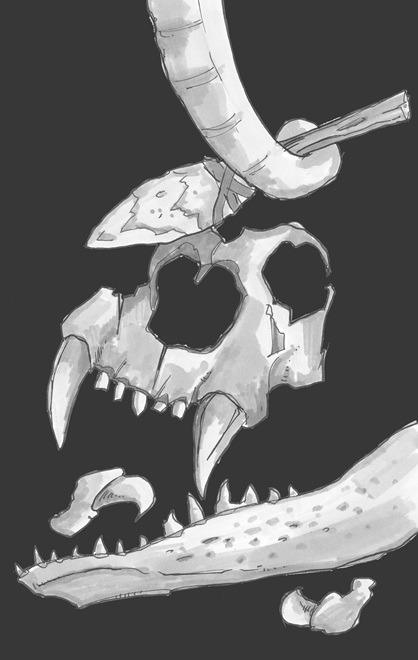
Kiptum heard sounds behind him: Selu grunting and shouting as he came out of the trance. But he himself was almost held in a trance as the marsh-elephant continued to show its trophies. Teeth and claws and bits of bone, and then, very clearly held so that Kiptum could see it, a flint spear with a broken haft. Out of the dark came the other two marsh-elephants, the big female leaning against the smaller. The smaller one bore her sister’s weight and in her trunk she carried the long limb with a burl and sharp broken root at the end.
The male leaned forward, wrapping his trunk around a thicker limb of one of the downed trees and easily dragged it back, opening a great gap in the barrier.
Leaving the old matriarch, the little female trotted up, and for a moment the two of them both wrapped trunks around the haft of the club, then the male swung his head from side to side, using the club to batter and snap branches, easily breaking down the hedge before stepping into the gap.
Kiptum wanted to run, but the elephants blocked the opening, and the crocodiles guarded the river. With rising panic, he swept up a burning limb from the fire, held it up he shouted and waved his spear.
The marsh-elephant’s ears snapped out, then it reared up and brought the club down with whistling force. A jump backward saved Kiptum’s life. He thrust the burning limb at the creature’s face, forcing it to shuffle back. Then it reared and swung again, crashing its club to the ground. It took two great steps, catching Kiptum in the hip with its knee. The hunter faltered and fell back.
The creature could easily have crushed him beneath its feet, or rammed him with its great head. Instead it hesitated, then trotted back. It stood, panted, then turned its head for another swing of the club in its trunk. Kiptum flailed backwards. The long swing fell short, and the beast followed it up with another, even wilder, then bounded up and brought another blow down.
Pain rocked down the top of Kiptum’s skull as he backed into leg of the sky-hut. For a moment he couldn’t do anything, couldn’t think of anything to do, anywhere to go; nobody could help him, Clauviku was but a Seer Folk woman, and Selu was lost in his trance.
“Mukali!” he bellowed.
Above him came a hum, then a whistle. The marsh-elephant paused in its swing, snapped its ears and turned its head up.
Kiptum looked up. Mukali leaned far out of the sky-hut, her free hand spun a thing- a long loop of rope ending in a strange box and a beyond that a glowing ball. She spun it faster and faster, and the whistling grew louder and the ball glowed brighter. Then she let go of the rope and the glowing ball lanced down, striking the marsh-elephant on the back and burst into a roaring fire that dripped down the creature’s flanks.
The elephant let out a bellow and began to careen madly.
Kiptum heard the trumpeting of the other two marsh-elephants, and over it the whistling of Mukali’s odd weapon. He forced his feet back under him and he stood beneath the very center of the sky-hut.
- A Woman of the Seer-Folk Sees the Future
Clauviku covered her ears, crouching by Selu. He moaned and struggled to wakefulness.
She knew that the return journey from the spirit world was difficult, that one had to rest. But Selu struggled like a man laying on ants.
“Be quiet,” she whispered. “Please, be quiet. They’ll hear you.”
She didn’t know what was going on outside, but it sounded like the end of the world. The elephants were tramping and trumpeting, and that horrid whistling sounded above that.
“Clauviku…” Selu whispered, “Clauviku… help me… take me to the marsh-elephants.”
Was he mad? “No, no. We can’t do that. The marsh-elephants are on a rampage, they will stomp us to death.”
The crashing around outside grew even worse and a new horror, a horrid reek of burning hair and skin came to her.
She looked out the hide hut and all her desire to stay within evaporated: a marsh-elephant, the male, was struggling and burning, and Kiptum ran at it, stabbing at it with a spear, out of rage or mercy she could not guess. But the marsh-elephant was bearing down on their little hut.
She grabbed Selu under his slick armpits and hauled him out. Panicked heartbeats later the burning marsh-elephant tore through the tent, tearing it to pieces.
Together she and Selu struggled away. Some tiny warning went off in her mind and she risked turning her back to the chaos in the camp and gaze out at the dark sluggish water. The eyes of the crocodiles gleamed, easing toward the shore.
The burning marsh-elephant spun, crashed against the wiry hedge of the wall and faltered. Kiptum appeared out of the smoky darkness, a new spear in his grip. He ran to the side of the creature and thrust the weapon deep under its foreleg. It let out a slurred growl and tried to swing its massive head back at him but could only drag its ears and face through the naked and jagged branches. The beast hung there and collapsed.
With surprising strength Selu struggled in her grip, gaining his feet and limping toward the scattered fire. She caught up to him before he fell.
“Take me to the big female,” he whispered.
“She’ll kill you. They are mad.”
“As far as the barrier, Clauviku, that’s all. I beg you! Just get me that far.”
Above them came the wailing whistle of Mukali’s magic rope. She looked up, her sister, the thing that possessed her sister, leaned out of the sky hut swinging the witch-rope, another sphere burning brighter and brighter on its end.
“Tell her not to—” Selu started.
The flaming ball flew out into the night and burst into a pool of flame, just beyond it, Clauviku saw the small female rear back. Then, with an almost comical deliberation, she ducked her massive head to the ground and with trunk and tusk heaved up sand at the fire.
Selu paused, breathed deep and hard, then turned his sweat-slick face up. “Mukali!” he yelled. “What will you do now? You can’t kill us! We are the arm that will throw the spear of the Yith into the tribes of men! Do you want to kill the marsh-elephant? The one you have waited so long for? The one with the fire in the head?
The old shaman gasped for breath for a few moments then struggled forward.
Above them Mukali yelled: “Stay away from her! She’s dangerous to you!”
Through the smoke and the horror Clauviku almost grinned. “Whatever possesses my sister’s body,” she whispered to Selu, “it is a terrible liar.”
She hung onto it, the one steady thing she knew.
- A Shaman Witnesses the True Sorcery of Man
Selu leaned against Clauviku, pushing forward past the scattered fire toward the broken hedge and out into the night. The wailing of the witch rope sounded behind and above him, then another of the burning clay pots flew into the darkness and shattered near the smaller female. She snorted, stamped, seemed almost angry that she had barely put out the first fire, and now here was another!
He had touched minds with them, for a few moments, and knew the childish route their thoughts took, that it wasn’t entirely surprising or mad that the creature would occupy itself putting out fires.
And Mukali? Mukali would not strike at him, or Clauviku, or even Kiptum. She needed them to spread the killing spirit among the tribes. The killing spirit she had already put into them.
She might strike at the marsh-elephant shaman, though, as much as the tribe of the Yith wanted them, they didn’t want them now, tonight, on the shore of this accursed river.
Kiptum appeared at his right, his eyes white-wide with terror, but his jaw was set hard, his lips a flat line in his face. He had no spears left, just a fist-sized stone carried in a white-knuckled grip. The hunter swept up Selu’s right arm and between them Selu half-walked and was half-carried.
Again and again the witch-rope shrieked and the burning clay spheres pelted around them, but the three humans walked on, and the two marsh-elephants did not flee.
“Tears-the-Vine,” he shouted. “Don’t hunt the Hyena-Ear tribe. I beg you! If you do this thing, they will fight back. The Seer Folk and the Red Wasp Clan, we can stop the Hyena-Ear tribe from raiding into the marshes!”
The great panting matriarch stared at him, its watery eyes glaring out of the yellow strip of paint. He knew she could not understand him, that human speech was beyond its ability. But he could see, could convince himself, that she recognized him from the spirit world.
She lurched to her feet, her ears snapping hard at them.
“Kiptum!” he cried. “Get back! She can smell the male’s blood on you.”
Her trunk lashed out and had she not had the weak knees of a shaman fresh from the spirit world, Kiptum would have been caught.
As the young hunter dodged back, Clauviku pulled hard at Selu, dragging him away.
“Back!” Kiptum said. “Turn back, she cannot catch us.”
Another clay ball shattered nearby, nearly catching the young female, who reared and skittered sideways away from it.
Tears-the-Vine bent her head and wrapped her trunk around a great half-buried tree-branch. Wrenching it free in a spray of dirt and sand she stood with it and gazed at them.
“Get away!” Selu shouted to his companions. Kiptum was already standing at a distance, and Selu shoved Clauviku hard.
The two of them stood, shaman to shaman in the world of the flesh. Tears-the-Vine turned her head, but unlike in the spirit world she turned her head halfway around, then spun her whole body in a great circle and with terrific force let the limb fly far above Selu’s head. As she floundered and fell to her side he heard the great limb whistle through the air and crash into the sky-tent.
He heard Mukali scream, but his attention was riveted to Tears-the-Vine. The great matriarch breathed hard and she lashed her trunk weakly and let out a final grunt. He heard the young female charge away, tearing through the dark forest. Was the grunt some kind of signal, or had the younger one finally seen enough horror and fled? Selu did not know, could not know. And he had no strength to flee.
- A Hunter Tries to Wash His Polluted Hands
Kiptum wanted more than anything to flee, but the night was not done and there was lurking danger in the forest.
They found Mukali trying to drag herself away from the base of the ruined sky-hut. She had a broken leg, between the foot and the knee, and when she breathed it sounded as ragged and wet as that of the marsh-elephant matriarch.
He and Clauviku had gathered Mukali, carefully, and brought her back, while Selu, carefully re-built their fire.
Dawn found Kiptum unable to stop staring at the dead marsh-elephant male. “Selu,” he said, “I have killed a sacred animal. I fought it because it tried to kill me. I stabbed it deep and into the heart as a mercy. It was burning.”
“You did what was right,” Selu said. “Even in this place.”
“Will you perform a cleansing ritual?” he asked. It worried him. He had come here for fame, but not the infamy that came with killing a sacred animal.
“I will,” Selu said. “We will do it here. Tomorrow, or maybe the next day.”
“Here?” Clauviku said, before Kiptum could. “Why should we stay here in this horrid place?” She kicked at one of the many clay faces starring blankly at the sky.
“Yes,” Mukali said. Then took a ragged breath. “Why stay here? You have so many secrets to take to your people. The secret of clay, the power of the sling, the-”
“We have to stay,” Selu interrupted. “We cannot abandon you. And I am weary. I cannot travel.”
Kiptum had become very fond of Selu in their travels, but there was something about the edge in the old man’s voice he did not like. He wasn’t sure what it was… A falseness not so far removed from that of Mukali.
“We have plenty of food,” Selu continued, and passed around more of the dried monkey meat, handing out a strip to each of them, even Mukali. The woman’s face crinkled in distaste, but then she looked at her swollen leg and took it. She put it between her teeth and gnawed.
Kiptum bit into his as well. For all her knowledge, Mukali didn’t seem to know how to dry meat very well at all. Not monkey, not crocodile. Not even the duiker deer, which was the easiest meat in the world to handle.
“I met your sister in the spirit world,” Selu said to Clauviku. “It is true that the spirit that guides her body now is like a stranger living in her hut. But she found me, despite the efforts of the tribe of the Yith.”
“Who are they?” Clauviku asked, then turned to Mukali, “what is the Yithian tribe?”
Mukali looked like she would not speak, then shrugged. “A tribe. A tribe that lives in the spirit world. We come into the waking world sometimes.”
“And my sister?”
“Learning a hundred languages in the camp of the Yith,” Mukali said with a smirk.
“Your sister is very strong,” Selu said. “Very clever and very brave. For a brief time, I touched minds with her and learned a great deal, enough to break the mind of most people, even most shamans. But you sister had untangled a great mass of vines.”
“A pity,” Mukali said, “that you have no way to pass such information on. I would have taught you such a secret, even a thousand generations hence would know.”
“I touched minds with Tears-the-Vine” Selu continued. “I can see why your folk would be so interested in them.”
“A pity that you will eat them all,” Mukali all but spat the words. Then for some reason she glared up at Kiptum.
The young man almost shivered under that gaze. “They are a sacred animal,” Kiptum said. “They are not to be eaten!”
“That makes it so much more unfortunate, then. All you do is eat! All you think about is eating! How did I do as much as I have in this wretched little body, when I had to stop all the time to stuff food into this dripping face-hole!”
“And yet we do well enough,” Selu said. “Well enough with wood and bone, flint and fire. Weak tools to be sure, but we have learned to live with them. Perhaps the Yith will have to make due with weak tools as well.”
Each of the shaman’s words seemed to stab at Mukali, and Kiptum could see that Selu realized it as well.
“Enough, Selu” Kiptum said. “Man, too, is a sacred animal. Stop taunting her!”
Selu’s face lost all expression for a moment, then he nodded. “Yes, you are right. It is this place, the events of the night. It has brought out a cruelty in me that I usually do not possess.”
Kiptum stood after a moment. Selu was not telling him the truth, not all of it at least. But it was the way of shamans to have secrets. And he wasn’t sure if all the dust and smoke from last night hadn’t gotten into his lungs, he didn’t feel very well.
Clauviku stood, too. “Kiptum, sacred animals or not, unless we want to spend the next few days within a spear-throw of two dead marsh-elephants. We need to move. You and I can take turns carrying all the dried meat and the hut.”
There was no denying that she was right.
“Let’s rest first,” he said. “Since it is just the two of us who will do all the work, we need to gather our strength.”
Clauviku considered for a moment, took another bite of monkey, then nodded. “We have hardly slept. I think I breathed in too much smoke and too much dust. Let us set the hut up away from the river’s edge, sleep for a time, and get to work on rebuilding a camp.”
Kiptum nodded, looked at the shaman and Mukali. Neither looked good. Mukali, he knew, would not last for long.
“Would you like something besides monkey and cattails?” he offered.
Mukali glared up at him, then laughed. “Yes. Maybe those… Clauviku! What were those things we cooked over the fire the night before I left the hut of Wafulu?”
“Osula root and four-strip dove.” Clauviku answered.
“Yes, hunter,” Mukali said, “to do a favor for a sacred animal, find me some of the four-striped doves”
“I’ll look,” Kiptum said—four-stripe being nowhere near the marshes, a lie was the best favor he could do.
“Osula root I can find,” Clauviku said, and to Kiptum it sounded like it was the last thing she wanted to do.
“Selu,” he said, “is there anything you want me to look for?”
In spite of the warning he had had just given him about taunting, the old man shook his head and looked at Mukali. “No. I can wait.”
________________________________________
Adrian Simmons is co-founder and cheif editor of Heroic Fantasy Quarterly. His work has appeared at Tales From the Magician’s Skull, Cirsova, and Savage Realms. He has a story forthcoming in Baen’s “Swords and Larceny” anthology.
Simon Walpole has been drawing for as long as he can remember and is fortunate to spend his freetime working as an illustrator. He primarily use pencils, pens and markers and use a bit of digital for tweaking. As well as doing interior illustrations for various publishing formats he has also drawn a lot of maps for novels. his work can be found at his website HandDrawnHeroes.
Advertisement