ERASE THE SLATE
ERASE THE SLATE, by Jonathan Olfert, art by Miguel Santos
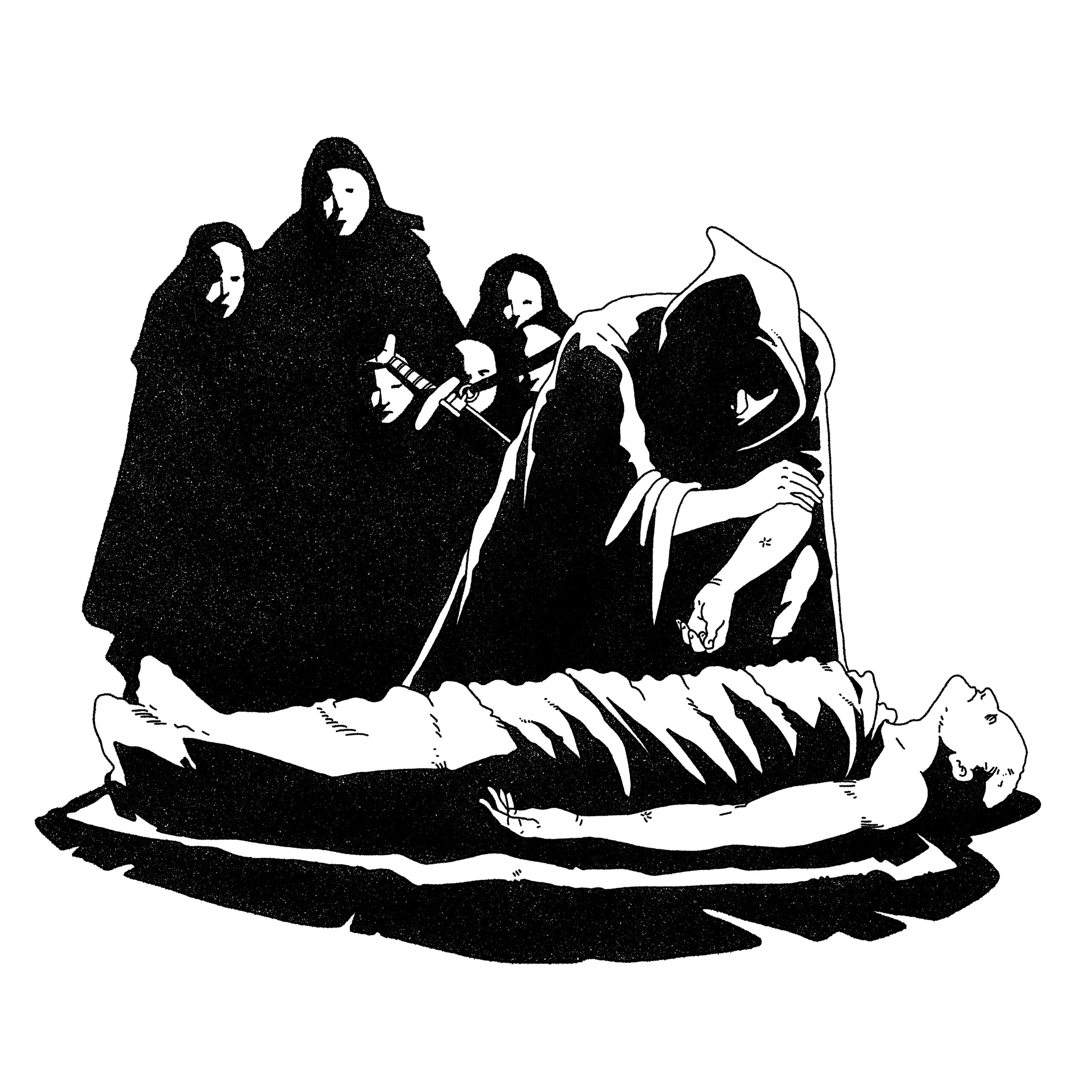
A proper funeral was not about the deceased. Sermons were to focus on gratitude for the eternal strategy of the Five On High. Ander Carmora — somehow the ranking Churchman in town tonight, senior to his partner by bare weeks of ordination — stumbled through the approved language inexpertly. Of those gathered in the churchyard by the grave, a third were weeping and a third stoic. That left those angry at Carmora’s clumsy ordinance as a clear minority, even counting his partner’s indignant glare. Good enough.
For the final component, Carmora had to move to the graveside, where the dead man, Silas Tanner, lay wrapped in cloth — an old blanket — except for his left arm, which wore a long old cord tied around the wrist. A richer man would have had a ribbon, and a beloved man would have had some keepsakes knotted in, but Silas had never had wealth or family or connections. Carmora shifted his sword-belt, dragged up his left sleeve, and knelt beside the corpse. Inside Carmora’s left forearm was the five-petaled rosette tattoo of a tithe collector. He compared the tattoo’s gradations to the tithepayer stamp in the same place on Silas’ arm. Maybe three months since he’d last paid; marginal for being allowed a churchyard burial. There were many shoddy graves in the swamp’s edge on the other side of the overgrown wall. Either this town had a strong contingent of unbelievers or the local priests had always been as strict and dour as Pekarre, who was away for a reason Carmora could not recall. They’d argued about it last night — he was sure of that much, but the memory escaped him.
Carmora weighed the glowering of certain mourners and thought of bad encounters on the road. The Fivefold Church ruled the known world, but a tithe collector who threw his weight around could easily meet misfortune. At least if Carmora ordered an unbeliever’s grave for Silas, his partner Edevadd would have his back. He was even taller than Carmora, his short-sword just as worn from daily carry on the back roads of the Churchlands. Carmora had suspected for a while that Edevadd nurtured some brooding inner life they hadn’t found the trust to broach. But like most tithe collectors, Edevadd was effectively a zealot not quite worn down to a pragmatist, and he’d draw that sword without hesitation if the moment struck. They sparred daily as tithe-takers’ writs of regulation required; Edevadd tended to win. He knew his business.
“A faded stamp,” Carmora said, and stood to meet a large man’s glare. That was Dryven, a swamp farmer, one of many who poled boats between hidden patches of good growth, and certainly knew ways to dispose of a body.
There was a time when that expression had intimidated Carmora or spurred him to enjoy breaking identical men’s pride. Now, after years of collection duty, it only made him melancholy. He thought of his own father, as much a zealot as Edevadd; how much Carmora’s father had given to the Church and how very little help or recognition it had given back.
“Was Silas faithful in his tithes?” Carmora asked Dryven and the rest. “Can anyone vouch for him?”
Carmora wasn’t technically supposed to give that much latitude if he had doubts, but that was more convention than doctrine. It was rare that a rank-and-file tithe-collector had real autonomy, constantly accompanied by others in mutual surveillance, and overseen by the First Steward of a county treasury or tithe convoy. In this moment, as officiator of a Final Reconciliation, with no higher authority around, Carmora had absolute discretion.
Giving Silas latitude obviously sat poorly with Edevadd, but exact obedience was Edevadd’s favourite virtue, so he stayed silent.
“Silas paid all his life,” said Dryven in a way that said we’ve been on this land a hundred generations; do right by one of ours or you risk disappearing on the way to your next tithe-taking.
“As the Fivefold Mysteries teach, believe the words of a faithful man. Good enough for me.” Carmora knelt and used the long cord to tie Silas’ left hand to his neck, so the tithepayer stamp rested over the dead man’s heart. “Silas Baker, I reconcile you to the Five.”
Tension and threat bled out of the small crowd — most of it, anyway; a handful of them split off sourly, and that was tomorrow’s problem. Dryven and others eased the blanket-wrapped body down into the grave. Carmora and Edevadd, who was now seething, helped them shovel in earth.
Mourners cast in soft pink waterlilies, a custom Carmora had never seen, but then again tithe-collectors were reassigned from route to route and partner to partner — across the known world, so far as sacred funds permitted — to stay uncorrupted. He hadn’t been in this county long. Edevadd’s tension grew with each bundle of flowers. Such additions to a Final Reconciliation suggested unassimilated, unapproved local beliefs. Carmora pretended not to understand; he just kept shoveling.
The pair of them weren’t invited for a meal, not by anyone. That was clearly Edevadd’s fault. Their billet was a shack behind the church, and they ate ration-biscuit porridge and the last of yesterday’s roast asparagus — cheap and plentiful — in cold reciprocal resentment.
###
After long prayers, Carmora ached to get away from Edevadd, to be alone, which was forbidden at all times, like women’s company and extra-scriptural reading.
He dared to slip down from the top bunk. His sword-belt included a steel-latched tithe purse of leather and mail with a few coins inside. Both belt and leather cuirass were too noisy to risk buckling on. Feeling unpleasantly naked in his nightshirt, Carmora eased through the door and into the churchyard.
The fort-like church, locked up tightly while the priest Pekarre was away, sat on a shallow hill alongside the slumbering town of Desht, which pressed up against the slope as if the church was guarding it from the swamp. The symbolism was likely intentional but not apt: all the towns around here made their living from the swamp, its foods and waterways. The church felt simply in the way.
The air always smelled of smoke, but what he smelled on the night wind wasn’t the faint dry smoke of campaigns halfway around the known world, or a flashback to the pine-tar reek of his youth on service crews. And lights he’d taken for late lamps or early stars were torches coming through town.
Carmora crouched behind the stone wall where the churchyard met the dirt road. You didn’t last long on the road, holy orders or not, without learning an instinct for threat. He counted a dozen adults with spades, led by the local priest, Pekarre, back from whatever errand had commanded him elsewhere. He wore a rosette cuirass and a sword-belt, not robes of office. Fear suggested Pekarre had come back to Desht, heard of the faded stamp and Carmora’s ruling, and rounded up hardliners to unearth the body for reburial outside the wall.
It was not an unfamiliar story, as not everyone was buried with a priest or tithe-collector around to check a tithepayer stamp with authority.
Although Pekarre was not in Carmora’s chain of command, he had First Steward rank, with a gold pit in the white of his right eye. If he went up against a simple tithe-collector in ecclesiastical justice, the consequences for Carmora could be severe. And, more salient to the moment: in spiritual matters and some temporal ones too, Pekarre ruled this town. Those spades looked sharp and heavy.
Carmora had been trained to deference since childhood: explanation, apology, knuckling under. Righteousness from a defensive crouch, you might say. But sparing Silas Tanner an unbeliever’s grave felt like the only serious decision he’d made in years. The town might belong to Pekarre’s stewardship, but that choice had belonged to Carmora. Beyond the contempt that Carmora felt at digging up a burial because a man might have missed paying his tithes for a few weeks — no, because Carmora had judged the stamp a notch too faint — it stuck in his craw to give that choice up.
He went back inside to dress quickly and buckle on his belt and cuirass; in any argument he’d never carry the day in a nightshirt. Looking righteous mattered, and not just for credibility. He was angry and growing angrier, and the ritual of dressing would give him a moment to put a leash on that anger. Edevadd tensed awake in the lower bunk, and a small curved knife glinted, a weapon Carmora had never seen before. Edevadd would side with Pekarre, at a guess. Like Carmora, he’d grown up in Church schools, virtually bred to deference.
Then again, that knife was unapproved by the rules of their ordination, a transgression as severe as if he’d been concealing writings or altering his blessed cuirass. And what had Edevadd been through, that he’d sleep armed with a weapon he’d concealed for weeks? A weapon whose possession carried the risk of an actual sin and a whipping?
Edevadd’s eyes and the tense lines of his neck and jaw all told of fear, defiance, shame, and a question, of course. Carmora answered that question by busying himself with dressing and pretending not to see the knife. Every Churchman, for various reasons, got good at pretending not to see things.
“Pekarre’s back early,” Carmora said, but only once he’d cinched the buckles of the cuirass, armoring himself against the risk of Edevadd’s opposition. “I think he’s looking to put Silas outside the wall.”
“‘I know where I stand in the chain,'” Edevadd mumbled, quoting scripture; the knife had disappeared and he seemed to be trying to put on both wakefulness and righteousness. “You had the authority to bury Silas; he has the authority to unbury him. If he’s back, he presides.”
“And we’d have our fun debating the doctrine of that any other day,” Carmora said. “Do what you will or go back to sleep.”
Shouts rose outside. Leaving Edevadd to make his choices, Carmora ducked out of the shack again. A scuffle was developing at the churchyard’s roadside gate. Dryven, the big swamp farmer, was blocking their way. Someone who looked cousin-similar gave him a spade upside the head for his trouble, and though Dryven got an arm up, iron cracked mercilessly against bone two, three, four times. The suddenness of the violence — these people were neighbours, cousins — wrung an actual gasp from Carmora, who’d seen his share of sudden violence here and there. He’d thought he had the measure of this situation and its risks.
Dryven reeled back and Pekarre shoved past the scuffle. He moved for the back end of the churchyard with his dozen hardliners in his wake, going around the front of the church and out of Carmora’s line of sight.
Other people were waking in the dark from the sound of violence, coming out into the streets of Desht with clubs or bows, but when they saw the nature of the confrontation, those weapons and their holders vanished quickly. They left Dryven sprawled alone in the street, wary in case he was labeled an apostate, slated for exile or worse if he lived. They’d get back to sleep if they could, and pretend it if they couldn’t.
“How can they all leave him there?” said Edevadd behind Carmora, and his voice was thick with not just contempt but devastation, for no reason Carmora could guess.
“What choice do they have?” Carmora said. “Or any of us? Life in the Churchlands.”
The treasonous cynicism came out by accident. What shocked him wasn’t the unthinkable words he’d said so much as the realization that he’d meant them, that he’d felt that way for a long, long time. Edevadd groaned with a restless, insoluble pain that Carmora understood all too well — and hadn’t thought Edevadd could understand at all. Edevadd moved past him toward the gate, maybe to speak with Dryven, to help him, to kill him. He’d buckled on his sword and cuirass and yet they looked ill-fitting, awkward in some way Carmora couldn’t name.
Behind the church, iron thudded into earth. Carmora gripped the hilt of his sheathed short-sword for comfort — abused and ground down keen a hundred times — and went that way.
###
The church doors stood open. Inside, oil lamps glinted off glass ornaments and panels of silver rosettes, ritual vessels and polished lecterns. The doors cast a wedge of dazzling light across the yard. Where the light failed, the hardliners were digging up Silas Tanner.
The task required fewer than the full dozen. Some tended lamps in the church, or kept watch, or stood by. He’d stamped all their arms and taken their tithes, but most days these were women and men he avoided for one reason or another.
They recognized him. He tried to weigh their attitude in their eyes and stances and how they held their spades. A tithe collector got respect as the instrument of collection, of course, and as one of the most tangible connections between the great chain of being and the regular inhabitants of the Churchlands. Worn silver rosettes marked his cuirass and the furniture of his sword, and he had the experience, reach, and relative youth to put that sword to work.
But to hardline believers, a tithe collector was still half a man. Unwed, rootless, childless, landless, an instrument rather than a full person. Even without Pekarre to lead them, there would’ve been limits to their deference. No, Carmora only saw contempt tonight, contempt worth fearing.
“Steward Pekarre,” he called, and the big priest came out from the group, spade in hand and smiling in a more welcoming way than he ever had before. “You’re back early, sir.”
Still smiling, Pekarre seemed to weigh him with his eyes. “A beautiful story,” he said. “A noble household’s faith so strong that every elder insisted on tithing their gold teeth.”
That felt like half an answer in more ways than one, and again Carmora tried to unfog the memory of their argument. It eluded him. And by the anger that image summoned — old people, nobles or not, having golden teeth pried out to prove their devotion, gold enough to eclipse the region’s quotas — the argument could have been a bitter one.
Privately, Carmora figured there were things you didn’t ask of people — donations that would bleed or starve them — even if you had the right and they had the faith. That wasn’t a belief it was particularly safe to speak aloud. But as a man in the sacred business of taking much from many, his regrets often whispered that there had to be a line somewhere. Teeth crossed that line or nothing did.
If he didn’t recall the argument, maybe he hadn’t stuck his neck out too far last night. Maybe.
That didn’t sound like him.
“Come tell me the story, then,” he said with all the normalcy he could summon. “The work’s all done here.” Dangerous as reopening that unremembered debate would be, he’d prefer that over Pekarre reopening the grave.
Instead of taking the lure, Pekarre gestured back at the group and the grave. “The withholder cripples the work,” Pekarre quoted from the Fivefold Mysteries, “but no grasping miser shall prevail.”
“He paid his tithes, sir. He earned his Final Reconciliation.”
“The Five On High owe us nothing,” Pekarre said. “It is we who owe them everything, but Silas grew lazy and weak in his worship. You’d have recognized that if not for your ambition and your own weakness.” The gentle smile remained.
There was too much wrong with that, too many grounds for anger, and Carmora couldn’t grasp an answer.
Behind Pekarre, men hauled Silas’ cloth-wrapped body from its rest and cut the cord between wrist and neck to let the arm flop free. Pekarre cast aside his spade, drew his short-sword, and cut the faded tithepayer stamp from Silas’ forearm in one deft motion, before Carmora could even see his intent. He drew his own sword without conscious thought. Murmurs of shock and unsettlement rose from here and there, but never to the threshold of actually questioning a priest.
Pekarre stalked into the light with congealed blood on his sword. He held up the scrap of skin and faded ink. The smile was gone, replaced with indignation. “This? This, you judged acceptable? Worth the risk of defiling this sacred ground with an apostate’s corpse?”
Carmora fell back on authority as trained, and hated that. “The choice was mine, sir; I was the presiding Churchman.”
“You were, but you remain accountable for all you do in the name of the Five, as any presiding Churchman would know.”
“Sir, I do have to point out that my place in the chain is under First Steward Laine at the county treasury.”
“I’ve known Laine since before you were born. You and the tithes are his purview. This town’s righteousness is mine.”
Which was true as a pragmatic matter. Carmora had no answer for that except a contest of scriptural authority, a Steward’s preferred battlefield.
No, no answer — but still a choice. How far he could fight for a dead man’s dignity before he truly risked the relative safety of his position as a Churchman, resent this life though he did.
“Silas was buried by proper authority and ordinance, sir,” he said at last, keeping that leash on his anger and his eyes off the scrap of skin. “As you say, I’m the one accountable — not him. Let the man rest while we bring this to First Steward Laine, and I’ll accept whatever reconciliation he requires.” Most likely a self-inflicted penitence whip, and worse than usual. There’d be blood. Tonight that seemed worth it.
Scriptural verses were already coming to mind, arguments he could make before Laine in favour of leaving the grave untouched forever. Something about how, after the burial ordinance, a dead man’s place in the great chain of being was more directly under the Five On High rather than through the mortal instruments of the Fivefold Church. That was risky territory, both because it implied Silas’ righteousness and it sidelined Church authority, but it was doctrinally grounded enough that it might do the trick. He didn’t know Laine well enough to say how fair-minded he might be. Make the question thorny enough, though, and Laine might decide to seek counsel from the Second Steward above him, with a letter or by travel, and this could all get much less urgent, much less angry, as Silas decomposed in peace.
Those possibilities — the penitence whip aside — seemed good and realistic until Pekarre smiled again.
“Your righteousness is a matter for another night, son,” he said. “My own responsibility is to keep my stewardship from being defiled. I’d be accountable for that myself if I didn’t safeguard that duty. Urgently.” He raised his voice and gestured back at Silas’ body. “Drag this unburied man over the fence and plant him there.”
There was a certain species of Church leader who would listen kindly, urge you to speak your piece, and then decide exactly what they’d determined from the beginning, making it clear that nothing you said had mattered at all. Most days he could bear up against that impregnable contempt. Tonight there was more at stake. This wasn’t solely about his pride; this was about dignity. A stranger’s dignity, to be sure, and not a well-liked one, which — come to think of it — was why it mattered.
Anyone could be out of favour. Anyone could be outside the bounds of righteousness. It didn’t take much at all.
He moved past Pekarre, on edge about that sword smeared with rotting blood, and went to the grave. Hardliners shifted back from the body.
He stuck his short-sword in the earth and retied the slashed cord, put the one free arm against the chest. “I give you your Final Reconciliation,” he said to Silas’ blanket-wrapped face, “if you even wanted it.”
“That,” said Pekarre behind him, a smile in his voice and unexpectedly close, “is apostasy.”
Carmora snatched the sword from the ground and whirled to strike before he quite knew what he was doing.
Pekarre was ready with a stout block and a heavy overhand strike. The short-swords bit into each other, edge to edge. The force of impact drove Carmora to one knee and shoved his boot back against Silas’ corpse. A spade whistled over Carmora’s head, and he lashed out and cut half a finger off someone unwary’s hand.
Before the hardliners could close in on him, he drove up against Pekarre’s guard. They hammered at each other with near-identical swords, not to bash steel but aimed to cut or intercept. A chip of steel pricked Carmora’s throat and fell rattling down the cuirass that protected only his trunk and shoulders. A heavy strike jarred his block out of line; Pekarre’s blade skewed against Carmora’s arm at an angle and left a stinging cut in its wake.
He smashed Pekarre’s sword away and drove him back with a wild sweep. The tip met tugging resistance and left a long scar across Pekarre’s cuirass. No blood welled up through the leather. Not nearly deep enough.
People were screaming but neither he nor Pekarre had attention to spare. He and Pekarre shifted and circled and charged with all the same long-honed footwork, fought in ways that made interference unwise. Like knifework, short-sword combat was unforgiving and hard to see coming. So it was nothing like honour that kept others from weighing in with spades and putting Carmora down.
This was Pekarre’s home ground in the truest sense. Carmora found himself stumbling over the corpse’s feet and fell back reeling into the grave. He scrambled up but long spades drove him down, given the opportunity. Blunt steel shoved and thwacked against his cuirass, scraped his neck and arms as he scrambled to avoid the worst of it.
“The Hundred Adversaries have a grip on you,” said Pekarre sorrowfully, breathing hard and backlit by the church doors. “A good man’s grave is not for you either, not tonight. The Queen of Pride hardens your heart against rightful counsel.”
In Church hierarchy you could encounter many shades and flavors of shame. Carmora had heard another Churchman say offhand, in a way that shook him, that shame was not an appropriate way to teach, but that perspective was rare. Pekarre was the kind of Steward who used shame like a hammer. That recognition did nothing to blunt the hurt and humiliation of the moment, but it gave him a handhold, a way to keep his bearings.
“But she may not yet have your allegiance,” said Pekarre when Carmora gave no answer. “Lachish, would you bring me the small oak casket in my quarters?”
He handed a woman a key and off she went. In the moment of distraction, someone’s spade sagged lower than the others, his footing poor on the edge of the grave. Carmora lashed out and grabbed the base of the spade’s head; as the man holding it reared back in panic, Carmora planted his foot in the wall of the grave. He hacked another spade out of the way as he pulled himself up. Men slipped and sprawled, and Carmora stumbled through the brief gap. There’d been a chance there to cut down one or two of them, and he missed that chance entirely. But the way they milled and yelled and flailed was just as if he’d hurt someone, and that gave him the heartbeat he needed to find his footing.
He ran. He had the vague idea of reaching the county treasury, where he could let Pekarre and Laine sort out the intersections of authorities. He dreaded ecclesiastical court and this level of penitence, but what else was there? An apostate’s exile? No, the Church would see that Pekarre had overreached—
About to hurdle the overgrown wall into the unbelievers’ graves, he froze. He could not do it and did not know why.
He found himself turning.
Back by the church doors, Pekarre held a liturgical implement that Carmora couldn’t recall seeing. It was brass and crystal and deeply respectable. Lamplight trickled through it in colours that drained fear and fury from Carmora’s heart. He felt at peace in a way he hadn’t for a very long time.
It was sorcery, some part of him said. Smaller in scale than the siege invocations, but clearly the same kind of great wonder that softened a city’s heart as the Church moved in. But the siege invocations were the work of far higher-ranking Stewards, and few enough Stewards knew Church sorcery anyway.
Church elders in far-flung domains ruled their flocks as they saw fit. No matter how consistent the liturgy and language, the Fivefold Church here might not be the same as the Fivefold Church two counties over. But that variation didn’t explain how some village priest could have this power over Carmora’s private heart.
Peace and forgetfulness drowned his outrage anew with every heartbeat. A useful anger, Carmora realized as he stood frozen, one hand on the wall, would need to be more about persistence and intention than about the fire in his heart at any given moment, so easily doused. He wanted to cling to his anger, whatever the consequence.
The hardliners stood stock-still, staring at the brass-and-crystal implement. So did Edevadd and the swamp farmer Dryven, now visible over by the billet shack. Edevadd, who had draped Dryven’s arm over his shoulder, was shaking and not just from Dryven’s half-limp weight.
“Repent!” called Pekarre, holding the implement high. The word rippled out, almost visible, like the smoky air was swampwater. Broken bits of memory and old fireside conjecture fit together, and Carmora saw a pattern he’d never seen, so far as he could recall. The sorcery that some Stewards used on the Church’s behalf was a sacred and practical thing, even glorious at times, but he imagined a whole other side, an unspoken side. A form of sorcery that could warp your private heart — compliance, memory, devotion — with those legendary siege-spells just one emanation of it. And if he needed evidence of that guesswork, it was this: for a compelling moment he truly wanted to repent of everything he’d done against Pekarre’s will and drag Silas’ body outside the fence himself.
He clung to the wrongness of that; he clung to his own mind.
Edevadd screamed far louder than the priest’s command. Carmora had never heard or dreamed of a sound like it. Night hid Edevadd’s expression, but there was tense horror in the way he fell to his knees. Without support, Dryven fell hard and curled up, contorted by his injuries or by that scream. Edevadd gulped breath and screamed again.
The sorcery sapped every emotion Carmora might have felt. Whatever Edevadd was feeling was too much for the spell, or something about that knife — or what it meant to him — might be fighting wildly against the sorcery. Or, perhaps, he’d faced it before, grown calloused to it. Scarred. In some other assignment…or in the Church schools.
Dispassionately — all his feelings still felt choked and buried — Carmora thought of the peace and religious passion he’d felt there as a child, sensations he’d clung to as evidence through hard years. Evidence that the Five On High were real and faithful to their worshippers. He thought of the people and the life he’d forgotten in his years there, and all of that fit the pattern too.
Edevadd kept screaming as he drew his sword, clumsily, still kneeling over by the shack. He killed Dryven with a wild slash, an unthinkable thing, initiated and done in a couple of heartbeats. And then, while Carmora struggled for a why that could explain that senseless killing, Edevadd charged.
Charged all of them.
The oppressive peace shattered. Carmora found himself laden with horror, fear, confusion, anger, and above all the need to vomit. Helplessly, he emptied his belly of asparagus and porridge all over the churchyard wall, and between hurls he watched what he could, knowing Edevadd could come at him any moment. With his regulation sword and that curved knife he’d concealed, Edevadd was hacking madly into the hardliners and their long spades. Three, four, five joined Silas in limp and splayed-out death; the rest scattered. The church doors slammed shut, Pekarre inside, and left the yard in darkness.
Edevadd’s gaze ranged around erratically and paused on Carmora. The scream slackened to a whine broken by Edevadd’s gulps of exertion. Carmora wiped his mouth with the wrist of his sword hand. He could run now — hurdle the wall and lose himself in the swamp until the world made sense again. He felt his future whirling away. He felt like choice was a muscle and the Church had let it, made it, wither into uselessness.
But he’d decided to give Silas a good burial — made that choice over and over as resistance grew more intense. A man who could do that could choose anything he had to.
Between waves of outrage and peace, he asked himself what he wanted most tonight, and that was clear enough. He wanted Pekarre to pay. And he did not, no matter how they’d struck sparks as partners, want to kill Edevadd. Everything else that weighed on him would have to wait its turn.
As Edevadd lurched through the graves with his bloody sword held high, Carmora came to meet him.
Fighting him was far different than fighting Pekarre — and different, too, from daily sparring. Tonight Edevadd moved without finesse or compunction. He had the edge on Carmora for reach, and his long arms whirled that short-sword and curved knife like windmill sails.
Carmora fought past the sorcery’s enforced peace and held his ground with firm, fast blocks that jarred his wrist. The waves of peace ended — a broken line of light between the double doors suggested Pekarre was watching his chief problems resolve themselves. Without the sorcery, the mania that trapped Edevadd couldn’t last. They were both tired from a long day and a much longer night.
For all his fury, Edevadd hadn’t pursued the hardliners who chose to run. Lose, said the instinct that had asked Carmora what he truly wanted. Just lose. That’s your way out.
As Edevadd faltered, weeping, out of breath, Carmora scrambled back through gravestones and sheathed his sword. His aching hand struggled to unclamp. He forced it to, even as Edevadd swiped at him with that long arm, with that bloody sword.
When Edevadd hesitated, Carmora bolted for the front doors of the church. It felt like the last of his strength. He’d simply need to find more.
That line of light closed off — Pekarre shutting the double doors. These kinds of churches all had the same bar, stout but slow to draw, especially alone. Pekarre was very much alone tonight. Carmora gripped one wrought iron handle and yanked at the carved door. The edge of the half-closed bar crunched and splintered. He planted his boot against the other door and yanked again, and the church burst open.
Light hit him. Light and peace, stronger than before. His anger sloughed away, and a weight that felt like a species of betrayal, and the share of his weariness — a large share — that was in his heart.
He came inside and finished barring the door, because that was what he had decided to do. This sorcery might steal the honesty of his feelings, but he had his intent. He had his memory.
He might not want to make Pekarre pay, but he clung to the knowledge that, only heartbeats ago, he’d wanted it deeply, judged it important. He decided to trust himself.
Pekarre now wore full robes with his scarred cuirass showing at the neck. Gloriously refracted lamplight twinkled off silver embroidery, and the colors shifted in ways they shouldn’t. He wore the brass-and-crystal implement on his chest, in a gilded harness akin to a Churchman’s sword belt.
Pekarre stood unarmed — no sword, knife, or even a penitence whip. Carmora realized that he should have been feeling deeply uneasy about that. What could a Church sorcerer of Pekarre’s obvious skill and utility do to merit such a backwater post? There were some elders, it was quietly said, who knew too much to be allowed to retire. Even quieter: there were some who simply liked the power and autonomy of isolation.
Carmora moved down the central aisle between the angled pews. The ornamentation’s refracted light was normally…cleaner. Gentler. Each step drove a spike of skewed brilliance into his eyes. He slitted them and led with his sword, listening in case Pekarre drew steel. Behind him, Edevadd or someone else was pounding on the barred door.
“You will learn,” said Pekarre. “Erase the slate, boy. Start again.”
A memory welled up from, oh, twenty years ago: the same words, the same voice or one like it, even the same warped light. It wasn’t possible, was it, that some version of the siege invocations could be woven into the Church schools? He’d spent half a lifetime there. He would have remembered.
###
He was pushing through light like a dense forest. His body felt like pushing forward had been important until now.
He ached in a dozen places as if he’d been running and fighting, and both aftermaths were familiar feelings. His regulation short-sword was in hand; he clung to it because it was familiar too.
The bright light faded. He was in a church like any other. The sword he gripped was bloody, and its edge was damaged, with enough chips and indents to keep him at sharpening-prayers for hours.
Robes slithered on the marble floor, and he looked up: a tall man in priest’s regalia was backing toward the refuge of the lectern his attention fixed on the door. The priest wore a strange ornament strapped to his chest. Someone was pounding and shoving at the door hard enough to wring a groan from the crossbeam and its brackets.
“Ander Carmora,” said the priest. “It’s good you’ve come back to yourself. The Five call on your service to protect this place. There are apostates at the doors. Protect this church with your life.”
Exact obedience was not high among Carmora’s virtues, but he liked to think he could dig in as well as anyone when the need was real. He ran a thumb down the hacked-up edge of his sword and probed the fresh scars on his cuirass. The pounding noise grew louder: he had no time to tend his gear or find better.
“Where’s my…where’s…?” He hadn’t been without a partner, day or night, in the years since a tithe collector’s oaths got him out of far worse kinds of Church service. Although new partners’ names certainly took time to sink in, this felt like a deeper forgetting. Something was powerfully wrong.
“Your partner is dead. Apostates blasted both of you with sorcery and looted his body. I was able to withstand it and provide some shelter here, blessed be the Five, but I am only a First Steward.” The priest came to join him, staring down the central aisle at the door. He rested a hand on Carmora’s shoulder and Carmora flinched with the nerves of recent and upcoming combat. “You’re tired.”
“Always.” And dreading the thought of going up against whatever kind of sorcery could damage memories. He had precious few good ones.
“Only one maniac remains. He’s too much for me alone.” The priest sighed and, from under his robes, drew a short-sword just like Carmora’s: rosette-marked and damaged along the edge. “Are you with me?”
Carmora pushed aside confusion and pain. “Ready as I can be.” Normally he’d have said ‘sir’ out of basic prudence. The honorific snagged on his tongue.
The door crashed open. A tall young man lurched in, wild-eyed and bloody up past the wrist. He carried a Churchman’s sword and a small curved knife, both gory, and he wore a blood-splashed Churchman’s cuirass. Carmora’s chest clenched and seized with a deep sense of wrongness.
“No laughing!” the tall young man shrieked senselessly, gaze fixed on the priest. “No reading, no song! Not a touch, not a friend, not a home! Take, take, take, take, take!”
He’d heard ranting in churches before, of course, the hate of the mad and apostate. This rant bit closer to the bone, too alike as it was to the occasional and secret miseries of a tithe collector scouring the range roads. It cast Carmora back to bad old days he’d rather not remember.
But the moment had pressing demands, and that was almost a relief. He rubbed the sore wrist of his sword hand, a knotted ache up through the ball of his thumb, and moved to intercept.
Strange light swelled behind Carmora, glinting off tears in the maniac’s eyes, and steel bit into steel. The maniac was good, and not just strong of arm and habit: he fought as if he could intuit Carmora’s tendencies and limits and pains, and that was frightening, to be read so well by a stranger.
Frightening, but infuriating too, and Carmora felt a deep reservoir of anger surging up, or like he was careening down a road on a furious horse. Where any of that feeling came from, he couldn’t say, but he was grateful for it and it fit the moment. That fury would need to be enough.
###
First Steward Laine’s tithe convoy rested outside the churchyard of a swamp town called Desht. Sitting on the armoured wagon’s rear sentry bench, Carmora had been cleaning and sharpening his old sword all evening. He’d lost track of time and felt bone-tired, though he couldn’t say he’d done much today beyond taking tithes. A pair of armoured Consecrated were emptying the church’s main contribution chest into the wagon and bickering over jostled silver.
The First Steward broke off a conversation with the local priest and came out of the churchyard through the gate. “Carmora!”
“Sir?”
“The priest says to thank you for helping him dig. You’re always welcome here.”
There’d been several funerals today, some kind of local tragedy. Carmora chewed a splinter from his hand — yes, he’d been digging graves, hadn’t he. Come to think of it, he’d been happy for something different to do until the magnitude of the rote work sank in. Half a dozen inside the yard, and three unbelievers beyond the fence, two of them big men who’d needed long graves. He felt he could sleep and never wake.
When Carmora didn’t answer, First Steward Laine searched his face — for what? — and nodded slowly. “Well, let’s get you to your new billet. We can make Kemry by sunset.”
The horses drew the convoy onward once all silver was accounted for. Carmora drew his legs up and rested on the sentry bench. A sheathed knife dug into the small of his back. He pulled it out: it was curved, messily notched, and of an unfamiliar design.
The convoy’s rearmost riders were watching swamp and woods, not him. He wiped inexplicable tears and went to toss the unapproved knife into the roadside weeds before it could call down trouble. But his hand clutched it unbidden, and he found himself concealing it instead. It felt like something he’d already lost once.
The convoy moved around a bend, and the swamp town vanished in the trees. What had been its name again?
________________________________________
Jonathan Olfert’s tales have thundered in the beams of forty worthy halls — among them Lightspeed, Analog, On Spec, and Beneath Ceaseless Skies — and he has been summoned by Rhysling but not yet chosen. Twice have his works been chronicled by Year’s Best Canadian Fantasy and Science Fiction. Hark, the thunder of his novelettes on the horizon: Fletcher’s Flights and Under White Air. Conjuror of charts and many whispers, wanderer upon strange roads, sworn ritualist of tyrants but no longer, he bears silver of his own hammering and walks with oak of his own cutting. He hails from golden prairie beneath great mountains’ haven; he dwells with alchemists above an iron sea.
Miguel Santos is a freelance illustrator and maker of Comics living in Portugal. His artwork has appeared in numerous issues of Heroic Fantasy Quarterly, as well as in the Heroic Fantasy Quarterly Best-of Volume 2. More of his work can be seen at his online portfolio and his instagram.
Advertisement