HUNTRESS OF THE HIGH TRAILS
HUNTRESS OF THE HIGH TRAILS, by Robert Rhodes, pending artwork by Karolína Wellartová
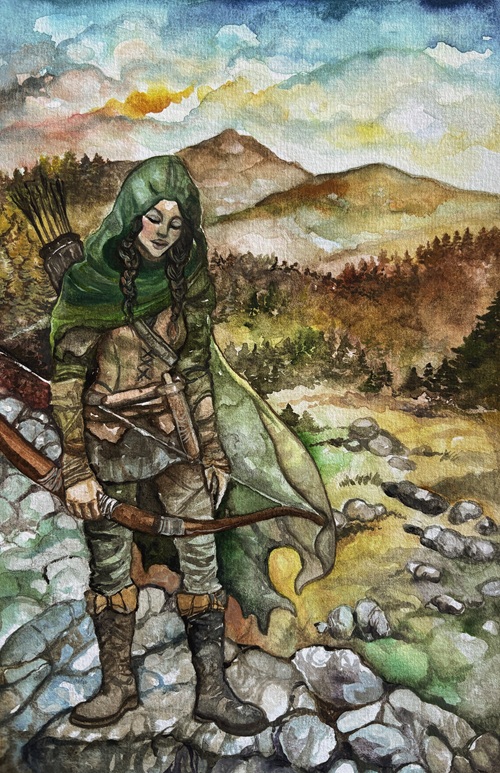
Valeriya on the trail
The shadow from Valeriya’s arrow, staked into the dirt of the trail, at last reached the coin she’d placed behind it. Enough time had passed. She shook her head.
Matviy was late.
Above her overlook on the Imperial Ridge’s eastern slope, the changing leaves of poplars and king-maples caught the sunlight like a weave of enchanted silk. The morning haze under the canopy brightened to a rippled blaze of honey and amber. Wind rushed through the branches, cold and leaf-stripping, stirring Valeriya’s braided hair and cloak. She snatched up the arrow and returned it to her quiver, the coin to a pocket inside her buckskin vest, tucking it beside her father’s silver arrowhead. Her forest-home filled her eyes with glory on the edge of winter, but worry chilled her more deeply than the wind.
Midday had come, but Matviy hadn’t.
She remembered the plans her mentor, Bodhan, had made with Matviy. If Matviy and the refugees he was guiding were delayed, either in leaving Kordesa’s gates or Bartosh’s farm where they’d have sheltered last night, she should meet them at the foot of Whitetail Run. To the south, as the mountains’ deer knew, the run offered watercourses and rocky switchbacks to elude pursuers. But she’d no reason to believe her friend was being pursued. She knew not how many Kordesan refugees accompanied him this time. Some traveled slowly, and the days had grown shorter, the nights colder. Even so, after almost two years and sixteen groups of refugees, this was the first time Matviy’d been late.
She braced the lower limb of her hunting bow against her right boot and, with her left, stepped between the flax string and curve of pale elm. Gently, she pulled the upper limb toward her and pushed the bowstring into its notch. The bow tensed, reassuring her. Better to be prepared if there was trouble or, with good fortune, a whitetail came foraging during the day. She and Bohdan would be grateful for every bit of meat she could harvest before riding out the winter in their den. Bodhan no longer hunted since his stroke that spring but kept an appetite like a bear. She had to sustain his strength. The burden of their mission, she feared, would fall and shatter if she carried it alone.
She turned southward, downward, on Grey Rabbit Trail, easing into a jog on the slopes. She passed the lightning-blasted cedar called The Burned Spear and veered, striding between trails. The wind remained mischievous, shaking high branches with an oceanic roar. Leaves danced and swirled around her, and she ghosted through the tumult, startling squirrels and black grouse. Twice, she reached for an arrow but thought of Matviy and hurried on.
She hoped, as she leapt over a muddy rivulet onto a fork of Whitetail Run, that Matviy carried a well-stuffed pack for her and Bodhan. Today would be their last meeting until spring, the last time she could safely shepherd refugees over the mountains. Snow already dusted the high trails where no trees grew, and those—leading to Yaroslav’s Stair—were the easiest path for travelers unaccustomed to the wilderness. She hoped Matviy had brought sausages and cheese and dried fruit, candles and fresh linen. She hoped he’d remembered a pot of honey and, surely, herbs and tea leaves for Bodhan. Most of all, she hoped he’d packed a book to enchant the slow hours. She dreamed of a copy of The Travels of Volodymyr Wingfoot or The Firebird Saga or …
The crack of a musket pierced the forest. A woman screamed.
Valeriya darted behind an oak trunk and peered down, centering her left hand on her bow’s leatherbound grip. Her right loosed the slipknot that held her hunting knife in its sheath. Not far below, a woman and child cowered behind a lichen-crowned boulder. Matviy stood near them, a large pack at his feet. He wore his weathered tricorn hat, boasting a suneagle feather, and desperately raised a pistol. Valeriya tracked his aim to two men, advancing between the trees.
Only two? She cocked her head, searching, praying she’d missed no others.
Matviy’s hunters were tall, long-limbed, and wore capes and domed caps of black bearskin. A chill tore through Valeriya, and her mouth went dry. Wurgri border marshals! Her fear of them urged her to flee and hide with Bodhan in their den. But two years before, the Wurgri had invaded her beautiful city. They breached the Seven-Tiered Gardens, toppled the World Tree, executed her father by its stump. They even burned his body, and hundreds more, in contempt of the Green Law. If fear licked her mind like a flame, her anger rose like the iron-cold wind scything across the mountainside. She saw only two. She chose to hunt.
She broke from the tree, circling away from the Wurgri’s vision. She stalked lower, screened by trunks and falling leaves, and assessed the marshals. The farther one, with a bristling ginger beard, had slowed to reload his musket. The closer, loping toward Matviy, was fair and blond. He brandished a pistol in his right hand, while his left waved a pale rod that glowed with a faint aura like moonstruck ice. Neither man wore armor, so she drew a broadhead arrow from the front of her quiver and nocked it.
At that moment, Matviy fired—not at the closer man but into the branches overhead. Matviy cursed and dropped the pistol, fumbling for the hand axe on his belt. He never lifted it, for a strange bird, thin and pale as the marshal’s rod, dove from the canopy and landed on Matviy’s shoulder, pecking at his throat. Matviy shrieked and fell to one knee, pawing at the creature helplessly.
Beside Matviy, the woman had drawn a slim knife. She rose to peer over the boulder but crouched again just as the marshals fired. Shards and dust erupted from the rock.
Now! Valeriya urged herself. Before they reload …
She set her arrow on its narrow shelf, on the left side of her grip. She tilted the bow to clear her sightline to the blond marshal and drew the string, right hand beside her cheek, her elbow a calligrapher’s V. The motion summoned her father’s voice, echoing through her childhood and countless hours of practice, teaching her during ten-thousand and more shots at hay bales and tree trunks, painted canvas, scarecrows, and doves flushed from tangled undergrowth. Her blisters had become a hunter’s calluses.
Steady the bow and steady the eye
The arm becomes iron
The hand becomes air
The fingers of her right hand became air, and the arrow sang. Even as it flew, she bounded forward and nocked another. She drew and aimed, legs and torso steady, her arrow-hand like iron then air. She bounded forward again, drew and sighted again. Iron and air. She marked the cloud-white goose fletching of her first two arrows, pinned in the blond marshal’s chest, likely one in each lung. Her aim had been true; it pleased her. Then the man stumbled and groaned, and she hesitated. For the first time, her target had been a living person, another soul. Yet he was Wurgri, and he glared at her, eyes bulging with shock and rage, and pointed the glowing rod toward her.
Her third arrow tore into his throat.
Three then see. Her father and Bodhan had trained her to loose three arrows swiftly, then see what more the moment demanded. Decide. Act.
The blond marshal fell, clutching his throat. When his rod struck the ground, the creature launched itself from Matviy. It beat its wings and arced toward her, and she gasped, for it was no bird but a serpent with bat-like wings. A spiked ridge ran from its skull to the joint of each wing, glowing palely like the marshal’s rod. The same bone-like substance framed each wing, filled with a diaphanous material like parchment. The serpent hissed at her but veered upward toward a gap in the canopy.
Valeriya nocked another arrow, hoping to maim the creature before it escaped. But at the edge of her vision, the other marshal moved. In the same moment, the refugee woman cried, “Look out!”
Valeriya let the serpent flee through the branches and spotted the ginger-bearded marshal leveling his musket. She dropped her bow and threw herself to the ground as the musket boomed. Its ball whistled overhead, spraying bark from a trunk behind her. She scrambled to her feet and reclaimed her bow and arrow, knowing she could finish him before he reloaded.
The marshal knew this also and charged her, musket in one hand, a drawn scimitar in the other. Valeriya sighted and loosed, sighted and loosed, stepping backward to keep her distance. But the marshal charged cunningly in a jagged line between the trees. Her first two arrows sped past his arms. She aimed lower, and when he planted his black-booted leg to dodge again, her third arrow sank into his thigh.
He stumbled but gritted his teeth and willed himself closer, raising his scimitar. She’d no time for three arrows, just one. He closed within fifteen paces as she nocked and drew.
“Kordesan bitch!” he bellowed. The glimmering curve of his blade, the blaze of his hazelnut eyes, consumed her sight.
The secret of the Boar’s Shot is courage, her father said. Stand before its tusks, unmoving. Unblinking, Val! Then trust your bow.
She clenched her jaw and stood. Iron and air! Her arrow snuffed the light in his left eye. He toppled forward, his scimitar careening beside her boot.
Valeriya lowered her bow and stared at the scimitar, the body sprawled in the leaves before her, its legs twitching as if it still strove to reach her. Her chest felt starved for air, her gut like a swinging cauldron. She thought she’d vomit and looked to the leaves and sky shimmering overheard. She swallowed, mastering her breath. Then she saw Matviy writhing on his back. She ran and knelt beside him. His hat had fallen, revealing his matted brown curls. The side of his neck was dusk-purple, swollen like a rotten plum. Blood seeped from four punctures like black crescent moons.
“Matviy! Matviy, I’m here,” she said, grasping his hand. “I—”
She paused at the woman and child’s approach. The quality of their garments surprised her. The child, a scrawny boy of perhaps eight winters, wore a long wool coat with a fox-fur collar. A fox-fur hat covered his hair and ears. The woman, his mother by resemblance, was also thin and several years older than Valeriya’s eighteen. She had rose-gold hair, travel-mussed but finely braided behind her, and with her sharp cheekbones would be considered striking, if not beautiful. She wore a tabard of olive-green velvet, the long loose sleeves embroidered with cloth-of-gold vines. She slipped her knife inside one of them. Lush mink encircled her collar and wrists. Smeared lines of kohl accentuated her eyes, and a small ruby winked on a golden ring that pierced the left side of her nose. A Wurgri marriage ring.
“Val, listen—” Matviy’s voice trailed into a rasp and wheeze.
“It was a snow viper—or was once,” the Wurgri woman said. “Can you help him?”
Valeriya ignored her. No, she couldn’t help him now. She clasped his hand between hers and leaned over him. “Matviy, they’re Wurgri! Why?” She couldn’t hide the confusion and betrayal in her question, nor did she try.
His eyes sought her face, and his hand trembled between hers like a bird desperate to fly. His voice was a whispered whine. “The boy. Andriy said … he’s special. Take them. Please.” He gasped and coughed, frothing at the corner of his mouth. “Ey, Val, do you remember that day? The day …”
One moment her friend was looking at her through his almond-brown eyes. Then he was gone.
She bowed her head, lifted his hand to her lips. Goddess, embrace Matviy, son of Marko, she prayed. But in the next moment, she shook her head and thought, It’s wrong. He shouldn’t have died like this. By venom, helping Wurgri. Matviy had done his part and more for their people. He loved them. He loved Kordesa, its taverns and gardens, its songs, its surrounding farmlands and ponds. But he also loved her, Valeriya suspected. Many times by now, he could’ve fled to a new life beyond the mountains. He stayed because he loved Kordesa and its people. But what if he’d also stayed because of her, because of a dream she’d someday see him not only as friend but husband? What if she’d poisoned his life with false hope?
The thought choked her, and she fought back a sob. Footsteps rustled the leaves behind her. The boy. She laid Matviy’s hand on his chest and tilted her head to let the boy know she was aware.
“You’re the Huntress,” the boy said. “I’m sorry about your friend. He was nice, and he was funny.”
She sniffed and wiped her eyes. “His name was Matviy. And I suppose I might be a huntress, but not the Huntress. That’s one of the faces of the Goddess.” Huntress, Mother, Seer! Feed our love and starve our fear.
“Some p-people call you the Huntress,” the boy told her. “In the city. They s-say you live here in the mountains, to p-protect people and help them leave.” The boy’s high voice had a stutter and quaver. His right eye blinked and twitched, shedding a wind-tear on his cheek.
“That much may be true,” she allowed. She sighed and stood. The Wurgri had rewritten Kordesa’s history in blood, but she couldn’t lay their crimes on a child’s shoulders. “I’m Valeriya,” she said with a nod to the boy and, after a moment, his mother.
The woman stepped forward. “I’m Klarysa,” she said. “And this is my son, Fedir.” She laid her hands on the boy’s shoulders. Pale hands without scars, her nails pointed and painted crimson. Gold and silver rings, bearing dark gems, glimmered on her slender fingers. “I, too, am sorry for your friend’s death. We’re forever in his debt. Our lives are yours.”
Valeriya watched the leaves falling around them, neither accepting nor denying the woman’s words. “Did you meet Andriy?” she asked Klarysa. Bodhan’s younger brother was one of the last Green Runners in the city and, as the leader of its threadbare resistance, the one who helped Matviy identify Kordesans who’d be more valuable if they escaped.
“Da,” the woman answered, “under the Sunflower Bridge. Or a man who said he was Andriy. He kept to the shadows and wore a hooded cloak.”
Valeriya watched the woman carefully and said, “I am the western wind, swift herald of rain.”
The woman blinked and opened her lips, but before she could answer, the boy hopped from one foot to another. “She said it, mama! Let me tell her the other half!” He looked solemnly at Valeriya and said, “I am the m-mouse in the shadows, the quick thief of grain!”
Valeriya nodded. “Very good.” She suppressed a smile at the boy’s triumphant grin. “So you’ve met Andriy and come this far. But you’re Wurgri and”—she gestured at Klarysa’s tabard and rings—“look to have wealth. They were Wurgri,” she added, nodding at the dead marshals. “Why leave? What’s happened there?”
Klarysa stroked the side of Fedir’s hat. “Show her, Faddei,” she told the boy.
“Mama …” he protested. Klarysa reached for the edges of his hat, but he wriggled away. “I’ll do it,” he said and stood before Valeriya, looking at the ground to avoid her gaze. With both hands, he removed his fox-fur hat and cradled it to his chest.
Valeriya stared at the boy’s head, her breath catching. His hair was fine and pale as cornsilk—but grew only on one side of his head. The left side of his skull, from crown to temple, was scoured of hair and flesh. Instead, a curved and glazed shard of stone, lunar-white like the marshal’s rod and engraved with dizzying runework, shimmered in the forest’s light.
“Goddess …” Valeriya whispered. She’d never imagined such desecration of a living creature, such perversion of the Green Law. Nor did she understand how the boy had survived it. But though his scalp was reddened and puckered where it met the shard’s edges, she saw no sign of infection or decay. “What is this?” she asked Klarysa.
“You know the White Kiln?” Klarysa asked. Valeriya nodded. The order of Wurgri craftsmen who armed their elite soldiers. Most were zealots of the Wurgri’s god of gold and fire. With clay from a secret mine, they sculpted breastplates, helmets, scimitars, and hammers, not of metal but steel-hard ceramic that never decayed in soil or sea—another violation of the Green Law. “They opened a chapterhouse in Kordesa and are making new things, like that snow viper. The kiln-master, Vasili Barmich, is young and ambitious. People call him a visionary, a sorcerer. Last year, my husband was posted to Kordesa as the deputy treasurer and tax-collector. He attends the governor’s council with the treasurer and Barmich.” Her voice grew thick with pride and sorrow.
“Barmich and his Kiln held a contest for the city’s children,” she continued. “Games and puzzles, riddles. Faddei’s clever beyond his years, especially with the Imperion board.”
“I used to defeat Papa,” Fedir said, “and he’d try his b-best. He took me to the park, and I made Tikhon Two-Towers surrender! Papa said he’s one of the best p-players in the army.”
Klarysa smiled and shook her head. “Faddei won the contest and spent some mornings with Barmich inside the Kiln chapterhouse. Then one day, he didn’t come home. Grigory, my husband, went to fetch him, but Barmich dismissed him. I wanted to call the guards, the governor, but Grigory insisted all was well, that Faddei was being honored by the Kiln. Honored, he said. The next day, they brought Faddei home. Like this. After that, I don’t know. I imagine your people have spies—forgive me. I imagine your people have sharp eyes and ears, perhaps among our servants and bathhouses, perhaps even in the Kiln. The city’s still their home. And at first, I was … outspoken about what Barmich had done.”
Klarysa stepped beside Fedir and embraced him again. “Put your hat on, love. A fortnight ago,” she told Valeriya, “a passerby at the market pressed a note in my hand. About meeting under the bridge if we wanted to escape. You can guess the rest. I decided to go as far as we can. Across the sea, I think. The city of Elenia is large and owes no allegiance to my people. It’s said to have the finest university. Perhaps they can help, help me understand—”
Leaves crunched behind Valeriya, and she spun, fearing more Wurgri. But she spotted a pair of squirrels leaping and spiraling up an oak trunk. She exhaled and studied the forest, eyes narrowing at the bodies of Matviy and the marshals. She marked the shifting of the sunlight, red and golden leaves falling like sands in an hourglass. Decide. Act.
“You can tell me more while we hike,” Valeriya said. “My home’s well above us, I’m afraid, and I’m sure you’re being hunted. Your husband, the army, the Kiln—they won’t let you go easily.”
“I did everything Andriy advised,” Klarysa said, as if to reassure herself. “I left Grigory a letter, claiming to go east and find a ship returning to our homeland. I said we needed a respite with my family. These marshals … Matviy thought they were bad luck. They came from the north, not the city, before they saw us.”
“That may be,” Valeriya said, “but—”
“The s-snake knows,” Fedir said, turning to the east and peering up at the sky. “It’s flying back to tell Master Barmich what it saw.”
Valeriya and Klarysa looked at one another, striking a silent bargain to go. Klarysa took Fedir’s hand and hurried to the boulder to gather their satchels. Valeriya busied herself with taking what the dead no longer needed.
She gave Klarysa Matviy’s pistol and powder horn and Fedir the suneagle feather from his hat. She dropped the marshals’ firearms into a nearby rivulet to rust and rolled their bearskin caps and capes into a tight bundle. She recovered her arrows, returning four unbroken ones to her quiver and handing Klarysa the three useless ones to scatter later near a fork in the trail. Lastly, she picked up the marshal’s ceramic rod. She loathed touching it, and a shiver raced up her arm, but Bodhan should see it. Perhaps he’d know more, as he often did.
She unbuckled the bulging pack Matviy had brought. Goddess, it was heavy and would make the hike difficult, but that was nothing compared to the worth of its supplies in winter. She opened the oilskin flap to slip the marshal’s rod inside and found on top, nestled on fresh linen, a book bound in worn red leather. The Travels of Volodymyr Wingfoot adorned its spine in flaking gold letters. It was just as she’d dreamed.
“The trail’s there. Head that way,” she called to Klarysa and Fedir. “I’ll catch up soon.”
Once they were out of sight, she bowed her head and lifted the book near her lips, its crafted leather evoking the scent of Kordesa, her stolen home. She clutched Matviy’s gift to her breast as the autumn wind and grief flooded over her. Tears fell from her cheeks, like leaves that spun through the gold-shadowed light before resting beside her friend in death.
* * *
“He’s asleep,” Klarysa said. She winced, favoring one leg, and gingerly sat by the cavern’s firepit, across from Valeriya and Bodhan. She set the birch-carved bowl and cup from which she’d fed Fedir beside her. Whatever the Kiln had done to the boy, he tired easily, and his thin legs trembled with palsy. Klarysa had carried him the last hour of their hike, limping herself after stumbling in the twilight and twisting an ankle. But the Wurgri woman never complained or asked Valeriya for help.
Valeriya rose and, from their iron cauldron, ladled stew into a clean bowl for Klarysa. Steam curled from it, rich with the aroma of squirrel and rabbit, buttercap mushrooms, wild onions and garlic. A sheen of oil glistened on the honey-brown broth. Without knowing how many refugees were coming, Bodhan had made enough for a dozen. Valeriya had wolfed two bowls while Klarysa settled Fedir. For an instant, Valeriya felt a blush of embarrassment at serving the older, nobly dressed woman such simple fare. But as the Wurgri took the bowl and a chunk of pan-bread, her hands trembled, and her thank you, Valeriya felt, went beyond the meal to the shielding of her life and Fedir’s.
Bodhan watched Klarysa taste the stew, nodding as she closed her eyes and savored it. Then he returned his attention to the marshal’s rod. Under the cavern’s weight of stone and shadow, he reclined against the burlap bolster, hide-wrapped and stuffed with straw and leaves, that he called his throne. And with his stout body bundled in furs and his cragged, flame-shadowed face beset by moss-gray tangles of hair and beard, he resembled a troll king of midnight fables, the pale rod balanced on his lap like a scepter.
As Bodhan studied the rod, his left eye glittered with motes of emerald light. The povitrya, he called it, the sign bestowed on the Green Runners’ chosen captain. How he’d received it decades before, Valeriya didn’t know. Neither Bodhan nor her father would speak of it. Nor of its nature, though it sharpened Bodhan’s sky-reading. Storm later, he sometimes muttered on cloudless mornings, tapping the corner of his eye. Trust. And Valeriya trusted and was no longer surprised when clouds billowed over the mountains and the forest swayed with wind and rain.
Bodhan grimaced and shifted against his bolster. With his right hand, he reached for his left leg, dragging it into a more comfortable position. “Let’s speak plainly,” he told Klarysa. His voice had always been gruff, reminding Valeriya of a broad-chested mastiff. But since his stroke, it had thickened, his words burbling from a throat clotted with phlegm.
“This is new,” he said, tapping the rod. “It has power. But the boy has more.” He stared at the darkened ledge where Fedir lay sleeping, and an emerald star streaked across his eye. “The Kiln will hunt him like a white stag with golden antlers. You need to leave at dawn. My nytsya says you hope to reach Elenia.” He gestured to Valeriya, calling her his half-niece, a girl who shared no blood but was precious to him. “She can take you. You’ve seen her woodcraft. But.”
He thrust the word into the firelight like a knife. Klarysa swallowed and laid her bowl on her lap.
“But?” she asked.
“There’s a price for your passage,” Bodhan said, tapping his thick forefinger on the rod. “When the time comes, when your son’s older and understands what your people did, he’ll work to free Kordesa. He’ll help her.” He nodded at Valeriya. “Swear it. What he won’t do is return to the Kiln. His journey will end here before I let that happen.”
Valeriya’s gut clenched, cold and heavy as stone. “Bodhan!” she gasped.
“Hush, girl,” he growled. “Children die in war. You know this. The boy’s a weapon. Or will be. Take it or break it, but only a fool returns an enemy’s blade to be swung again. We didn’t make the boy what he is.”
“But the Green Law—”
“He’s right,” Klarysa interrupted. “And it’s a fair trade. Kordesans never maimed my son. His own people did. His own!” She bit her lip and shook her head, holding back tears. “Da. Da, we’ll help you,” she told Valeriya. “By Drokov’s fist, I swear.” She named the Wurgri god of fire and touched her breast.
Bodhan snorted. “No, Drokov is the name your men give their lust for gold and power. Drokov is an excuse for conquest. Swear by something real. Swear by your son’s life.”
Klarysa glared at him before shaking her head. Her mouth curled with grim amusement. “You may not be wrong. Da, on Fedir’s life I swear. Now pardon me. I’m exhausted.” She stood, a hiss escaping her lips as she tested her ankle.
“One of the pots by the bedrolls has ointment,” Bodhan told her. “Brown with blue wax. Comfrey and arnica. Rub it into the ankle and let Valeriya bind it in the morning. It’s going to be stiff. Goodnight.”
Valeriya stretched out her legs and stared at the firepit, tongues of copper flame writhing from its hot red heart. Her thighs and shoulders ached, and her belly was full. She wasn’t drowsy, though. The faces of Matviy and the border marshals drifted among the flames, between embers rising like the snow viper’s flight. She dreaded seeing the men’s faces once she slept. And she wanted to turn the first pages of Matviy’s book.
“This time’s over,” Bodhan said, ending her reverie. “Help me up.”
She stood and took his callused right hand with both of hers, bracing her feet. He grunted and forced himself up with his right leg as she leaned back, pulling, marveling at his weight and strength. When he stood, she reached down behind his bolster, hefted his elmwood crutch, and helped him nestle it under his left arm.
He led her into the deeper shadows near the cave-mouth, the foot of his crutch tap-scraping over dry stone. The passage curved, hiding the light from their firepit. Above them, its smoke drifted outside in a slow, gray stream. Cold mountain air wafted under the smoke, evergreen-sweet. Bodhan stopped, staring into the night.
“You have your father’s arrowhead?” he asked. She nodded, and he held out his hand. She took it from her vest and placed it in his palm. His face was hard to read—darkened, bearded—but she thought he smiled as he tapped his finger on its silver point.
“We had a ceremony for this. Speeches, vows, a bloody hymn at the end. And mead and vodka. Ha! But we’re past the time for speeches and songs. And you need to rest, and I need to pack.”
“Pack?” she echoed. Bodhan seldom left the cavern since his stroke and never ventured far.
“I said this time’s done. Matviy’s gone. These are the last refugees. You’re taking the boy to Tilgrade. To its harbor, then across the sea. To Elenia and its university. Learn what the Kiln did to him, what he can do to them. He could be a gift, Val, the tip of a new spear. But I’m returning to Kordesa. To join Andriy and see what gaps we find in the bastards’ armor. I’d be a turnip to winter here without you. A cold, fat turnip best left in the dirt.”
She shook her head, ignoring the jest. “I’ll come back!” she protested. “I’ll take them down the Stair, within sight of Tilgrade if I must. But once they see its walls, they can reach it and board a ship without me.” She swallowed, hating the childishness in her voice. She’d never sailed on a ship. “And you can’t go to Kordesa. The Wurgri mustn’t discover the povitrya. That’s why—that’s what he told me …” She halted, her words crashing into her last memories of her father.
I have to stay, Val. To protect the Tree, at least for a time. Bodhan can’t. He’s the captain. We can’t risk the povitrya. He’ll protect you, teach you, and you’ll help him make a waypoint in the mountains. Goddess willing, the city holds, and I’ll find you soon.
Bodhan nodded. “Clever girl. That’s still true. Now go one step higher. I’m returning to Kordesa without the povitrya. Because …” He tilted his head as he once did before drawing his great yew longbow. His left eye flashed in the darkness like a sunstruck emerald.
“Bodhan, no …”
“Valeriya, Yuri’s daughter, I’m no longer fit to be the Green Runners’ captain. I yield my place and the povitrya. You’re a daughter of Kordesa, faithful to the Goddess, skilled in woodcraft and bow. I name you Green Runner until death. And I choose you as our captain. Do you accept?”
“Bodhan, I can’t! I—” She turned to the cave-mouth, wanting to run into the night, to hide and wait for sunrise in a world that made sense. But she felt his hand on her shoulder. Heavy and firm, gentle and warm.
“Nytsya, please. You may not’ve seen its end, but this is the trail you’ve been climbing. I know you don’t want to fail. That also makes you worthy.”
She shook her head. “You can give it to Andriy. Or Artem! You said Artem has a body and heart like a mountain lion. He’s a—” He’s a warrior, she wanted to say. But the word slipped in her mouth like a cherry pit.
“He’s a killer,” Bodhan finished. “And I love my brother, but …” He closed his eyes and shook his head. “He’s in the city. He won’t leave the city until the work is done.” Valeriya heard the grim prophecy behind his voice. He’s in the city. He won’t leave because he’ll die there.
She faced him. She was his height now. The captain her father followed, bowed by age and infirmity, appeared a hermit or beggar. But for two years they’d survived together, and his eyes smoldered with conviction. She trusted him with her life. She always had.
He tapped the corner of his eye. “Trust. And if you don’t like it, find a sharp bit of silver and give it to someone else. If you can.”
She swallowed, forced a smile without happiness—only trust. “Yes. Yes, I accept.”
He nodded. “Now you’d swear to honor the Goddess, follow the Green Law, and carry messages faithfully. But you do all that. So stand there. Look at me. Don’t look away.”
He tilted his head backward and touched the arrowhead to the white of his left eye. He took a deep breath and pressed the tip inward, clenching his teeth. “Out!” he grunted. “Out, damn you! Out!”
Valeriya covered her mouth as blood spattered his fingernails. His head whipped forward, and he bit back a roar of agony, caging it in his throat. “Bodhan!” she gasped and reached for his arm.
The passage blazed with emerald light. A cloud of stars erupted from his eye, whirling into constellations. She beheld a ram on a mountaintop, a fish leaping from a stream, a falcon riding a storm. It dove, falcon and storm rushing into her eye, and her sight blazed green, green, green. Her heart thundered, her skin tingled, and between ecstasy and terror she fought for breath. She stumbled into the passage wall, shivering and blind.
Then Bodhan’s arm fell across her shoulders, gathering her to his side. “Steady, lass. I’ve got you. It won’t harm you, but it’s like the wild. You have to find your own way with it.” Through a burning emerald fog, he led her and eased her down. She felt the warmth of the firepit and the musky hides of his bolster. Her body fell away. The edges of the fog dimmed, trimmed with a lace of starless night.
Bodhan’s hand left her shoulder. His fingers stroked her hair, brushing it from her eyes. “Take the boy to Elenia. Send word once you’re there.” He coughed, and when he spoke again, his voice trembled like thunder on the horizon. “I’m proud of you, Captain. I’m so damned proud of you.”
She tried to say his name. But her vision drowned in darkness, her flesh became air, and she was falling, adrift in a sky of endless emerald stars.
* * *
Valeriya knew, even as they walked, she’d always remember this morning. The sky moments after dawn, pale and still as a bowl of fresh milk. The clouds swiftly thinning, wind-torn to reveal a glow like lapis. Fedir, refreshed and holding Klarysa’s hand, Matviy’s feather jutting from his fox-fur hat, wide-eyed as they climbed the North Wind’s Walk.
Klarysa had washed the kohl from her face and removed her jeweled rings, hiding them throughout their packs. She wore a long brown hunting tunic, its sleeves and skirt reinforced with leather, and looked younger, entertaining Fedir with stories of duck-stalking on her grandfather’s estate. Once, she drew Matviy’s pistol from her belt and mimed how she’d winged a trumpeting old drake her grandfather named The Emperor. Sometimes, the Wurgri slowed to ease her bandaged ankle, but they halted only once for Fedir to lower his breeches and water a scraggly blue birch. Valeriya was pleased with their pace.
Then they broke above the tree line, and she could see as never before. Light and color, each branch and leaf below her, red shoots of winterfire ivy bursting from the rocks, the stubble of reaped grain in the farmlands below, the fieldstone chimneys of farmhouses. She blinked, her breath catching, and saw the sunlight and wind—shafts of golden crystal, rivers and eddies of shimmering power, weaving leaves and birds and clouds into a living tapestry. Mists rose from the fields and forest, sunstruck, and she could see, now and in time to come, vapor gathering as clouds, returning to the earth as rain and snow.
The gift of the povitrya. Valeriya stopped for a moment, wanting to weep and laugh at the wonder of all things, of being one with all things, with sunlight and wind, with Klarysa and Fedir and the frosted mountainside, with clouds that bore the sweat of farmers, with autumn’s rain now flowing in her blood. They’d nearly reached the end of the high trail. When it crested and curved to the west, not far now, they’d pass the Gate of the Goddess, a gap in the ridge, its walls flecked with silver, jade, and gold. Then the first plateau of Yaroslav’s Stair, a steady descent for those who knew the way. She quickened her stride, eager to see the land beyond the ridge-top. With Bodhan’s gift, she thought she might see the spires of Tilgrade, even the sea glittering beyond.
But she halted as she climbed the final curve, the fingertips of her left hand trailing along the cold rock wall. She stared up and ahead, her eyes narrowing. The swift lines and whorls of wind seemed, through the povitrya, somehow wrong. Some were tangled like vines of blackthorn; elsewhere the air hung like a cloud, like breath on a bitter night. She shifted her pack and unslung her bow.
“What?” Klarysa asked. “What is it?”
“I … I’m not sure. Perhaps something in the air.” Valeriya shook her head. She hadn’t told them of the povitrya. Her gift was too new, too strange for spoken words. “We’re almost to the Gate, though.” She gave Faddei a smile and pressed ahead.
She completed the curved ascent and beheld the Gate of the Goddess, an ice-blue sliver of sky gleaming beyond its broken arch. But her eyes shifted to a knot of serpents on the path before it, no more than thirty paces away.
Their presence was impossible. The high trails, especially now, were too cold for serpents. She closed her eyes, fearing some madness between herself and the povitrya.
Then a man emerged from the shadows of the Gate. He was clad in strange, bone-white armor and helm and seemed at once a living statue, an icon of some vengeful warrior-saint, and yet like no one Valeriya had ever seen.
“Good,” he said, “it’s a splendid view but rather boring. And the chill has my companions in a foul mood.” He stepped forward, and the serpents uncoiled, five in all. Valeriya marked the snow viper, a night adder, and by its flaring ruby hood a Wurgri cobra. The other two she didn’t know. All were ceramic-crested, their spines and wings glowing faintly, silver in her awakened sight. She cursed herself. A curved ascent was a perfect spot for an ambush. She knew this but never believed it was possible—not here.
“Barmich!” Klarysa spat, brushing past Valeriya. She tossed her satchel on the trail, drawing Matviy’s pistol. “Go back,” she murmured to Valeriya. “Take Faddei and run. Hide—please!”
Valeriya dropped her own pack and flexed her fingers. She respected the woman’s courage, but there was no hiding, not with Fedir’s unsteady legs, not on the barren paths above the forest. To their left were boulders and a wall of rock, to their right a scree slope, gently—then steeply—falling away to swirling air and the treetops below.
“Klarysa Ivanova!” proclaimed the kiln-master. “The governor signed a warrant condemning your treason. Stealing the boy from his father and a glorious future! How selfish of you.” He was slim, dark-bearded, his voice like polished silver. The back of his ceramic breastplate, Valeriya noted as she shifted behind Klarysa, bulged like a beetle’s shell. It and his helmet rippled with icy radiance. The breastplate had a high collar; cuisses and greaves protected his legs. There were gaps for arrows, she thought, but narrow ones. And the wind was tricksome.
“Come, Faddei,” Barmich called to the boy, offering his hand. “Would you like to fly back with me to the city? Yes, fly!” He spread his arms and laughed. “We’re going to make miracles together. Do you see my armor? It’s not perfected yet, not the runework, but I dared use it for you. That’s how special you are. You’re going to be a great hero of the White Kiln, Faddei. And your father’s worried about you. You want to see him, don’t you? Come!”
Light pulsed from his helm, and two ceramic-and-fabric wings unfolded behind his breastplate. He leapt into the air just above the trail, wings beating and glowing, leaf-light and terrifying as a ghost. Valeriya had never imagined such magic outside of fables.
Klarysa bowed her head, glancing back at Valeriya. “Don’t let him take my son,” she pleaded. “Don’t.” Then she raised her chin and her voice. “Of all the snakes in this world,” she said, “the smallest and vilest, Vasili Barmich, is you.”
She aimed the pistol and fired, its explosion resounding from the rocks. Fedir yelped, smoke billowing around his head.
Barmich grunted and drifted back into the mouth of the Goddess’s gate. The pistol ball dropped onto the stones with a clink. A circular crack like a spiderweb marred his breastplate, cold light leaking from its center.
The kiln-master hissed, pointing down at Klarysa like a spirit of judgment, and the serpents leapt from the path in a storm of wings and fangs. Klarysa batted away the night adder with her pistol. Valeriya stepped back and put a broadhead through one of the cobra’s wings, knocking it to the stones. But the serpents swarmed Klarysa, striking her arms and legs.
“Mama!” Fedir shrieked. Valeriya grabbed his collar and pulled him behind her. She drew another arrow, but Klarysa was screaming, stumbling from the trail.
“Run, Faddei!” Klarysa shouted. She dropped the pistol and grasped the snow viper with both hands, howling as it latched onto her cheek. She ran, as if to leap, but her ankle buckled, and she slipped, tumbling onto the scree slope, the viper raging in her embrace. Her body skidded with a cascade of rocks and dust. Then she and the viper were falling, plummeting into the forest below.
“Mama!” Fedir screamed.
Valeriya threw her arm across his chest, pressing him against her leg, before he could bolt toward the edge and four remaining serpents. The boy sobbed, shaking. Through the povitrya, she saw the air around him change, as if he were a stone cast into a lake.
The serpents turned to them, heads swaying above their bodies like nightmarish flowers. Silent. Watching. Valeriya smelled smoldering fur and flesh. Smoke trailed from Fedir’s hat, and she pulled it from his head. He ducked under her arm, and she gasped. Golden light blazed from the runeworked shard atop his head. Burning. Blinding.
“Steady, Faddei!” Barmich called. He descended, wings folding into his armor with clicks and whispers, until he again stood on the trail. He approached slowly. “See the runes and shape them into a word. Remember—”
“You killed her!” the boy screamed. He raised his arms and howled wordlessly, his anguish breaking against the mountainside. The runes across his skull flickered and flashed lightning-white. “Drokov burn you all!”
The serpents thrashed as if the trail had turned to burning coals, baring their fangs to the sky in silent agony. The ridges on their spines shattered, their wings dropping away like dried petals. Their eyes burst, and they fell limp, smoke oozing from their scales. Barmich groaned and clutched his helm with both hands, as if struck by a warhammer. The icy light of his armor vanished for an instant, like moonlight bowing before the sun.
Fedir turned to Valeriya, his chest heaving, cheeks wet with tears. “M-my head hurts,” he whispered. He took a step toward her, and his legs collapsed like a wooden puppet’s.
She sprang forward and caught him, cradling his head. His eyelids closed drowsily. The shard no longer glowed. Blood streamed from his nose, poppy-red and, through the povitrya, golden, beautiful as midsummer light. A drop struck the dirt and reshaped itself into a perfect rune. Sharp lines and graceful arcs beyond mortal skill, gleaming like liquid fire.
“I don’t know who you are, girl,” Barmich called to her. “And I don’t care.” From beside his left cuisse, he drew a pistol. Double-barreled, a ceramic handle, gilded. A lord’s armament. “Only I can help him. No doubt you understand this. I know you don’t understand the Kiln’s craft. My craft. A bow and arrows, for Drokov’s sake!” he scoffed. “In fifty years, Kordesa—the entire world—will give thanks to have buried the age of carved sticks.”
He cocked one hammer of the pistol. “Leave the boy and go. Keep your bow and arrows. And your life. You have my word. If not …” He cocked the second.
She glanced at Fedir. His fluttering eyelids, his cornsilk hair, the raw golden power in his blood. He—the power flowing through him—could defeat Barmich. But Fedir was exhausted, and she was overwhelmed, a mouse in a hawk’s shadow. She glanced at the boy’s fox-fur hat, threads of smoke unraveling from it. Or like a hungry fox cub …
“You’re right!” she called over her shoulder. “I’ve had enough of Wurgri. I want no more of this.” Slowly, she drew an arrow from the back of her quiver—no broadhead but a bodkin, its tip slim and sharp as a serpent’s fang.
“Stop!” Barmich called. “Put back the arrow, girl. What do—”
“I’m going,” she told him, raising her voice. “But the woman and her coin purse are gone. Even the ruby from her wedding ring would’ve been something. But if there’s no coin for me, at least I can take a drop of the boy’s ruby blood. An offering to the Goddess—and to remind me how foolish I was to work with Wurgri.”
As she spoke, she laid the tip of the arrow against Fedir’s lips and the stain under his nose. She turned it gently, slicking the steel with his saliva and blood. She ran her hand over his eyelids, twitching as in a dark dream, and slid her fingers down his nose, pinching a spurt of blood onto the arrowhead. It began to glow in her sight.
“Enough of that—” Barmich chided.
“I’m going,” she told him again, briskly standing. “Forgive me, lord,” she added. She held her bow and arrow by her sides and strode toward the trail’s curve and descent. She paused beside her pack, two paces from the rock wall.
“Thank you for sparing my life, lord,” she called back. “You’re a mighty sorcerer, and I see now how stupid my people are to stand against you.” She bowed her head, then bent her legs as if to hoist her pack. She sensed his gaze and the line of his pistol upon her. Her spine felt like a branch encrusted with ice.
The arrowhead’s glow began to dim. She had to decide—now.
She whirled and sprang toward the rock face. She drove the sole of her left boot against it and pushed off, upward and away. Barmich’s eyes went wide, and he fired his pistol. No warrior, flashed her mind. He’d panicked, when a braver man would’ve let her land.
His pistol boomed like a forked thunderbolt. She watched the bullets split the wind. One sped between her bow and its string. The other gouged her thigh with a kiss of stinging fire.
She landed, stumbling with a cry of pain. She nocked and drew. Fedir’s blood blazed on the arrowhead like molten gold. The trail flashed green before her, the wind flowing like a hundred emerald rivers. She set her feet like iron. Her hand became air, one with the river rushing toward the kiln-master’s breastplate.
Her arrow sped into his breastplate, into the core of the spiderweb-crack left by Klarysa’s shot. Barmich grunted. His armor dimmed, becoming the color of dust, of soiled snow.
In a halo of sunlight, the kiln-master’s armor exploded, runes dissolving on the wind like embers.
Valeriya turned away, shielding her eyes. Dull ceramic shards littered the trail. She limped to Fedir and rolled him onto his back. His eyes struggled open—he was unharmed—and she touched his hand. “Rest,” she told him. “You’re safe. When you’re ready, we’ll look for Tilgrade from the top of the Stair. There’s a waterfall on the other side, Yaroslav’s Basin. We can wash and eat there.” He nodded weakly, and she touched his cheek.
She stood and went to Barmich, sprawled on the dirt, her arrow upright in his gut. He was young, perhaps younger than Klarysa. Blood from countless cuts seeped into his fine, milk-white undertunic. A shard had burst through the underside of his jaw. Blood pooled in his mouth, overflowing.
“Do you know The Fox Cub and The Bloodhawk?’ Valeriya asked. She let the wind carry her question to him, then away. She stood over him, the trail silent but for his choked breaths. “In The Firebird Saga, one of the little fables.” She sniffled, memory and the biting wind drawing tears from her eyes.
“Once, there was a fox cub. Alone and hungry on a cold night. No mother or father. A bloodhawk landed on the birch above him with a rabbit in its beak. The bloodhawk was proud and refused to share his meal, no matter how politely the cub asked.
“So the cub praised the bloodhawk for his feathers, blacker than night, and the sharpness of his talons. And the cub asked the bloodhawk if his cry could shatter the moon. Surely one so great and fierce as you can shatter the moon? the fox cub asked. The bloodhawk opened his beak and cried, dropping the rabbit. The cub snatched it up and darted into his burrow. And his belly and clever heart were full to bursting that night.” She shook her head, smiling sadly.
“You could fly, my lord. But you’re no bloodhawk—neither you nor your Drokov. Nor am I some craven mercenary who makes blood offerings to her goddess. I’ll be with you now,” she promised. “Then the vultures will. You’ll fly with them for a season, then return to the earth. This is the way of all things. This is the Green Law.”
Moments later, she left him, his eyes blinded to the sky. She was no seer, yet she’d received the povitrya. She was no mother, yet she’d protected a child’s life with her own. She decided to retell the fable for Fedir while they rested.
Far above the high trail, a suneagle—sacred—circled on the living wind. Valeriya called to the boy, pointing, then unfastened the string from her bow.
Author’s note: This story is dedicated to the unwavering people of Ukraine.
________________________________________
Born in New Orleans, Robert Rhodes (SFWA) is an attorney who lives in Spartanburg, South Carolina. He is a Writers of the Future Finalist whose stories have appeared in diverse publications, including Black Gate, Swords & Sorcery Magazine, and Old Moon Quarterly, as well as anthologies The Return of the Sword and The Best of Heroic Fantasy Quarterly (Vol. 1). His story “The Fury’s Blade”—and other tales of Gabriela de Quetar—will appear in Battleborn Magazine. He assisted Howard Andrew Jones in completing the Sword & Sorcery chapter of The Greenwood Encyclopedia of New American Reading. Rob’s early short fiction is collected in Shadow, Light, & Steel (amazon.com). Social media: @rrhodeswriter.bsky.social
Karolína Wellartová is a Czech artist, painter creating images predominantly with the wildlife themes, nature studies and the literary characters. She’s mostly inspired by the curious shapes and a materials from the nature, but the main source still comes from literature.
From a young age she tried to express herself and her observations on paper. Painting and drawing were always the most important thing for her and visiting the local art school helped her understand the new techniques and the science of the colour mediums. She’s the award winning artist for “Best Book Cover in 2015” in Czechia.
Her work has been published in American magazines such as Spirituality Health Magazine, International Wolf, Metaphorosis, Orion, and Heroic Fantasy Quarterly. Check out more of her work at her website.
Advertisement