THE HEAD OF SPURIUS HALFHEART
THE HEAD OF SPURIUS HALFHEART, by H.R. Laurence, pending art by Caterina Gerbasi
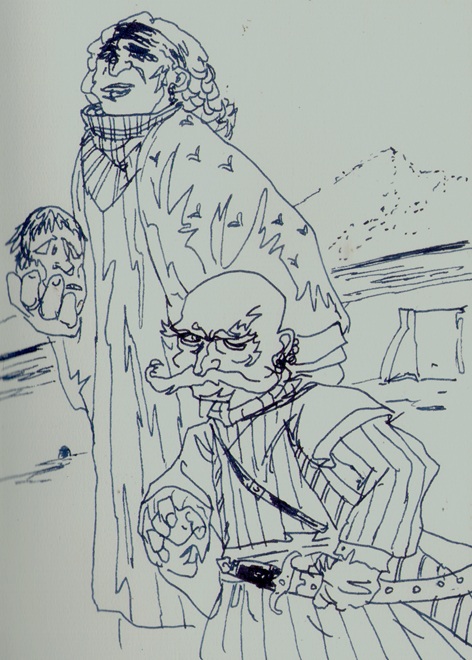
Todric and Yorris, and what’s left of Spurius
“Yorris,” said Todric. “Is that not Spurius Halfheart the sellsword?”
“He is also a horse-thief, and an indifferent pander of second-rate – oh,” said Yorris, following his companion’s gesture to the public gibbet which loomed like an iron bramble over the market ziggurat of Kyarif.
“Yes,” he said, after a moment. “That’s old Spurius, poor fellow! We’ll raise a cup in his honour once we’ve divested our wares.”
The sellsword in question was only a day or so dead, a sole fresh corpse crucified amongst the long-decayed ne’er-do-wells upon the arch of sharp stark girders which comprised the gibbet.
“I wonder what happened,” said Todric as they drew their cart beneath the gibbet, towards the narrow bridge which stretched the span between the ziggurats of market and port. “Spurius was a fast sword.”
“One of the fastest,” Yorris agreed. ‘I was always glad to have no quarrel with him.’
The market crowd extended the same courtesy of not quarrelling, and parted before them despite the narrowness of the way. The pair were almost comically disparate – Yorris a small shaven-headed man of wiry strength and long golden moustaches, Todric tall and built like a barrel, with braided russet hair and a beard that a yak could be proud of – but there was nothing funny in their carriage and easy confidence, nor in the curved scimitar Yorris wore upon his hip or the double-bearded axe upon Todric’s shoulder.
They drew between them a handcart loaded high with embalming jars and small sarcophagi, which they had just plundered from a barrow-tomb upon the plain without the city. The day was winding to its close, and the cart-wheels crunched over mouldering marketplace detritus; half-rotted cabbages, overripe fish-heads, gourds burst and broken. The market ziggurat had once been home to bloodthirsty battle-gods, but old warlike Kyarif had been worn away by rival powers and shrinking harvests and the caprice of the flooding river Rif, and it was many centuries since the city had fallen into the slumberous routine of a backwater province in somebody else’s empire. Now the weathered alters of the ziggurat’s many de-sanctified chapels were spread with produce, and the only blood spilt upon them that of fish or sheep.
Across the high bridge they went, over the once-sacred canal which in centuries past had borne boatloads of sacrificial victims to the ziggurat, clogged now with waterborne merchants and houseboats. The ziggurat of the riverport rose before them, larger than its market fellow, cranes and pulleys bristling from every tier and its ramps and gangways heaving with sweat-soaked work-gangs and cargo. It was in the midst of this activity that Collum Riverborne looked over the contents of their cart and pursed his lips.
“I cannot give you more than two crowns,” he said.
“Six months past you bought a load half as good for five,” Yorris protested. Collum shrugged.
“The going-rate for mummies isn’t what it was,” he said. “You’ve heard of the mass graves recently unearthed in Kalth? The barrows plundered by the troops in Traotia? The market is flooded, my friends; necromancers across the Empire are elbow-deep in corpses and their accoutrements, and only a top-class mummy attracts their interest. Turn over a royal tomb and we might speak – but these desert barrows are hardly worth the effort.”
He would not budge, and eventually they yielded. Collum patted their shoulders as his freedmen wheeled away the cheap-bought cart.
“Come,” he said, steering them towards a tavern. “Let me stand you a flagon of wine to dull the disappointment.”
He was clearly known within, for the keeper at once took one of the finer flagons from the top shelf, and placed it before them with an obsequious nod.
“It is strange to see you so respectable,” said Yorris, ruefully. “You were a notorious outlaw when we last partnered.”
“Those were the days, eh?” said Collum. “Back in the dives and fleshpits of Port Usk.”
“Spurius Halfheart ran one such fleshpit, did he not?” said Todric, the deceased sellsword fresh in his mind.
“Spurius – why, yes! I’d quite forgotten,” said Collum “Of course, we’re unlikely to see Spurius again around these parts – what with the news.”
“Quite,” said Todric. “Sad news.”
Collum shrugged.
“Hardly the worst thing to befall Spurius,” he said. Todric frowned at his callousness, and was about to speak when Yorris kicked him beneath the table.
“I seem to have missed a turn,” the small man said. “What news is this?”
“Oh,” said Collum, not noticing the too-casual tone of Yorris’s voice. “He slew some princeling in a duel in Kyanmark, upon the Mercer Road south of here, and there’s a bounty of a thousand crowns on his head. Last I heard he was bound north back to Usk, and all speed to him.”
“I see,” said Yorris. Plainly Collum had not visited the market these past few days. “Will you not stay to share this flagon?”
“I cannot,” said Collum. “My boat waits at the river-dock, and already I linger too long. Prosper, friends! Waste no more time with barrow-mummies.”
They bade him farewell, and took the wine, and sat thoughtfully in the corner.
“How extraordinary,” said Todric.
“Aye,” said Yorris. “I suppose Spurius was here under one of his many aliases, and the Temple Watch have no idea who they’ve gibbeted, nor that his head is so valuable, which…”
He tailed off.
“You cannot be thinking it, Yorris,” said Todric. The small man tugged at his moustaches.
“A thousand crowns,” he said. “Is a great temptation. It would be a simple thing to shimmy up the gibbet and remove the fellow’s head, then claim in Kyanmark that we slew him.”
“I will not desecrate the corpse of a friend,” said Todric solemnly. “Not for any sum.”
“Aye, well-spoken,” said Yorris. “You are, as ever, my conscience.”
They finished their flagon, and ordered a second, and spoke of different things until they were halfway through it, when a lull fell in the conversation and Yorris said:
“Of course, one could argue that the Temple Watch of Kyarif have already done the desecrating.”
Todric thought on this.
“A fair point,” he conceded. “But still, a fellow’s head is important; a vengeful shade would surely first turn its ire upon those who took it.”
“That’s true,” said Yorris. “And I have no wish to tangle with shades of any kind, even forgiving and placid ones. Shall we have another?”
Todric, shaking the last dregs from the second flagon, nodded his assent.
“Here’s the thing,” said Yorris, once decent headway had been made on the third. “Old Spurius liked nothing so much as easy money, unless it was making fools of authoritative men. Would it not be in many ways a tribute to the man if by means of his corpse we could dupe the King of Kyanmark of a thousand dinars?”
“I had not looked at it that way,” Todric admitted. “And there’s some merit to the thought. But let’s have another cup.”
“If Spurius knew that this opportunity was untaken before us he’d be furious,” declared Yorris, nearing the bottom of the fourth flagon. “I shouldn’t be at all surprised if he rises from whichever hell he now resides in purely to haunt us, should we not seize the day. He could never stand to see money left on the table.”
“Yorris, I am in full agreement,” said Todric. “And ready to put money on this table, to buy more wine and toast the enterprise.”
Which they did. It was the last of what Collum had given them, and they left the tavern a trifle unbalanced.
“Another fine tribute to Spurius,” Yorris chuckled, as they wobbled across the narrow bridge into the now-empty marketplace. “The man undertook no escapade sober.”
This observation struck Todric as more instructional than comical, given the end that Spurius had clearly come to. But before he could voice this thought, a lone patrolling guardsman, khopesh slung across his shoulder, came walking his beat through the square. They fell silent as he passed, and went with studied, slightly unsteady disinterest beneath the gibbet. Spurius hung above them – tantalising, and only a little rotten.
“Maybe we could take him entire?” asked Todric, once the guard was out of earshot. The uneasy thought of desecration had reasserted itself through his drunkenness.
“It’s five day’s hard riding to Kyanmark,” Yorris said. ‘Do you want to carry him, guts and all?’
But the big man had a point, for leaving the headless body would raise questions, and could thwart their plan if the dead man were identified. Then, at the corner of the square, Yorris’s eyes lighted upon one of the great amphorae which held oil for the city lamplighters. It was sealed with a clay stopper, and warded against thievery by many threatening heiroglyphs, none of which deterred Todric from lifting it, albeit with considerable effort. They rolled it together to the foot of the gibbet.
“There!” said Yorris, putting a generous hole into the amphora with the tip of his scimitar. “We do Spurius a turn after all, and all of these unfortunates – soon to have a decent funeral pyre.”
Todric found a bucket discarded by a market sweeper, and proceeded to fill and fling several buckets of oil up over the bodies – many of them dry as tinder and practically mummies already – as Yorris divested himself of cloak and sword-belt, and took his poinard in his teeth.
He was just reaching for the first girder of the gibbet when there came a clatter of boots and spear-butts, and a patrol of the Temple Watch came marching across the bridge. Todric moved with a speed that belied his size, and went dashing with a great clatter across the square, his voice rising in one of the raucous drinking songs of the Sarks:
Oh! for a girl with flaxen hair,
Who holds her drink like a sturdy jug!
Oh! for a girl with nary-a-care,
Who’ll sell for a song and pay with a tug!
The ditty echoed from the chapel-walls of the pyramid, and the watchmen sighed exasperation and set off in pursuit of the drunk. Grinning about the blade in his teeth, Yorris scurried up the gibbet. He could trace the progress of the chase by the sound of Todric’s song, faint and increasingly obscene snatches of which came drifting from the adjoining alleyways and cloisters.
Up he went, and braced himself against the girders almost astraddle Spurius’s corpse. Hear he paused. The dead man’s face was sallow, but his handsomeness wasn’t altogether gone, and Yorris could still imagine the devil-may-care spark which had once existed in the crow-plucked holes of his eyes. Todric had been right; it was no light thing to decapitate a friend.
“Spurius, old boy,” he murmured. “I wouldn’t do it save for the money.”
He thought the old sellsword would understand that, and perhaps be placated. Then he took his poinard and did the deed.
Oh! for a girl with cunning lips,
Who scorns to kiss the mouth for luck!
Oh! for a girl with lying hips,
And sundry other bits to –
Todric’s song ceased, quite abruptly. Doubtless the big man had decided it was time to lose his pursuers and return silently to the square – but Yorris couldn’t shake a slight sense of unease. He tucked his gory prize into the sack at his belt, and clung to the gibbet a moment longer so that he might scour the dark corners of the square while he had the advantage of height.
The faint clamour of pursuit was growing louder. A cat stalked through one of the dark alleys; in the doorway of a deserted chapel a rough curtain of sackcloth stirred in a night breeze. Something fluttered atop a rooftop – a discarded scrap from a haberdasher’s stall? A dark cloak? Yorris squinted, and had almost decided that he had imagined it when with sudden cry Todric came dashing into the square with the shouts of the Temple Watch resounding behind him.
Yorris was down in three swift leaps. Todric bore a burning brand in his hand, snatched from a baffled lamplighter, and as Yorris snatched up his cloak and sabre the big man tossed it into the huge pool of oil which had by now drained from the holed amphora. With a whumpf of heat and light it ignited, and flame went coursing up the gibbet.
For a moment it seemed that Spurius’s headless corpse hung untouched in a halo of fire: then it was burning like the rest, and the watchmen were charging into the square with spears levelled, and loud protestations of outrage. Yorris and Todric took to their heels and fled, flame licking for a moment at their oily sandals as if in pursuit. With a great crash the gibbet-arch gave way behind them, and tumbled into the path of the watchmen.
Through the narrow market streets they went; down one of the zig-zag ramps descending the pyramid. Lights on the way ahead, a second patrol – they vaulted the ramp and went scrambling on the weathered flank of the ziggurat itself. A flung spear glanced from worn stone; they neared the water and saw the dark shape of a punted boat upon it, drifting into place beneath them as if ordained by a friendly god.
“Here!” cried the merchant as they landed amidst his cargo and set his boat rocking. Yorris drew his scimitar and waved it, and the merchant’s outrage became an obsequious smile.
“Very good, sirs,” he said. “Where to?”
***
The city of Kyarif had shrunk over her long centuries of decline, slowly shrivelling towards her centre, and by dawn the merchant’s boat was drifting through a vast garden of ruined and abandoned stone on the outskirts of the city, overgrown and entangled with weeds, only the occasional sad habitation holding out against the encroaching vegetation.
Todric watched it roll past in the early light, as tendrils of river mist danced across the surface of the water and between the tumbledown buildings. The previous night’s wine was wearing off, and he had a headache coming on, along a number of reservations about their nocturnal activity. The view he gazed on at once soothed and unsettled him. He wondered at how strangely beautiful the ruins were, imbued with weird dignity by their very decrepitude; how strange also that the decay of a person could never be beautiful, or dignified, but only sadly repulsive.
He was thinking of the unassuming sack which sat on the deck of the boat between Yorris and he. For the dozenth time, Todric gently peeled away the sackcloth to peer within.
“Surely,” said Yorris, who was leaning against the gunwhale with his eyes closed, for all the world asleep. “You have satisfied yourself by now that I took the right head?”
Todric sighed.
“It was never a question in my mind, Yorris,” he said. It was undoubtedly Spurius’s head; but the man had been so full of life that the very fact of his deadness made him unrecognisable. Todric looked anew at the shore. A figure flitted between buildings; he wondered for a moment if the Temple Watch could have sent fast riders to intercept them. But there was no clamour of alarm, nor any sign of the patrol-galleys which from time to time blockaded the river in search of fugitives. Doubtless it was just some early-rising resident of the crumbling old town.
“Ah, Todric,” said Yorris, stretching and yawning as though he had enjoyed the finest night’s sleep. “It’s been some time since we last had such good exercise. I’d not realised how I’d missed it. Barrow-robbing is all very well, but it can’t match the excitement of fleeing armed men through high and perilous territory. Why,” he said, sitting up and warming to his theme. “It puts me in mind of some of our escapades across the roofs of Port Usk. I can’t help but feel that Spurius was smiling on us last night, from somewhere.”
“Probably from within the sack,” said Todric, massaging his temples with large fingers. “Since that’s where his mouth is.”
Yorris cast his companion a searching look, somewhat put-out at the big man’s lack of enthusiasm. But before he could respond the merchant called to them. Shortly after their brisk embarkation the prior night Yorris had given the man a silver half-crown, which Todric had promised to match on arrival, and the man’s tone was consequently as civil as could be wished for. Threats were all very well in the heat of the moment, but a little silver behind the steel made a palpable difference.
Now the ruins at the riverside were starting to be clear of vegetation, and many of them had been rebuilt, and there were sundry new buildings too, and great jetties stretching into the wide water with vessels of all kinds moored along them. They had reached the port of Ar-Rif, where the river and the Mercer’s Road diverged. Here Todric handed over the half-crown – his last – and he and Yorris pooled the rest of their now-limited coin to purchase a pair of half-starved nags for their journey
By the time the sun was high they were well upon their way. Close to the river the land was green; neat fields full of flax and barley and well-kempt groves of olive trees, irrigated with channels and waterwheels. Workers glanced up at the mismatched riders, and in the distance the sails of tall mills turned like leisurely dancers in the early breeze. But soon the farmland became sparser, and the shadoofs loomed like gallows-poles.
Yorris sat high in his saddle, a jaunty whistle upon his lips, and beside him Todric gripped his saddle tightly and blinked hard at every rattle the horse’s motion sent through his now aching head. The sun rose higher and hotter, and the jauntiness of Yorris’s whistle became shrill and grating, and the sackcloth bundle at his saddle bounced and rebounded and bounced again from the horse’s flank with a soft muffled squelch of wet fabric upon horseflesh.
“Yorris,” Todric said at last. “You must know other tunes.”
The smaller man blinked, and shrugged, and fell silent. They rode on. The land turned to dusty unbroken plain. Another hour slid slowly past them.
Old comrades that they were, they were used to passing days upon the road with barely a word spoken – and yet, Yorris found the silence now somewhat chillier than the heat of the day should have allowed for. His large friend was angry at him, he felt. And he was quite sure he had done nothing to merit it. He began to whistle again. Todric fixed him with a baleful eye.
“Alright,” said Yorris, as soon as he felt it. “Something bothers you. My high spirits have never frustrated you like this before, and gods know they come rarely enough. Let’s have it out.”
“I don’t like this business,” said Todric, so quickly that it was clear the sentiment had been festering. “Bad enough to be hauling a head for bounty, like common footpads – but the head of a comrade? I mislike this, Yorris. I mislike it very heartily.”
“Look, old friend,” Yorris said, with a sigh. “I was fond of Spurius, in the scheme of things, and we had some adventures together – but you speak of him as though he was a blood-brother. Were it your head in question, and he who stood to gain the ransom –”
“I am hardly Spurius Halfheart!” said Todric, and realised too late that the indignation in his voice had undermined his own cause. With a wicked twinkle in his eyes, Yorris seized upon it.
“Indeed you’re not! You’re a model of loyalty – and Spurius himself, it has to be said – as much as I liked the fellow – as dearly as I recall our escapades in Port Usk – was something of a scoundrel, to whom loyalty meant very little, and who never had a mother he wouldn’t cheerfully sell for a flagon of half-good wine. Spurius would find your qualms a comedy, Todric, and I’m sure he’d be the first to acknowledge himself unworthy of them.”
Todric glowered, for Yorris spoke the truth and he had no quick rejoinder. He looked away. The plain was broken from time to time with patches of low scrubby bush, and just as he looked up a black desert fox was flitting between two such copses parallel with them – surely a fox, though a big one to be sure. Spurius, he remembered, had once spent an entire month’s earnings upon a hideous fox-fur cloak, which had earned him the ridicule of the entire thieve’s quarter, and led to at least three lethal duels. What the man had lacked in fashion-sense he had made up for in prowess. There had been something both endearing and awful about him.
“How shall we say we slew him?” he asked. A man so swaggeringly larger than life deserved a notable story for his death; perhaps they could wile away the next few of hours of riding by concocting one. But his companion was suddenly silent.
“I’m happy to say you removed his head with your axe,” said Yorris, carelessly, after too long a pause. He yawned, and stretched, and Todric narrowed his eyes a little.
“That is not quite what I asked,” he said.
“Well, old boy,” said Yorris. “Spurius was damnably quick with that blade of his, and though none would doubt your power with the axe – it might be more convincing to say I slew him. One visualises the match-up – the flurry of blades – the naked swordsmanship – ” – here Todric snorted like a . Yorris seemed not to hear him “ – the back-and-forth upon the duelling ground, the fateful feint! The tip of my scimitar in his heart – ”
“You seem to have put a good deal of thought into this a-ready,” said Todric. “We could as easily say that we found him asleep and smothered him.”
“It lacks romance,” said Yorris. “They would not accept it in Kyanmark. A bard once told me that even the telling of true stories requires a little invention; dry facts may serve for dispatches, but for a sophisticated audience the workaday lacks verisimilitude.”
Todric considered it.
“I don’t see why it follows that you should have been the one to slay him,” he said. “The axe, after all, is the tool of the headsman, and there’s a certain neatness to it if the killing and decapitating strokes are one and the same. I am sure your bard would agree that neatness makes a great asset to any story.”
“You would clutter the neatness with untruth,” said Yorris, a little loudly. “Since you were, in fact, nowhere near the decapitation.”
“Nor were you engaged in any daring swordplay,” Todric observed, his own voice rising a trifle. “I led the guards away from the gibbet, and was the only one risking his neck – unless you feared falling on yours?”
Yorris spluttered at this calumny, and fell quiet, apparently too outraged to respond. For a while, stony silence reigned upon the desert road. The way was straight, and rocky, and potholed at regular intervals with the prints of overladen mammoth-yaks making their way to Kyanmark. After a while, they saw a squat tower jutting from the flat earth; an hour of riding, and they saw that it marked what looked to be a deep, wide pit in the ground; half an hour more and the pit revealed itself a sunken caravanserai, dug into the hard desert surface.
“We haven’t much more than an hour of daylight left,” said Yorris, his tone determinedly casual. “Shall we rest for the night here?”
“Aye,” said Todric, curt, lest he sound too conciliatory. “We could do that.”
A track curled from the main road through the arched gateway of the caravansary, into a wide courtyard ringed with cave-like mouths – taverns and stables and hostels.
“Shall we have a drink?” asked Yorris. “My round, I think.”
Todric grunted; he had a strong suspicion that the wine was mostly to blame for their current circumstance. And yet, whatever his virtues, Yorris was a miser when sober. This was an olive branch of rare worth.
“Ay,” he said, gruffly. “I think it is.”
As Yorris went to fetch the wine, Todric leant his axe in a corner and stowed all that remained of Spurius beneath their table. Two sleepy-looking musicians were playing a repetitive melody of oud and drum, and a raven-tressed young woman of great pulchritude and limited attire was dancing atop the tables with rather more enthusiasm than the sleepy late-afternoon patrons seemed to demand of her.
Todric nodded to the trio of swordsmen occupying the table next to theirs, Xyrenian brothers from their looks, and noticed that Yorris was haggling animatedly with the tavernkeep over a large flagon– the small man must be spending the last of his money, Todric realised, for he had only a copper or two himself. A clatter of bangles as the dancing-girl leapt to a nearby table startled him. One of the men managed a tired jeer, and threw her a coin. Todric watched it glimmer in the air before it disappeared into the beads and bangles of her brief costume.
Hadn’t he and Yorris shared their coin to buy the horses? He was sure they had – in fact, he distinctly remembered Yorris joking that the poor quality of the nags would be mitigated by the paucity of gold they had to carry. Where, then, had Yorris found money for so much wine? Had there been a close observer of Todric’s in the tavern, they might at this point have noted a tightening of his eyebrows, as though two red caterpillars were at the point of fighting upon his furrowed forehead.
Yorris was not such an observer.
“Six coppers for this vinegar,” he said, sourly, as he bore the flagon to the table. “I’d haggle with the bloodthirstiest sellsword sooner than a caravansery tapster.”
“Indeed?” said Todric. One of the caterpillars gained the advantage of height over its fellow. “And there I was thinking you’d haggled well – for I’ve only a couple of coppers myself.”
Yorris was halfway through pouring before he realised his companion’s drift.
“Oh,” he said, and sighed. “You’re thinking of the horses.”
“I am,” said Todric, steadily. “Since I paid the greater share for them.”
Yorris slid a brimming cup to Todric’s side of the table.
“Todric, my friend,” he said. “I simply stowed some coin for the road. I assumed you did as much. Are we to quarrel over a few coppers?”
“If your coppers are hidden when mine are offered up, we may,” said Todric, solemnly. Yorris rolled his eyes.
“This is ever your problem,” he said, just as the dancing-girl hopped onto the table between them. “You stand upon points of principle, and they prick your feet before you ever see the view entire.”
“Pricked feet!” Todric exclaimed, ducking so that he could glower at his companion between the dancer’s shapely legs. “A guilty conscience conjured that conceit – you’ve had coins stowed in your boot.”
“By the gods,” Yorris snapped, his voice rising a little to compete with the jangle of ankle-bells and the rattle of a beaded skirt. “When did you become so holy? I took you for a comrade, not a judge.”
“Comrades do not steal one another’s heads!” Todric rejoined, deftly snatching up his cup before vermillion-daubed toenails could kick it.
“Indeed?” Yorris exclaimed. “And who did you imagine was paying for our board tonight, if not your comrade?”
Todric hesitated a moment at this, and then noticed that the girl above and between them was casting aggrieved glances down, perhaps feeling that she was receiving insufficient attention for writhing of not-inconsiderable energy. Out of politeness he fumbled in his pouch for one of his remaining coppers.
“You’re right,” he said, gruffly. “It’s silly for friends to quarrel over fripperies.”
Yorris glowered for a moment, then wavered, and sighed. Then he poured two more cups of wine.
“Agreed,” he said. “Come; here’s to Spurius Halfheart.”
The noise of bells and beads ceased abruptly. Yorris glanced up the dancer on the table.
“Please, my dear,” he said. “Don’t let us stop you.”
She gazed down at him, her hazel eyes narrowing.
“Spurius Halfheart,” she said, with venom in her tone. Todric was suddenly aware that every other eye in the tavern was upon them, and more than a few hands were resting upon dagger-hilts. “Did you say Spurius Halfheart?”
“No,” said Yorris, adapting swiftly. “I referred to Sixtus Hangcart, my brother-in-law, who operates the municipal tumbril in Aranmar, and –”
He sprang back, snatching the flagon from the tabletop and dashing its contents into the face of the tavern-keep, who with cudgel in hand had sidled almost unnoticed into coshing distance behind him. The man reeled; his blow went wide, and Yorris broke the flagon across his crown.
The three adjacent swordsmen rose at once, sabres flying free, and Todric upended the table, dancing-girl and all, into their path. The dancer shrieked as she fell, and with commendable gallantry the swordsmen abandoned their weapons to catch her. She was not so heavy as to require all three of them, and they encumbered one another in their haste, with the result that all four ended in a heap upon the floor.
Todric snatched up axe and head alike, and Yorris drew his scimitar, and back-to-back they made their way across the floor to the door. Every man in the tavern was afoot now, many with weapons drawn, but none had particular appetite to be the first in cleaving-range, and they hung sullenly back. The dancing-girl extricated herself from the tangle of swordsmen – who were now squabbling amongst themselves as to who had caught her first – and flung out a furious arm.
“Begone!” she cried, as though banishing them. “Do not darken our door again!”
“You would have to pay us to!” said Yorris, as they reached the threshold in question. “For the welcome here was shameful, the wine indifferent, and your gyrations heavy-footed and unseemly.”
“You lying wretch!” the girl spat, paling with outrage.
“It was as though a mammoth-yak danced upon our table!” roared Yorris, and slammed the door with a noise like a thunder-clap.
***
“It seems our friend made an ill name for himself,” Yorris remarked, as they went into the stable to retrieve their horses. “You think he gulled them of money? Slew a jealous lover? Let’s see if we can’t uncover it.”
“It hardly matters, Yorris,” said Todric. That Spurius’s name was known here made him anxious; it gave him a sense of carrying illicit goods through unfriendly territory. “Let’s fetch the horses and begone.”
But Yorris was already waving to attract the stablekeep’s attention. “Here, fellow! Perhaps a friend of ours lodged here – one Spurius Halfheart?”
“I’ve never heard the name,” said the stablekeep, with a cough and shuffle which suggested the confident certainty of his tone was negotiable, should a silver coin or two be dropped into his palm. But of course, they had no more money.
“We go too far, Yorris,” Todric said, as he held the struggling stablekeep face down in one of the water-troughs. “Every step of this venture makes me feel more of a brigand.”
“Tush,” said Yorris, peering cautiously from the stable door. Men had emerged from the tavern and were gathering there. “Unless you mean to take the fellow’s coin there’s nothing brigandly about it.”
“Hmph,” said Todric, and pulled the drenched stablekeep free. The story they had from him was predictable; the caravansary was frequented by a loosely affiliated group of ne’er-do-wells, with whom Spurius had fallen in and then dramatically broken from.
“He slew four, right in the yard!” the stablekeep spluttered. “And fled, with the gains of their last robbery. Every man in the tavern lost by it – some lads even swore they’d dob him to the guard in Kyarif.”
Yorris and Todric shared a glance. The vengeful tale-telling of the caravansary robbers may very well have proved Spurius’s bane.
“What did he steal?” Yorris asked, but the noise of hooves without called their attention away. Todric dropped the spluttering stablekeep and joined Yorris at the door. A group of riders had dismounted in the courtyard, and the men without the tavern were pointing them to the stable. It didn’t seem from their mien or manner that they were giving advice on the care of horses.
“We could slip from the back unseen,” Todric whispered.
“I hardly fancy walking to Kyanmark,” said Yorris. Todric took a small throwing-axe from his saddle-bag, and put it loose into his belt. They threw open the stable doors.
Six men waited in the dying sunlight, wearing the desert-worn leathers of travelling caravan-guards, or perhaps brigands – in harder years there was no great distinction between such groups. The tallest of them seemed their leader; there were more scars upon his face, and slightly fewer holes in his cloak.
“I hear you’re friends of the Halfheart,” he said. “We thought to find him in Kyarif.”
“Old Spurius?” said Yorris, with the affectation of surprise. “What a coincidence – we were just speaking of him. It’s been many a year since we left him in Port Usk.”
“Indeed,” said the leader, with a meaningful glance at the bag hanging from Todric’s belt. “So perhaps you carry a dead cat? Or a single, rotting cabbage?” His men chuckled, though two armed with spears were drifting like sloping dogs into a flanking position. Todric turned slowly with them.
“You might consider,” said Yorris. “That the Halfheart was reputed a very fine sword, and his vanquishers would surely not be men to trifle with. Mere conjecture, of course, since Spurius Halfheart to the best of my knowledge is alive and well and living in Kyarif.”
“Not Port Usk?” said the leader.
“Ah,” said Yorris. The leader’s grin was wolfish.
“I think you have been poor friends to Spurius,” he said.
Yorris was still searching for a riposte when Todric’s throwing-axe tore through the air past him. The leader rocked back on his heels as the blade struck his forehead; when he swung back upright his eyes were full of blood, and he was still grinning, and for a moment he stood as straight and unconcerned as any living man.
Then he fell.
Yorris reacted at once; he closed on the nearest startled bounty-hunter and was within his guard and drawing his blade and slashing in one swift motion. The man went wailing half-blind to the dust, clutching his sabre-torn face.
With cries his friends started forward. Yorris twisted to evade a spear-thrust; there were two more men upon him, and he fell swiftly back across the courtyard before they could pin him between their blades. Cries and curses; he caught a glimpse of Todric, the big man’s axe scattering gory droplets in its wake as a foeman’s cleaved arm went spinning away from its owner’s body.
One of Yorris’s attackers had outpaced his fellow; he lunged forward now and Yorris stumbled as he sought to avoid the blow, falling upon one knee in the dust. Snarling, the man thrust again. Yorris blinded him with a fistful of flung sand, then tripped him as the momentum of his thrust carried him forward. It was a trick he’d used on bullies as a child, and one that a grown man – let alone one who made his living as a fighter – should have been ashamed to fall for.
Yorris spared the fellow any further embarrassment with a swift thrust to the throat. He rose ready to meet his next assailant – but Todric’s axe had just passed beneath the man’s chin. As the bounty hunter’s head departed its shoulders Yorris saw a look of utter surprise on its face; then it was rolling in the dust, and there was quiet, save for the whimpering of the wounded and the heavy breathing of the victors. Yorris and Todric fell back to one another, and regarded the scene.
“You started that very abruptly,” said Yorris. His heart was pounding; his nerves thoroughly rattled. He glanced rapidly about; all of the bounty hunters were dead or maimed. “I’m sure I could have talked sense into them.”
“I’ll not be called a false friend,” said Todric, coldly, and plucked his throwing-axe from the leader’s split skull. Yorris winced a little at the fleshy sound. He had not often seen his friend so ready to start a fight, and certainly not against such odds – and, with some irritation he noted that he had accounted for only two of the foe, to Todric’s four.
“You should tell me before you try such things,” he said, to salve his pride. “I give better account of myself with a moment of notice.”
“I had faith in your naked swordsmanship,” said Todric, pointedly.
The tavern patrons were looking on in silence. None of their earlier belligerence was now apparent; they shuffled their feet and turned away. But from the stables and resting-rooms more were coming; quite a number, and a not few of them were armed.
It didn’t seem wise to stop and quarrel. Yorris called for their horses, and the dripping stablekeep was admirably sensible about complying. They mounted, and rode, and as the eventide pressed itself upon the desert the lamps in the sunken caravansary behind them glowed like a firey eye in the face of the plain.
Leading the horses afoot through the twilight they found a cave beneath a rocky outcrop to shelter in. Todric took first watch. When it was his turn to sleep, he dreamt that the dirt beneath him became moist and yielding, and the air warm and wet and foul, and rose to find that the rocks at the cavemouth were a row of vast, yellowing teeth, and the gigantic mouth which now prisoned him was making to swallow –
He was on the cusp of the nightmare gullet when Yorris woke him. Todric said nothing of the dream; in the sun it seemed foolish, and the distant caravansary looked nothing like an eye.
***
They spent much of the next day constructing an account of their supposed duel with Spurius – one in which they fought him together, while he wielded two blades with such prowess that they were almost overmatched. Half a day they struggled, in the dramatic but conveniently witness-free ruins without Kyarif, until, in a perfectly synchronous moment, Todric’s axe parted neck at precisely the moment that Yorris’s sabre found heart.
They were neither of them quite satisfied with this story, for though the ending was neat they could find only twisting, convoluted routes to it. Their own path ran contrastingly straight across the great plain before slowly curving towards the mountains which ringed many-domed Kyanmark. No one followed from the caravansary; no fresh packs of bounty hunters came down the road; nothing more fearsome befell them than the odd suspicious glance from horse-archers guarding the merchant caravans, which from time-to-time they passed or overtook.
Soon they found themselves at odds as to the telling of their tale. Todric, mindful of the jobsworth eunach-beaureaucrats of Kyanmark, wanted to account for each thrust and parry of the imagined fight in exhaustive detail, whereas Yorris’s inclination was to condense particulars into poetical flights that might appeal to an audience of aristocratic ladies, with much emphasis upon the glimmer of blades in evening sun and the glistening, pantherish thews of the combatants. In Todric’s view this was wholly indulgent.
“I don’t think either of us resembles a panther in the slightest,” he said. “They won’t buy that in Kyanmark.”
“They do nothing but buy in Kyanmark,” said Yorris. “So long as the dressing is pretty.”
The head they hoped to sell was becoming very far from pretty – it stank fit to empty a tavern, and dripped a fatty brown discharge, and there were a multitude of flies in constant attendance upon its sack. Yorris had by now mentally spent the thousand-crown reward twice over, but in the village where they slept that night the small man pawned his poinard for their lodging.
On the third day they rode in silence. Without the chatter to distract him, it seemed to Todric that whenever he glanced from the road something fluttered and darted at the limit of his vision, and resolved itself too slowly into a hovering vulture, or the flying pennant of a distant caravan. By sunset his nerves shook with the motion of the horse, and he could have sworn that his very eyes were haunted. They stopped in a wayside tavern, where he sold his throwing-axe, and they drank overmuch again – outside, since the other patrons protested the presence of the sack.
By the fourth morning the mountains loomed and the trail sloped up to a point where they parted like a road-gouged wound. Todric’s stomach swam with bile, and he clung to his saddle, with no spirit to swat the flies. Their buzzing was like a low chant in the background, and at times he almost fancied that he heard a voice mutter below it. Once, when they had briefly stopped, something compelled him to peer within the sack, but no great truth revealed itself in the rotting face of his friend – only the reassurance that he was dead.
They entered the pass at noon on the fifth day, and the cool shadows within were welcome as cold water. They were weary now – but next morning, gods’ willing, they would reach their destination. Even Todric found himself relaxing. Somehow, the high and constricting canyon walls were more restful than the expansive emptiness of the plain, for all that their high crevices and branching pathways might conceal. It felt as though some element of choice had been lifted from him; he could do nothing but follow the road forward or back.
“It’ll lose its charm soon enough,” Yorris said. “Mountain roads from here ‘til Kyanmark, and –”
A whiplike ‘swish’; the ripple of an object tearing air; the crack of stone on skull. Yorris jerked in his saddle and toppled from it.
“Yorris!”
Todric vaulted down – and as he did figures sprang from cracks in the rock, and a gleaming sword-tip was thrust so close to his face that he felt his eyes cross. He followed the blade until the blurry figure holding it resolved into the youngest of the three Xyrene brothers from the caravansary.
Groaning, Yorris stirred, and Todric sighed deep with relief, his breath misting against the blade in his face. The eldest Xyrene stood over Yorris with a drawn sword, and from the passage ahead came the third, leading three sleek horses. They must have ridden through the nights to reach this perfect place of ambush ahead of them. Todric lifted his hands, feeling strangely at peace with this turn of events. Let the Xyrenes take the head. It would be a weight off his shoulders.
“Take it and go,” he said. “We won’t follow.”
The middle brother ignored him, and went to rifle through Yorris’s saddlebags – which seemed an odd place to look for a severed head.
“They’ve no gold, Elissy!” he called.
He seemed to be addressing the sky. For a moment Todric wondered if this Elissy was a minor deity, whose cult he had never had cause to tangle with. Then a slender figure appeared on the wall of the canyon above, dark against the high sun, and with some astonishment he recognised the tavern dancer. She tied the sling with which she had unhorsed Yorris about her slim waist, then sprang down the cliff-face as lightly as she had hopped across table-tops, landing before them with her hands planted on her hips.
“I should like,” she said. “To see a mammoth-yak do that.”
Yorris had lifted himself upon his elbows. His eyes were dazed, and the blood running from his cracked head had stained his moustache half-red.
“Grace personified,” Yorris said, as though he stood in a palace. “Like a descending goddess. And I do apologise if any thoughtless words previously escaped my lips in a heated moment –”
The elder brother clouted him with the flat of his blade as Elissy strode imperiously past.
“They’ll have gold,” she declared. “They’re friends of Spurius; you heard them say it.”
“We’ve no gold,” said Todric, truthfully.
“Liar!” Elissy spat. “The vial was worth seven fortunes; Spurius couldn’t hope to carry such riches alone.”
“Hold on,” said Yorris, sitting back up, with a slight wince. “This seems the middle of a story we’ve not had the start of.”
The middle brother had come to the bag which hung from Todric’s saddle. He paused, noting its weight, and shape, and the flies which circled it, and the faint brownish stain at the bottom of it, and – very tentatively– said “Are we sure they are his friends?”
“You saw them kill the hunters,” said Elissy, and then she saw the bag and paled. “What is that?”
“A rare desert civet-cat, slain by us, which we mean to present to the Alchemist-Royal of Kyanmark for use in certain magickal devisings,” croaked Yorris, whose capacity for invention seemed unstemmed by his sling-cracked head. “But for occult efficacy the carcass must be quite rancid, so I’d advise against opening the bag lest you –”
Elissy’s gasp as the head was lifted free cut him off; it rose into a shriek of horror. She had not known that Spurius was dead, Todric realised. The possibility hadn’t occurred to him. Suddenly he was no longer at peace. Elissy’s cry had become furious.
“Kill them!” she screamed.
It was at this moment that the cold lips of Spurius Halfheart curled up into a smile.
As one the brothers recoiled – and Yorris lashed out with his foot, catching the eldest neatly in the crux of his legs. Todric at same time moved with a swiftness that belied his size and brought the heads of the younger two together at some speed – an action of reflex rather than thought, for his own astonishment was so great that he barely realised what he did.
A moment later, all three Xyrenes were in the dust, two of them insensible and the third doubled over his midriff in agony. Yorris, rising, snatched up a fallen sword, and was on the point of plunging it into its master when Todric caught his arm to stay him.
“Hold,” he said. “No more blood.”
He couldn’t say if it was the presence of sorcery or of heartbreak which stayed his hand. Elissy had sunk to her knees to retrieve the head from where it had rolled, and now she knelt, cradling the half-rotted skull to her breast. There was no smile on its face now.
“He swore he’d sell the vial in Kyarif, and return,” she said, stroking a strand of fraying hair from an eye-socket. “I thought he had lied – oh, my poor love! I thought you lied.”
“You’d think a girl who dances at caravansaries for a living would be less naive,” Yorris whispered.
Todric shook his head.
“One can have feelings for a scoundrel,” he said. “Even if he’s undeserving of them.”
He felt very undeserving himself, as though he intruded on something that should go unseen. It was left to Yorris to retrieve the head.
“Curse the teeth of Gammun-Kuul,” Elissy was saying. “Curse the day you slew their bearer! Would that I had gone with you to Usk, as you once asked…”
“Excuse me,” said Yorris, and gently took the head away. Elissy lifted her tear-creased face to him.
“You said you were his friends,” she said.
***
Those words rang in Todric’s ears as they took the Xyrenes’ horses and rode on. After a safe while they stopped, and he washed and bound Yorris’s wound, and found himself unable to say a word. On they went. The head-bag bounced where it hung from Yorris’s saddle, slapping horse-flank with a regular wet beat. Yorris began to whistle again. Todric groaned aloud, and the small man stopped, but the echo of the thin melody seemed to pursue them through the canyon.
“I really think it could have been worse,” said Yorris. “All things considered.”
Todric could hardly think of a deed worse than prizing the last mortal remains of a weeping woman’s lover from her hands. You said you were his friends. Maybe that was worse. Maybe this enterprise had been worse from the beginning.
“We left them our horses,” said Yorris, as if anticipating his companion’s thoughts. “Worn-out nags, admittedly, but they shan’t perish.”
…you were his friends, she had said.
“She’ll return to the tavern, and resume her dancing, and her trio of admirers will dust themselves off and do whatever they were doing, and –”
What else had she said? Curse someone’s teeth – Gammun-something – a familiar name, Todric thought, a name he had heard, a name –
“Gammun-Kuul,” Todric said, cutting Yorris off mid-platitude. “Are there not tales of a long-dead wizard of that name?”
“Yes,” Yorris said. “The sort of stories one tells naughty children, to impress upon them the likelihood of being eaten if they –”
“Stories,” said Todric, determinedly. “Of a mage who bound a djinn to every tooth in his mouth, so that even naked and alone he could summon spirits of aweful potency. Stories of how his skull was plundered from his tomb, long after his death, and his teeth ground to powder, and the powder dealt out by pinch-by-pinch for foul workings by the mages of Kyanmark, one of whom – I doubt it not – was waylaid and slain in this very desert by Spurius and his cronies, who carried off the vial of powdered tooth for sale in Kyarif.”
Yorris shrugged.
“It sounds the sort of thing Spurius would do,” he said. “What of it? If the Temple-Watch recovered so potent a geegaw it will be in a sacred crypt by now. Hardly our affair.”
“By all the gods!” cried Todric. “Did you not just see a dead man smile?”
“A trick of the noon sun,” said Yorris, with the air of one who had been expecting this conversation and meant to master it. “Shadows in the canyon – our own high blood. For my part, I had been very recently stunned, and can hardly trust –”
“If you say another word in this line, Yorris, I will stun you again,” said Todric.
And so they were quiet all afternoon. In silence they left the wide road to take the high and rocky path which led most directly to Kyanmark; in silence they rode along it. Upon their right hand the land plunged away into a deep gorge. With it went the security Todric had felt – however unfounded – in the canyon. He could go forward, or back, or tumble into a void…
And then he had fewer options still, for ahead the path was blocked by fallen rocks. Their hands flew weaponsward; their eyes up. The sun was low and orange. No ambushing foe was silhouetted against it.
“Why, it’s just a natural little landslide, with no malice in it,” Yorris said, slipping from his saddle. Even so, his hand was on his sword hilt as he wandered over to the debris. He kicked at it. Many of the rocks were loose and small.
“We can clear a path for the horses before dark,” he said. “I don’t like the idea of camping here.”
Nor did Todric. With a grunt the big man dismounted, and bent to the task. It was sweaty, dusty work, and soon the sinking sun was hidden by the mountains, and the rocks about them tooth-like, and every shadow a lurking enemy. As Yorris laboured to clear the path he found that the easy certainty he’d had in daylight was drifting away. His thoughts drifted uneasily with it to memories of Spurius.
“Todric,” he said. “How large do you suppose this stolen vial was?”
Todric considered it as he strove to pull a small boulder free of the rubble.
“Hardly large,” he said. “If all it contained was a powdered tooth.”
For a few more minutes they worked in silence, until the space they had cleared seemed wide enough for the horses. Then, standing back to look on their handiwork, Yorris pursed his lips, and kicked the gravel, and said, quite reluctantly –
“Do you recall the emerald that the dowager Jarless wore in her navel, and how Spurius smuggled it past her guards after purloining it?”
“You think –”
“I should think it likely. The man was always doing tavern tricks with figs, and pickles, and –”
“And if he did swallow it –”
“Then I imagine,” said Yorris. “That we burned the powder with him.”
For a moment the two comrades regarded one another. Then Todric swore an oath in the tongue of the Sarks, and the blasphemy echoed from the mountains and hung about them. One of the horses behind them started, and whickered in reproach.
“This is the price of our desecration,” Todric said. “We released our bane into the world the moment we burned poor Spurius’s trunk. Loosed from its powdery prison, the djinn dogs us for revenge.”
Yorris tutted and made to calm him.
“Hardly a certainty,” he said. “If I were a prisoned djinn I should hardly seek vengeance on those who freed me. And what woes have become us, Todric? A little ill-temper – a fracas with some bounty hunters – a sore head? Surely a decent djinn would have dealt blows more awful, let alone the kind of hellprince worthy of a molar of Gammun-Kuul.”
“Have you not felt followed this time entire?” Todric asked. “Don’t make light; I know you’ve seen it, from your eyes’ corner. A desert fox – a flapping bird – a –”
“A scrap of cloth,” said Yorris. And all at once his bluster seemed gone; he shook his head and pinched his nose, and his grand moustaches seemed to droop. “Yes. I’ve imagined such things…”
“Let us throw the head away,” Todric said, with a pleading note in his voice. “Or make proper burial of it.” But Yorris shook his head.
“We shall find a priest in Kyanmark,” he said. “The best we can find – or at least, the best who’ll perform the proper rites on credit – and then –”
“And then convert the head of our friend into golden crowns?” Todric’s voice rose, high with outrage. “You’d make a mockery of the blessing!”
“Hells!” said Yorris. “With the money we can raise a temple to him.” But there was madness in Yorris’s eyes, Todric thought; his small friend was crazed with the thought of gold.
“You call yourself a friend of Spurius,” he said. “And yet would serve him so poorly.”
“You call yourself a friend of mine,” spat Yorris. “And yet would rob your comrade of a thousand crowns!”
“A thousand crowns, all for you?” cried Todric. “Then you planned to take my share – to put your blade through my throat, as you did to Spurius?”
In some strange, distant way he could tell that he was himself mad – that the words he spoke were furious, and ill-considered, and that he would regret them soon. But in a hot, close, angry way he cared not at all. Almost without realising it he was striding back to the horses, his only thought to seize the wretched bag and fling it away.
“If you touch that head –” Yorris snarled, close on his heels – and so Todric snatched first for the haft of his axe, hanging in the saddle-loop. As he pulled it free, the nervous horse started and shied away; so did Yorris’s, bearing the head with it. Now the small man was upon him, his knuckles white upon the hilt of his sabre, and in another moment they might have been at blows – had someone not coughed on the path ahead.
Like schoolboys caught quarrelling they turned to see two men before them, framed by the rubble to either side. They were tall and pale, with the brown eyes and jet-black hair of Kyanmarkers, and a likeness more than just brotherly; they were twins, as identical as fangs in a mouth. Black cloaks swirled about their slender figures, billowing more than the slight breeze seemed to merit. Yorris thought of the scrap of sackcloth glimpsed upon the roof in Kyarif, and looked at one of the brothers. Todric remembered the black fox he had seen in the desert, and looked at the other.
“I am Eko, and he is Keo,” said one. “We are the favourite killers of the King of Kyanmark.”
“And killing is our favourite,” said the other. “Sore disappointment it was to learn that killing had been done so carelessly.”
“And amusing to see who seek to take credit for it.”
“Fat and tall, thin and small; liars both.”
Todric gripped his axe, and Yorris loosened his sabre, and the brothers moved smoke-swift. All of a-sudden, one stood before them and one behind. They could not say which was which, and wouldn’t have cared to guess.
“A fun game it was, to wait,” said one. “We had thought to let you come to Kyanmark, and lie before the King – he would have been much amused when we told him of the lie, and ordered your deaths by many entertaining torments.”
“But Kyanmark seems unlikely now,” said the other. “For you quarrel like dogs. And if the big man flings the head away, we’ll have no reward. What is to be done, then?”
Yorris stepped a little closer to Todric. He had no thought of trying to bargain. The two assassins circled.
“I think it is killing-time, Brother Eko,” said one, drawing a long, slight-curved blade.
“Aye, Brother Keo,’ said the other, doing likewise. “Killing time.”
“Yorris,” said Todric, very quiet. There seemed little time left for speaking, and he had a sudden urge to say very much. “What I said –”
“I know,” said Yorris, and drew.
Keo moved, fast as the polished steel in his hand. Yorris’s sabre was up, barely in time, and the flat of his blade brushed against the sword darting for his heart. A weak scrape of metal; a frown on the Kyanmarker’s face as the clumsy parry turned his blade a half inch from its target. The tip tore Yorris’s tunic and scored his chest, and left him reeling back, bloody but living.
Todric saw none of this, for in the same moment Eko’s sword swung from its slack hold as though possessed, dragging its master’s arm behind it. The big man all but dropped his axe, and the shaft of it caught the rising sword and forced it down the moment before it opened his belly. Any other opponent might have been shaken by the force of such a parry, but Eko somehow harnessed the momentum into a counter-stroke so effortless that it would have looked lazy, were it not for its freakish speed. Todric reeled, and a lock of his hair fell cleaved to the earth.
Frantically warding another snake-fast thrust of Keo’s blade, Yorris caught the slim assassin’s eye, and knew that he was fighting a swordsman more than his match; a man who would certainly kill him. He gave ground, even as Todric recoiled with furious bafflement behind him, only the whirling momentum of his axe keeping his foe at bay.
Another step and they would be back-to-back, with no space left to retreat from the merciless blades of their assailants. With a gasp of desperation, Todric flung his arm out, clutching the very end of the axe-shaft so that it swung like a huge scythe. The blow was immense; impossible to parry, and so Eko ducked beneath it. He rose as it passed. his sword flicking forward in triumph like the tongue of a snake. Todric had left himself unguarded.
But his axe-stroke continued its momentum; it swung an inch above Yorris’s bare skull, and swept into Keo’s neck and lifted his unsuspecting head from his trunk. He had himself been on the verge of slaying Yorris, who had inexplicably twisted and, presenting his back to his opponent, thrust his sword beneath Todric’s outstretched arm. Eko practically stepped onto it; he grimaced as his heart was pierced, and as his brother’s head struck the ground and bounced he went toppling down to join him. Then the two assassins were still, and Yorris and Todric stood and breathed deep, the ragged noise echoing in the canyon.
“Oh, Todric,” said Yorris, after a very long time had passed and the hammering of his heart had left his ears. “I would not care to fight such a fight again.” Todric seemed not to hear him; he was leant upon his axe, murmuring a prayer of thanks unspoken since his childhood.
At length they recovered themselves – tumbled the corpses of the killers into the gorge, saw to the horses, and kindled a fire at the roadside. But dawn found them awake, and it was with a kind of mad, sleepless energy that Yorris began to make ready for the day’s ride.
“My mind was half-full of Gammun-Kuul last night,” he admitted, saddling his horse. “I kept a merry face, but inwardly I jumped at every shadow – I know you did likewise! How foolish of us, Todric. There wasn’t a whiff of the supernatural about the business. We were tracked by paid killers – skilful men, I’ll grant, but flesh and blood, as our blades proved. By the gods, Todric! That was a bold chance you took, to swing for my man instead of yours.”
“And you – to show the foe your back,” said Todric. He groped for the right words. “I am very glad to know that when you called I acted without thought – despite our angry words. It says something of our friendship, I think.”
“Quite,” said Yorris. He paused, with the saddle not quite tightened. “Did I call? I thought it was you who spoke.”
“Not a word,” said Todric. “What would I have said?”
“Hm.” Yorris was sure someone had spoken – but, now he thought on it, no shouted instruction could possibly have been timely enough to save them. “Quick, Yorris! Turn and slay my foe, while I despatch yours” – no, that was absurd. And yet… Yorris looked to his friend, and Todric looked at the bag hanging from the lopsided saddle.
“It doesn’t matter,” said Yorris, and yanked the saddlestrap tight, hard enough to make the poor horse whinny. “The sun is up! The road to Kyanmark lies open!”
But Todric hadn’t moved.
“What fear have we now?” Yorris asked, a note of pleading in his voice. “Why not see this thing to its ending?”
Todric nodded very slowly, to show that he had understood.
“Yorris,” he said. “If you care a fig for me, you’ll let me throw that head away.”
For a long moment Yorris gazed out over the landscape below, to where a distant gleam of azure rooftiles bespoke many-domed Kyanmark. Then he sighed.
“The two we slew bore fifty crowns apiece,” he said. “Not bad for a few days’ work.”
Todric lifted Spurius from his sack. The empty sockets, the half-parted unsmiling lips; skull-bone showing through the wreckage of skin. Small crawling things in the fleshcracks and crevices. Todric shook his head.
“He was hardly a good man,” he said. “But he was our friend.”
“Aye,” said Yorris. “Toss him.” And Todric flung the head of Spurius Halfheart out into space.
There was no moment, as that gory sphere flew across the gorge, when it seemed to hang in space; no instant when the sun caught the few remaining whisps of hair and made them shine goldlike. It travelled like a flung cabbage, and when it struck the rock wall opposite it burst into fragments of black and brown, and they heard clearly the clatter of individual teeth tumbling down into the valley.
But, though neither of them would breath a word of it to the other, when they turned away, they could have sworn that someone in the empty valley below was laughing.
________________________________________
H. R. Laurence grew up in North Yorkshire, and now works in the film industry in London. His weird fiction and sword & sorcery stories have appeared in multiple magazines and anthologies, including Old Moon Quarterly, Pseudopod, and Beyond & Within: Folk Horror from Flame Tree Press.
Caterina Gerbasi is a transgender painter and writer from Argentina obsessed with grimy knights and nasty monsters. Also loves to dress in bright pastel purple. Her favourite color is brown.
Advertisement