THE CHARIOT OF NARAM-ZAHUR
THE CHARIOT OF NARAM-ZAHUR by Dariel R. A. Quiogue, artwork by Simon Walpole and Gary McCluskey
The three travelers reached the oasis just as the molten copper orb of the sun touched the horizon, and the first evening winds stirred the dust after a breathless, molten metal day. But at the lip of the bowl cradling that haven of palm trees and clear pools, they hesitated, reining in their camels.
Beside the sprawl of old and tattered nomad tents were gay clumps of striped and fringed silken pavilions, scores of bawling dromedaries, and a bustle of drovers, swaggering barbarian guards, and loinclouted slaves. To one side of the camp, a herd of horned horses grazed inside a corral of brush. A merchants’ caravan was visiting to buy the fleet and fiery creatures, prized far above the hornless ordinary breeds, to take back to the Zarmandran kingdoms.
And that meant danger to the three newcomers. Merchants and their followers, men of the cities, might know of the three slaves who had fled Bel-Ezor with a stupendous price on their heads. Worse yet, horse dealers had good cause to recognize one of the fugitives. Almost, they turned back for the desert. But Amla the dancer shook her head. “We need food. And water.”
The corpulent, gnome-like Berosh, who hated the precariousness of his seat on camelback, his legs too short to properly grip the saddle, cast a worried glance eastward. Even as the crimson sun sank, another blood red orb was rising opposite it, its aspect sullen and evil, its course on a path to overlap the golden moon already in the sky. Neither of the two other moons were visible, having set much earlier.
“Zahur is full and eclipses Yashtar tonight. Better to be surrounded by many, rather than be alone in the desert with the things that will roam beneath the demon moon,” the dwarf said. “To say nothing of what Nabusharudun can summon while the gates are open. And I am running low on ward-dust. We should buy more, if they will sell.”
The last rider, a tall and lithe falcon of man, his face veiled by a Nahalla turban, eyed the bustling encampment doubtfully then gave a curt nod, to the woman’s relief.
“We dare not sell any of Lord Sotar’s jewels here though, lest they be recognized. What shall we do for money?” wondered the veiled Kalis. The clumsily wrapped headscarf slipped, revealing a visage whose entire left side was one horrific scar. With a muttered oath he retightened the cloth, the sleeve falling back from a left arm that was also covered in scars.
Amla smiled wearily. “That is simply solved. I hear music and merriment down there. I will dance,” she said.
“No! I forbid it!”
The woman smiled sweetly at him, but her eyes had a flinty gleam. “You are my lover, Kalis, but not my master. We left all masters behind when we fled Bel-Ezor.”
As they approached the camp, a crone in black robes who had been drawing a protective barrier around the tents with aromatic incense-tree ash stopped them and aspersed them with it. The dwarf sneezed. Only when the three showed no adverse reaction, proving they were not demons, did she welcome them.
They were welcomed warmly to the camp and shown to the open-sided feasting pavilion, where the chiefs and elders of the tribe shared platters of rice and mutton with the visiting merchants. They had expected to be given room among the servants, but no, they were strangers and all too obviously waifs long tormented by desert travel, so with true nomad hospitality they were led to the pavilion. Men made room for them at one of the great brass platters that served also as tables, and sitting on the old carpets, they had their first decent meal in days.
They ate to the music of flutes and drums, played with lustiness but indifferent skill by the rustic tribesmen, while the tribe’s maidens tried to pirouette in time, clashing little castanets and flourishing festival skirts sewn with tiny bells. The skirts, bangles, and necklaces of beads and semiprecious stones were all they wore. The merchants smiled and toasted their hosts, but the three could tell they were bored, jaded and habituated to finer fare. As the night wore on, sated with the heavy food, some merchants began casting furtive glances toward their own tents. Even the shaikh’s white hunting lynx, curled up at his feet on a rug, was now falling asleep where earlier it had avidly been observing everything.
Amla stood up, all eyes following her for she was taller than any other woman present. “Good sirs, I am a dancer, and though my husband and I have left our troupe to return to our home village, I beg your leave to show you my dance. We are sadly penurious after long weeks of travel, so if you find pleasure in my performance, I beg you to spare a few coins for our journey,” she said, and her low voice was honey and strong wine.
She shed her robe, and a sigh of appreciation rose from the throng. Beneath the travel-stained robe she wore nothing but a diaphanous silk underskirt, held up by a plain girdle. Her veil she kept on, but that only accentuated the liquid luster of her golden eyes, her long sooty lashes needing no touch of kohl. With a practiced fillip she signaled the musicians to strike up a faster beat, moved to the center of the pavilion, and began to dance.
Though the tribe’s maidens were all younger, dripping with coral and turquoise, silver and brass, their hands and flickering naked bellies painted in erotic patterns with henna, they were as shadows to the stranger. When she moved, she was poetry and fire made flesh, with the entrancing strength of falling water, the languidness of a leopardess. Her every glance, every elegant gesture, was a tug on all the watching men’s heart strings. The sheen of torchlight on her sweat-beaded skin alternated gold and ebony. The merchants, their favorites, and even the tribe’s graybeards gathered there began to clap and shout their approval.
Amla teased the shaikh’s lynx from its rug and got it to join in her dance, until it was gamboling around her like a kitten to the beat, and the shouts and applause swelled. Then she took a tambourine from the musicians and began to dance faster, until she was running around the pavilion tiptoe with the tambourine stretched out in graceful imploration. The merchants laughed, tossing copper and even silver coins into the instrument. Then one produced a fifty-laric gold coin, and instead of tossing it into the proffered tambourine, seized her wrist and pressed the coin into her palm.
“One night,” the greasy-bearded merchant croaked, eyes glassy and near-incoherent with wine and lust. “Make me feel truly young again, and I’ll give you another of these.”
The eyes of the tribal maidens were great and round, for most of them had never seen such a coin in their lives; all knew though that just one would sufficed to buy all their fathers’ camels, tents, and even their treasured bronze knives. But Amla brusquely dashed the coin away. “I am not for sale!” she snarled. “Let go!”
The merchant drew her stumbling closer. “Of course you are!” he boomed. “All dancers are sluts, and available, if the price be right! Name your price, woman, and you’ll have it!”
Kalis stood and shoved his way forward, laying a hand on the merchant’s shoulder. “She said let go,” he warned, gently but with grim promise. The merchant turned, and saw the stranger had a hand on his knife hilt.
The drunken trader reeled back, howling, “He draws blade on me! Help your guest, O men of the Iruzai!”
The pavilion erupted into a tumult of roaring men and bright bronze flashing redly in the torchlight. While none of the Iruzai had seen the tall veiled one draw blade — he hadn’t — any suggested violation of their sacred hospitality fired them to rage. In a trice the tall man was ringed by tribesmen, many of them graybeards but still of fighting trim, brandishing cruelly curved daggers, and joined now by the traders’ hulking bodyguards, who had drawn their bronze swords and kopeshes.
A huge Gezerite bodyguard grabbed Kalis from behind, or tried to.
But slippery as an eel, he violently twisted away, tearing open his robe and leaving only his mantle and the veiled turban in the Gezerite’s hands. Through the gaping gap in his robe shone a sweaty, dark bronze body muscled like the demigods enshrined in Kadmean temples, the breast marked with elaborate tattoos. His entire left side, from forehead to thigh, was dark with scars. Golden eyes blazing, teeth bared in a savage rictus, Kalis drew sword and dagger.
“Let my wife go, or blood will run,” he growled. The Gezerite tried to seize him again, but a slash of the dagger laid open the bodyguard’s face and sent him scuttering backward, groping for the throwing knives in his girdle.
The fat merchant gasped as he backed away, shielding himself with Amla so the stranger dared not attack him. “Those tattoos — the horses, the sunburst, the four crowns — those scars — I know you now! Kalis the Charioteer! Four-time winner of the Azhariad!” His expression changed from anger and fear to surprise to pleased and cunning calculation. “Escaping after your accident with your lover, I see! Ha! Friends! Lord Sotar of Bel-Ezor will pay a fortune to have this fugitive slave returned to him!”
“Seize him!” roared the shaikh of the Iruzai.
With savage cries the mob fell upon Kalis — or rather, tried to. He whirled as lithely as his wife had danced, his bronze blades flashing, sending yelping attackers away clutching slashed hands or arms. He kicked a great platter over, splattering its hot, greasy contents on their faces and causing them to slip over pieces of fat mutton. When they dove for his legs, he leaped high, when they swung fists and clubs whistling at his head he ducked, so his attackers often bashed or smashed into each other.
Amla snapped her head back into the fat merchant’s nose, causing him to let go, then seized an amphora from a dumbstruck tribal girl and hurled it with surprising strength. The jug broke on the head of the Gezerite, who was about to let fly his knife. He went down in a heap. The dwarfish fugitive Berosh rushed in, ferret-swift despite his stumpy legs, and drove his knife into the back of the merchant.
But there were too many, the pavilion’s confines too close, and Kalis was a charioteer, not a warrior. He fought only to be free, not to kill. At last they seized his arms and wrenched the blades from his hands, then Iruzai warriors wrestled him down while the traders restrained Amla and the dwarf. Even as Kalis struggled, though, he thought he heard the clap of mighty wings above the pavilion.
A massive claw ripped the tentcloth open.
A great nightmare peered in with four crimson eyes, hovering above the tent on batlike black wings. The men around her shrank back in terror, falling over each other, overturning the lamps they had avoided earlier, while the shaikh’s lynx, unable to escape amid the churning legs and falling bodies, backed against a pile of cushions, yowling and hissing like a banshee. “The sorcery of Nabusharudun! He’s found us!” Amla cried in shattering despair.
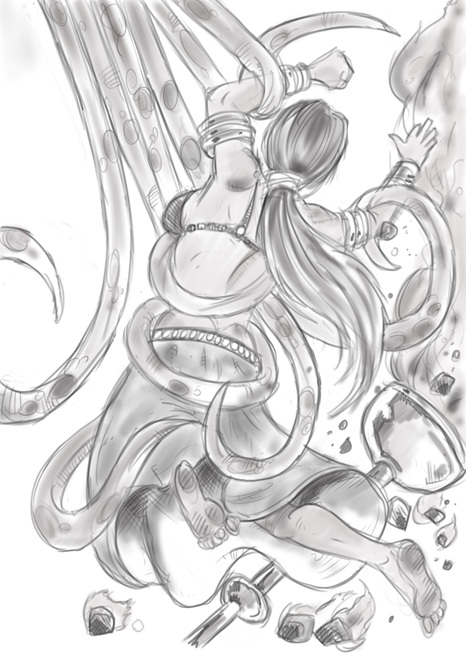
The monstrosity opened its hawklike beak, vomiting out a mass of inky tentacles. They enfolded Amla, who was helpless to escape their grip despite her dancer’s strength and agility. Sand fountained as it beat its wings, air laden with the chill and stench of the underearth blasted the torn tent open, as the creature bore her away.
#
With a volcanic heave, Kalis shook off the dumbstruck men holding him. Before they could grab him again he had laid low two of them with lightning-like fists to jaw and gut, then dashed out of the tent after the monster. One of the armed servants tried to seize him by the arm, but Kalis tore free with such violence his already rent robe was ripped away.
Chaos reigned outside as horses screamed and galloped around their corral seeking a way out, bawling camels bolted, and Iruzai men, women and children scattered from the creature, all save one. Only one young man had mastered his fear enough to loose an arrow at the creature, and was already drawing another shaft from his quiver.
“Stop, fool!” Kalis snarled, bounding up to the youth and knocking him down. “You’ll hit my wife!”
He ran for the corral, instinctively picking out the fastest of the prize steeds, a fiery white stallion with a pair of great curling horns. He vaulted onto its bare back and rode it out of the corral, leaving the gate open.
“Stop, thief, stop!” an anguished merchant cried. “That horse is meant for the king of Amath!”
“I’ll return it!” Kalis shouted over his shoulder, even as he urged the horse into a gallop after the winged creature using only his knees and the halter.
“I’ll bring it back!” cried the youth Kalis had knocked over. He too ran for the corral, but was bowled over from behind by the fat dwarf. He yelled again in frustrated fury as the dwarf ran on, the boy’s bow in his hand and Kalis’ sword in his sash.
Berosh laughed at him as he ran. “You’ll take no potshots at me or my friend, boy,” he mocked as reached the corral’s open gate, caught one of the horses following Kalis’ stolen steed and forcing it to kneel, threw himself onto its back. “But fear not! We’ll bring the horses back, for what Kalis the Charioteer promises, he will do, though old Berosh thinks him an idiot!”
Cursing, the youth ran lightly after the dwarf, caught a horse and vaulted on. He galloped after the fugitives, the rest of the horse herd streaming after, the nomads, merchants, and their servants chasing them with frantic cries to come back.
It was a mad ride through the desert, Kalis driving his horse like a man possessed up and down the dunes, heart sinking as the winged creature carrying off Amla receded from his sight, the dwarf Berosh clinging desperately to his own steed’s mane, in desperate fear of slipping off but in greater fear of being left behind, and the nomad youth grimly determined to catch them, or at least their precious steeds.
But at last Kalis slowed, his horseman’s instincts telling him to preserve the beast’s stamina. That allowed Berosh to catch up and pass him back his sword. Moments later, the youth rode past them then wheeled his horse about to block their path.
The charioteer glanced at the bronze knife in the youth’s hand, glinting redly in the demon moon’s ruddy glow. “Try nothing, boy. I have a sword to your knife, and there are two of us.” He started the horse again at a walk, heading in the direction he’d last seen the winged monstrosity go, and right at the young Iruzai.
But the youth did not move. “You said you’d bring the horse back. Will you?” he challenged.
“I will. But only after I’ve recovered my wife. On my honor as the last man of the Deozai, I swear it.”
The stripling bit his lip in hard thought. “Then I will help you, so you can return the horses sooner,” he decided. “You’re going in the wrong direction. The creature went that way,” he pointed.
“How did you know?”
“Blood, or whatever that thing bleeds. Look, there to your left. A trail of black wetness on the sand, and it smells foul. My arrow wounded it badly, I think. I should take the lead, I’ve hunted since I was tall enough to ride. You, however, seem to know nothing of the desert. You rode your horse down the slipface of a dune — don’t you know you could break its legs that way?”
Kalis was chagrined. He knew horses, his father having been stable master to Lord Sotar, but it was true, he did not know the wilderness. Born and raised a slave, all he had ever seen of the desert was the flat, tame plain outside Bel-Ezor where the city’s famous race was held every year, and where the city’s charioteers practiced with their teams. “Thank you. I’ll follow your lead — and I’ll not call you ‘boy’ again.”
“That was your first wise thought today, you impulsive whelp,” Berosh observed sourly.
The youth grinned, a daredevil quirk of the lips that reminded Kalis of himself. “I’m Rozad, son of Miraz.”
The charioteer nodded meaningfully at Berosh, who hesitated. “It’s all right. Give him back his bow.”
“Are you a fool?” growled the dwarfish eunuch. “He’ll shoot us in the back!”
“And ride back home while Zahur’s red moon is high in the sky, and the demon-gates open? You know better than that, don’t you, son of the chief?” Kalis grinned. “Besides, he has said he will aid us, and the Iruzai code is much like the Deozai ways my father raised me with. We are kin in spirit,” he said to Berosh.
“A hunt for a monster, on a night when Zahur reigns,” the youth grinned eagerly. “This is the stuff songs are made of.”
“If we live through it,” Berosh groused as he handed back the bow. His horse trembled as a distant roar floated to their ears. Was it lion — or something else?
Kalis grimaced. No time for fear now, with Amla being borne off to some unknown fate. While there was no doubt in his mind who was behind it — the sorcerer-priest Nabusharudun — he still had no clear idea why the man was so obsessed with her. Was it simply lust, or was something more sinister involved? Were it mere lust, the priest had the influence to have any other woman he wanted in Bel-Ezor. He did not wish to think of the alternatives.
He recalled the accident that had disfigured him, swerving away from the horrific apparition no one else remembered seeing, and losing control, the agony as his panicked team had dragged him out of the overturned chariot, his left wrist tangled in the reins, and the heartbreak on awakening days later to discover that his master Sotar had sold Amla to the high priest Nabusharudun. For months while he recuperated he heard nothing of his lover, but on a chance meeting in the market Amla had revealed Nabusharudun’s boast to her he had caused the crash himself with his sorcery.
Sotar had been content enough to keep Kalis and Amla together so long as the charioteer won races for him, despite the high priest of Zahur’s frequent and escalating offers to buy her. It was but one of the many favors the nobleman had showered on his racing champion, while Kalis had regarded Sotar like his own father. With the crash, though, his master had considered the deal off and given in to Nabusharudun’s importuning.
So Kalis had bided his time while he recovered his strength, even as he plotted Amla’s rescue from the high priest’s palace along with the eunuch Berosh.
He motioned impatiently at his companions. “The horses have regained their breath. Let us ride.”
They galloped across the sands, Rozad in the lead, the youth’s keen eyes and nose unerringly finding every drop of the foul black ichor. The demon moon rose higher above them, its swift wild course rapidly closing on golden Yashtar as the charioteer remembered closing doggedly on a leading chariot.
When next Kalis thought to look up, Zahur had begun to occlude the golden moon, bathing the land with a sinister aura so the dunes and weirdling, wind-scoured rock formations of the desert were a mural painted in blood. An unnatural chill began to permeate the air, making Kalis keenly aware he had nothing on but a kilt. Something howled somewhere on their flank, and was answered by a chorus of howls on their other flank.
“Those aren’t wolves!” cried Rozad over his shoulder, eyes suddenly wide in fear, and instinctively unlimbering his bow.
“Ride on!” Kalis shouted back. “Let the horses carry us past them!” More howls came from behind them, growing closer, though they could see nothing in the deceitful shadows.
There was no need to urge the horses harder. Eyes rolling white, they galloped at speeds they must never have run before in their lives. In their haste to get away, though, the three riders failed to notice they had veered away from the flying creature’s blood trail. For many minutes they pounded on, until the howls behind them eventually grew fainter.
At last Kalis began to think they could afford to rest the horses again and regain their bearings. But even as he slowed, an unmistakably female figure came into view atop a dune before them, and as they drew nearer, she came down in a stumbling run, arms outstretched.
“Oh, Kalis! At last, you’re here!” she cried. The charioteer let out a great cry of joy. It was Amla.
Kalis dismounted and ran to her. She was fully naked, her ringleted hair wildly tumbled, and weeping with joy and relief. Just as he was about to enfold the sobbing woman in his arms, Berosh gave a warning cry. “Beware, Kalis! That’s not Amla!”
She flung herself into the charioteer’s embrace.
Kalis hesitated, perplexed. The woman who had flung herself into his eager clasp had the wondrous golden eyes, the perfect oval face and form of his beloved dancer. She clung to him with a desperate warmth that could not be feigned. Her near-naked body was warm and familiar, pressed against his own bare flesh. Yet this was a night of Zahur, the Demon Moon, and anything was possible.
“Kalis! Her skin! She bears no marks at all from the creature’s grasp!” Berosh cried again, urging his reluctant horse closer.
Still half-entranced, Kalis hesitantly tried to release the crushing embrace. But he could not. For the woman grasping him had suddenly grown, now overtopping his tall frame by head and shoulders, her body hairy and muscular as an ape’s, her visage part-crone, part-beast, and now she strove to bury long yellow fangs in the charioteer’s throat. Howls now resounded from the dunes all around them, as shadowy creatures materialized and came charging at Berosh and Rozad.
The horses screamed, all of them bolting in different directions. Even as he was borne off by his mare, though, Rozad snapped off a desperate shot at the creature mauling Kalis.
The bronze-tipped arrow slammed into her lower back, causing her to roar with rage and pain, and her grasp weakened enough for Kalis to break free. He pushed himself away from her with a horrified oath, snatched his sword from his scabbard, and sank the blade into her belly.
It fazed the creature not at all. With one swipe of a great arm, she knocked Kalis down, then pounced on him like a ravening wolf. Great horny fingers wrapped around his throat, the unnatural beast laughing as it throttled him into submission. Kalis sought in vain to pull those hands away, slammed a fist into her ear, jammed a knee into her flank, all to no avail.
Then his desperate, weakening hand found the sword hilt, still sticking out from her belly, and gave it a savage wrench.
That, the creature felt. It roared as it fell back from him, powerful arms flailing, but Kalis slipped beneath them, then came up with the sword swinging at its neck. Dark blood fountained as he slashed open a vein, drenching him, and he followed it down, stabbing again and again with the sharp bronze in a frenzy of horror. At last the creature stopped clawing at him and he staggered away, holding one hand to his bruised and battered throat while readying himself to meet the rush of the beast-demon’s packmates or children.
There were none in sight. The ghostly hunting pack had vanished without a trace, and Kalis realized they had merely been illusions, spun by the beast-demon to drive her prey into her clutches. A wave of relief washed through him. He’d been afraid he’d rise from his triumph over his assailant only to find the lesser beasts devouring his companions’ mangled corpses. But where were they? And where, by the gods of the Deozai, was the track of the flying demon they followed?
He was lost in the desert, and alone.
#
An oval face framed in luxurious coppery ringlets like his own untameable locks, golden-eyed as his own, sweetly curved lips calling his name in love and shared pride, swam before Kalis’ mind’s eye. Amla.
Their unusual height and similarity of features had led many to comment they must be kin, and it was likely true. They were, after all, likely the last of the Deozai, a small barbarian tribe that had been broken at Zarmandra’s borders as they fled the droughts and famines and hordes of starveling marauders racing ahead of the Marching Ice. The scattered survivors had been sold on the slave blocks, and every year there had been fewer and fewer of them as the men fell in the arenas or deadly chariot races, while the women had wasted away as concubines.
After his parents’ passing, Kalis had believed he was indeed the last Deozai. He had known of no others in Bel-Ezor, and Lord Sotar’s guests had always been surprised to find he was one, remarking it had been years since they had seen one of that unique tribe.
His fists now clenched involuntarily as he renewed his oft-repeated vow: “Amla, I’ll find you and take you to see the mountains of our ancestral lands yet, I promise. We may starve in the eternal cold that grips it now, but we’ll be together, and free.”
Doggedly determined despite his sinking hopes, he collected his fallen dagger, then blotted away the beast-demon’s foul blood from his skin with handfuls of sand as he circled the area, casting about for some sign of where Amla’s captor had gone.
He went in an expanding spiral even as Zahur achieved full occlusion of golden Yashtar and the night’s unearthly chill deepened with the presence of visitors from beyond. He paid no heed to the flock of gibbering, translucent bat-moth-things that rivered across the heavens at some point, nor the distant sound of malevolent childlike laughter borne on the fitful wind, and of course he never saw the eight arachnid eyes of the formless thing that watched him, fortunately with idle fascination alone, from the shadow of a dune. There was nothing for Kalis save the desperate quest to find some sign of where to find his beloved.
So intent was he on this purpose that he did not even hear a familiar rhythm beating closer and closer to him, not until the white stallion whickered a glad greeting.
Kalis straightened, his heart hammering and full as he extended one hand. The horse nuzzled his offered palm. It was the old magic again, the magic, apparently, of his blood; his father Maldur had possessed it, as had Maldur’s father. They were born with an instinctive understanding of horses, able to bond quickly even with stallions no others could handle. He could never have mounted this proud, fiery courser had it not trusted him from the very first.
Better yet, the white had brought a gift; more hoofbeats floated to Kalis’ ears, and in moments Berosh and Rozad appeared.
“Amazing! I saw the white right after my mount had run out its terror, and followed it hoping it would lead us either to you or the Iruzai camp. It called Rozad’s horse to it, then went straight to you!” called Berosh.
“He is the chieftain, the guardian of his herd, like my father,” said Rozad, nodding sagely at the stallion. “Before this night, none but my father could ride him. But he has accepted you, and that is another reason I accompany you. My father always said horses and dogs are good at reading men’s hearts; those they trust must be good men.”
“Your father is the shaikh?”
“Yes. I’ll lead the tribe someday — and they will follow me better if they know I have done great deeds.”
The dwarf suddenly chuckled, shaking his head. “Ah, gods! Demons jest with us this night. We have spilled blood in our hosts’ camp, stolen their most prized horse, and led their chieftain’s son into a quest that’s likely to kill us all. And after all this, Kalis, you intend to ride back there after rescuing Amla, just to return a horse? They’ll flay us alive!”
“If we can bring the horses back, we shall all be welcomed as heroes. I’ll get my father to grant you sanctuary,” Rozad declared before Kalis could think of anything to say.
“Go back, both of you,” the charioteer said somberly. “I’ll follow the creature alone.”
“And who will guide you through the desert, city man?” shot back the youth.
“And who will guard your back, and think ahead for you when you want to leap into danger?” prodded Berosh. He looked at the sky. “It’s said sorcerers can only work their mightiest spells on nights like these, when the red moon opens the way to the demon realms. I believe Nabusharudun plans to use Amla in some dark ritual tonight, that’s why he’s used so blatant a means to steal her. Always before he has used more subtle methods. We must find her before Zahur’s moon sets.”
Kalis nodded in defeat, inwardly glad. “Ah, you’re both right. Let’s ride. Which way?”
“Absinnu lies in the direction the creature was flying,” Rozad pointed at a bright blue star. “We follow it!”
Without another word Kalis set off at a fast trot. With the star to guide him, he no longer needed to rely on the nomad youth’s lead, and knowing his horse was much faster than theirs, had already decided he would leave them behind if he had to. The dread of what Nabusharudun, the foul occultist who had hounded her for years, would do drove him. From time to time he would urge the white to a gallop, constantly checking the crimson moon’s progress against their pace.
Their mounts ate up the miles as only the fleet desert-born steeds could, but who knew how far the creature they chased had flown? They passed league after league of empty wasteland without any sign of the creature, though otherworldly things swarmed aplenty; phantasms that sailed the skies on filmy wings, silvery forms that danced atop a ruin among the dunes, and from afar a gigantic stilt-legged thing hooting and whistling like a madman as it strode across the plain. Fortunately, no more took notice of them. The eldritch moon raced on above them, by now having passed both Yashtar and its zenith. It would set well before dawn.
It was not just the horses that were tiring. Berosh fell off with a yelp, having fallen asleep. Luckily he landed in soft sand. Even Kalis had to fight his body’s demands for him to close his eyes. Indeed, he dozed off twice, awakened each time by Rozad’s warning that he was veering off course. Thus when he went over the lip of what must have been a lake in some distant eon, he thought he was dreaming.
An ancient necropolis filled the depression before him. A great stepped ziggurat towered jaggedly over crumbling temples and palatial mausoleums, many of them lying open to the stars, their roofs having fallen in with age. But where there should have been only stillness, there was life.
Upon the ziggurat’s flat summit an abhuman figure with what seemed like a ram’s head, great horns curling around its ears, danced as it played a merrily evil tune on its pipes. Below it ramped the noise and spectacle of some royal festival. Chariots raced around the base of the ziggurat, drawn by skeletally thin horses, driven by equally gaunt drivers. Dancers whirled and postured to the creature’s frenetic music. Kalis and his companions should have been too far to hear the instruments, but they did as if the sound propagated not through the thin desert air alone.
The ruddy moonlight glinted off the bronze helms, armor and spears of ranked guards, all beneath the eyes of a huge man, surely some legendary king with the blood of giants in him, watching from a throne set on the ziggurat’s steps while unusually gaunt hunting lynxes played at his feet.
Now the creature turned hellishly lambent eyes up to them, and played a flourish on its pipe. At this the enthroned figure also looked up at Kalis, and beckoned. The crowd also turned to look up, and in the moonlight he saw they were all the leathery masks of mummies, or grinning bare skulls. Even the king’s lynxes had been mummified.
Dread filled the charioteer. He tried to call out to his companions to turn and flee, but he could not. He willed himself to make his mount turn around, but his muscles would not obey, and with eyes rolling white in helpless terror, the proud stallion began to descend. Behind him he heard the footfalls of the other two horses, and knew Berosh and Rozad too had fallen under the spell.
Their unwilling horses brought the three to the foot of the ziggurat, the guards and crowds of dancers and servants parting before them with a dry sussurrus like that of crawling snakes, to where the inhumanly tall king, clad in rotting cerements and lavish ornaments of beaten gold, waited on his throne. There they were made to dismount and kneel, flanked by the skeletons of the royal guard.
“Welcome, strangers, to the halls of Naram-Zahur,” sighed the long dead king in a voice like the dry desert wind. “Join us in our revels. Drink with us the dust from grapes that grew only in our time, dance with the slave maidens sacrificed at our funeral and sport with whichever of them you fancy, for when the moon sets, you join us in our tombs.”
#
The dead king gestured at them to stand, and skeletal guards hauled them to their feet. As Kalis rose, the king’s lightless eyes fell upon the tattoos on his breast and he gave a start.
“I know these signs,” the revenant whispered ominously. “Why do you, a wanderer, wear them? What gives you the right to bear my emblem, and with four crowns too? Speak! And if I find you have defiled my dread crest, I shall consign you to torment eternal, to unlife in the open where vultures and jackals will feast every day on your eyes and entrails!”
“O king, I wear the mark of one who has won the Azhariad, the great annual chariot race of Bel-Ezor, and the four crowns mean I have won it four times,” Kalis replied, wondering whether that would please the king or enrage him further.
“Bel-Ezor? Is that what you call my glorious capital, Bel-Azhar, now?” Naram-Zahur seemed intrigued. He descended the steps, walked around Kalis, looking him up and down, glanced at his trembling white stallion. “I see you are a born horseman. You did not master this magnificent beast, you made it your brother.
“But I, Naram-Zahur, created that chariot race to kill. Every death in it was an offering to Zahur for victory. In my lifetime no man ever won it more than twice. And you won four times? Surely, the track, the rules, have been changed to be easier?”
“Lord, the Azhariad still kills several charioteers every year,” said Kalis, and at the king’s command he described how it was run, the treachery of the course with its multiple trapped gates and narrows, and how many drivers, forbidden to attack each other or the horses, contrived dastardly tricks with their long whips.
He spoke of his long training and his beloved horse teams, and the countless times they’d galloped around a track built to mimic the Azhariad’s. “It’s the horses, I believe. Larger, longer of leg and deeper-chested than what I see you had, O king,” the charioteer opined. “I see only your chariot has the horned breed in harness; nowadays all racing chariots, and many war chariots, have them.”
Naram-Zahur nodded at each point, pleased. At last he laid both hands on Kalis’ shoulders, as a father might welcome a son coming home. “It is indeed still the same race. And you have won it four times, yet there is no scent of blood on your soul from it. Amazing. For this I grant you your lives. You may go free, but I shall keep your steeds. Those magnificent beasts I shall have embalmed, to preserve their beauty forever and race for my pleasure when Zahur’s fullness awakens us again.”
Kalis once more dropped to his knees. “O king, spare our horses! They are my only hope!” He described how Amla had been carried off by the winged creature, and how they had followed its trail of blood, likening the perilous pursuit to the Azhariad. He told the king of Nabusharudun and his sorcery, and how he planned to use Amla in some evil rite.
“And I gave my word to return them to the Iruzai,” he added.
“No. I must have them. Besides, no mortal horse can carry you to where your quarry has gone, not before Zahur sets. And the rite your foe, Nabusharudun, intends to use her in will be done by then.” The dead king turned away, as if casting otherworldly senses far and wide, then turned back to Kalis, his features writhing into a ghastly grin. “This priestling is ambitious. He aims for power even beyond mine at is height, intending to bring Zahur himself to the world in fleshly form. I will not allow it. I was, and will remain, the greatest sorcerer-king the world has ever known!
“I offer you the loan of my chariot in exchange,” said Naram-Zahur. “Unliving, my horses can run all night without weariness, or fear of the apparitions that prowl this night. And my chariot has been enspelled for protection against many things. What say you?”
Kalis glanced at the crimson moon, checking its position in the sky. It was no more than two hours from setting. It rankled him to give up such noble creatures to this foul, unnatural fate. But it was them or Amla. He wondered how Rozad would take the betrayal. He bowed. “I gratefully accept, O king. How shall we return it afterward?”
“My horses will come back on their own, and the chariot with them, just as they know where you need to go,” replied the mummy. “But they will return to me before Zahur sets, whether you have accomplished your purpose or no.”
“I will find her. I will save her, and you will remain the sorcerer-king the whole land still dreads,” Kalis whispered.
“Then go, and may victory ride with you!” said Naram-Zahur, and he clapped his hands for the chariot to be brought.
#
“I am sorry. I had no choice, for Amla’s sake,” Kalis said to Rozad as he boarded the magnificently crafted chariot.
The youth stared back with a stony face, on the verge of an outburst. Manfully he restrained himself, and at last took a deep breath. “My father always said, ‘When someone offends you, always think first why they did it.’ And it occurs to me that I have a little sister I cherish, and I too would give all the tribe’s horses, aye and our camels too, to save her from a sorcerer. I will go on with you.” He got into the chariot.
Berosh got on last, fingering the spears, javelins, bow and quiver of arrows in racks hung from the car’s rim. The weapons were painted with what had been bright colors in their day and decorated with bands of gold, and despite their age the wood and horn were sound and the bronze still sharp. “This is a king’s war chariot indeed,” he breathed to himself.
But the king had heard him. “I am Naram-Zahur. Would I have been buried with anything else? Use as many of my weapons as you need — but if you take any to sell, little man, as you are thinking, I will know.”
Berosh let go the spear he was admiring as if it were a snake.
Kalis shook his head. Even surrounded by horrors, Berosh could be relied on to think in gold larics. He shook the reins and clucked to the trio of black, cerement-wrapped horses, and they set off at a gallop.
They drove through the desert with a dust storm in their wake, the gaunt horses of Naram-Zahur in their harnesses of golden talismans graven with dread sigils running faster than swifts or stooping falcons. Similar talismans clashed like bells and gongs upon the chariot, and inscriptions in long-dead tongues crawled all over the chariot’s bronze front and sides. Hungry demon-beasts from beyond the stars were flocking to the chariot, out for one last taste of human flesh before Zahur’s setting closed their way back home, but recoiled shrieking from those wards.
Kalis leaned forward, urging the horses on with hoarse cries and singing whip, for Zahur now low over the horizon.
Where were Amla and Nabusharudun? The undead king had assured them the horses knew the way, but still they could see no sign of the creature that had taken Amla, nor where the sorcerer might lair. There was nothing before them but more desert, the all but endless sands broken only by scattered stone outcrops. In the sinister light of the red moon, those formations seemed to twist and take nightmare shapes, like devouring swamp trees or obscene fungi, or the heads and maws of monstrous beasts. Yet others recalled the decaying and just barely recognizable towers and ziggurats of fallen cities.
Then he saw the fire.
It blazed to life atop a sandstone tor, no more than a couple of miles ahead, and he saw the tor was no natural rock formation. It was an ancient ziggurat, carved from rock instead of built up, and surrounded by the half-buried ruins of a lost city. The fire on its summit could only have been made by a sorcerer, for it flickered a hellish purple and blue.
Nabusharudun!
Kalis shouted encouragement again to the horses, though they likely neither needed it nor felt it in their stilled hearts. They understood his will, though, and accelerated until the rush of the wind past their faces was like a storm. Despite their incredible speed, it seemed to Kalis it took forever to cover the last mile. And Nabusharudun, or his creature, had seen them.
The great winged monstrosity that had taken Amla came flying at them from the ziggurat, swooping low and right at the horses with its tentacles lashing from its open beak. Perhaps it had intended to crash their chariot by frightening the horses, just as Nabusharudun had used an apparition to cause Kalis’ accident in his last race. But Naram-Zahur’s horses could no longer feel fear. Straight at the thing they ran, then swerved at the last moment.
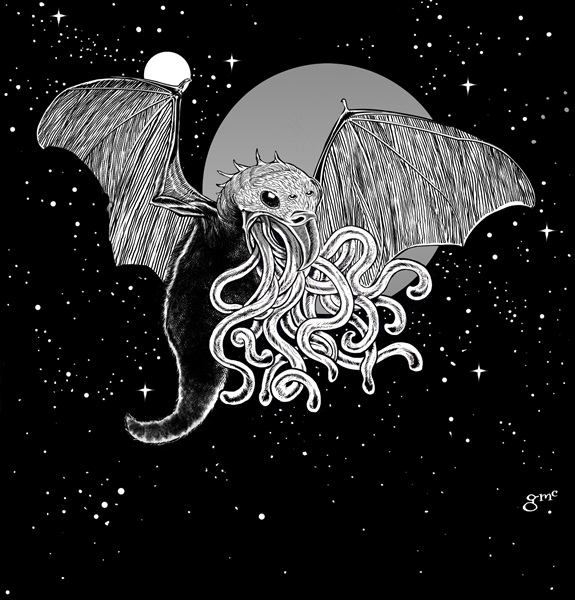
A deep twang resounded by Kalis’ ear. Rozad had loosed his bow at point blank range, and the creature jerked and swerved as it was hit. Kalis seized a heavy spear from the rack and hurled it, but its point only grazed the creature’s temples. The beast spiraled up, wings laboring, and they saw it had a broken arrow shaft beneath one wing.
Kalis seized another spear and wheeled the chariot left, and as the creature maneuvered to dive again on their rear, he wheeled right, so hard the vehicle rose on one wheel. Berosh yammered as he clung to whatever supports he could, at one point hanging from the chariot cab’s rim while his legs kicked air. The creature missed its pass, and as it turned again above their heads, Kalis threw with a scream of long-pent fury.
The spear took it in one wing’s root, and such was the force of the charioteer’s throw that it crashed to earth, crippled.
And a horrifying transformation took place as the thing shriveled, losing wings, tentacles, claws and beak, until all that was left was recognizable as a man.
He had only a fleeting glimpse as the chariot raced on, but the last Kalis saw was the man raising an arm and pointing at the ziggurat. Had that been gratitude and joy on his face, before the wound’s pain overwhelmed him? Acceptance of his sad fate? A black fury the charioteer had never known before suffused his veins. That violation of a human soul, making the victim only too glad to die on restoration to his mortal form, was beyond unforgivable,
“Nabusharudun!” he roared at the top of his lungs, and his roar was that of a lion.
They raced for the ziggurat, Kalis’ wrath growing even as the purple flames rose higher. He was frantic now, for the ritual was evidently reaching its climax. Now they could hear the chanting of the sorcerer-priest as he invoked Zahur and the other gods of darkness, his voice booming like a bell, as if Nabusharudun wore a bronze actor’s mask. The ancient temple-mound towered imposingly above them now, its summit so close yet so dauntingly far. Kalis looked for guards or armed servants such as the priest might have traveled with, but there were none.
At last Kalis reined in at the ziggurat’s foot, and they spilled out even before the chariot came to a halt. Rozad was cursing, for his bow had broken unnoticed, perhaps in the wild maneuvers the charioteer had taken to evade the transformed Jonan. The boy tried Naram-Zahur’s recurve bow, and found it beyond his young strength. He offered it to Kalis, who shook his head and instead took a pair of javelins from the rack, and passed Berosh another pair. The charioteer offered Rozad a handful of javelins, but the boy shook his head and unbound the leather fillet on his brow, then selected several stones from the ground. He had been wearing a sling.
“Let’s each ascend a different side, so we can surround the bastard,” suggested the dwarf.
“Good idea. I’m a fast runner, I’ll go around to the far side — ” said Kalis, but halted as an ominous clicking scutter came from the stones above them.
Nabusharudun was not without guardians after all. Creatures out of legend, six tall, burly men with the hindquarters of enormous red scorpions, were crawling swiftly down the ziggurat’s sides. They had sickle swords in their hands, and their long needle-tipped tails were poised to kill.
“We stay together after all!” Kalis yelled. He hurled a javelin, hitting one of the scorpion men squarely in the breast. The dart bounced off the creature’s chitinous coat, and it hissed in anger. Another dart glanced off another scorpion man’s belly; Berosh’s cast had also failed to pierce.
The charioteer heard Rozad running away, and he settled into a fighting crouch, transferring the javelin to his left hand and drawing his sword. He could not blame the stripling for giving in to terror. Berosh gamely held up a shield for them both, knowing Kalis’ left arm was still too weak after his accident to do it himself. The scorpion men fanned out to surround them.
Suddenly one’s head snapped back, its face a crimson ruin. “Ha! Bronze cannot pierce them, but stones can crush!” exulted Rozad from behind them. The boy had not fled. He had only given himself room to use his sling.
“Berosh! There’s a mace in the chariot! Get it!” Kalis pushed the dwarf back toward the waiting vehicle.
“But you’ll be shieldless!”
“But I’m fast. Go!”
The remaining scorpion men tried to get past Kalis, recognizing the slinger as the more powerful threat. But the charioteer would not let them. Though he had never been a warrior like his tribal forebears, Lord Sotar his master had thought it good to give him some training at arms, for one needed combat reflexes to compete in the Azhariad. Kalis knew well enough the arts of cut, parry, and feint, of remaining in balance while never staying still, and his body was lithe and fast. He darted nearer the monsters, feinting at their legs with his sword, at their eyes with the javelin, swaying away from their stabbing stingers and slashing blades.
He heard the whir of the sling behind him, half-saw a stone whiz past a scorpion man’s head, heard Rozad curse. “Keep moving, Rozad!” he warned. Intent on his slinging, the Iruzai had not stirred from his original shooting position.
Another scorpion man tried to get past him on the left, and when Kalis moved to intercept it, it suddenly turned, whipping its tail sideways into his legs. He was knocked sprawling. Two scorpion men ran past him. One of them went down, skull smashed by a heavy stone. But the other got through, followed by a cry of pain and despair.
Kalis scrambled to his feet. The shaikh’s son was down, mouth foaming, contorting and spasming in the death throes of the scorpion-stung.
Now it was four against one, unless Berosh could rejoin him in time.
#
Kalis retreated toward the chariot, desperately dodging strike after strike from the four scorpion men dogging his steps. He could no longer make feints to distract them, nor try anything that left him open, for their attention was no longer divided. Again and again he evaded death in torment by the merest hair as he danced away from the stingers, as he had evaded his rival drivers’ whips in the Azhariad, the hairy armored appendages often grazing his skin.
Bronze sang against bronze as he parried their sickle swords, and one barely parried blade kissed his thigh. He was moments from death. Where was the dwarf?
Hooves came pounding behind him, and the rumble of chariot wheels. “Kalis! Jump left!” Berosh cried in Deozai. Kalis sprang away. Ignorant of that obscure tongue, the scorpion men were caught by surprise.
The chariot wheels crunched and squelched over the body and skull of one, ran over another’s four right legs, crippling it, and scattered the other two. As the chariot passed, Berosh tossed a mace onto the sand close to Kalis. Dropping his javelin, Kalis ran for the mace, then hammered it into the crippled scorpion man’s skull.
The charioteer sprang for the ziggurat’s stairs, pursued by one of the last scorpion men. Despite Kalis’ agility it rapidly outclimbed him, turned, and began driving him back down. A glance over one shoulder showed the last of the monsters was now climbing behind him. He tried to sidle away, to face both creatures, but with their eight sprawling legs they outmaneuvered him, keeping him between them. The stingers came closer, beads of venom glistening like blood from their tips when they caught the crimson moonlight.
Suddenly the scorpion man below him screamed, letting fall its sickle sword, then slumped onto the steps. A familiar grunt came from beneath it, as did a gout of blood. As they had been playing their cats and mouse game, Berosh, aided by his diminutiveness, had stalked beneath the creature from behind to stab its soft underbelly. It crashed heavily, pinning its slayer beneath it.
With a cry of rage the last scorpion man attacked. Hammering furiously at Kalis’ weapon, it got above him and drove him down the steps, faster and faster to threaten his balance. Kalis parried alternately with both weapons, had the sword knocked out of his weak left, slipped, and rolled painfully down the stairs. As he did, he also lost the mace. Still pinned beneath his victim, Berosh groaned in despair.
Kalis rolled past him. With catlike reflexes the charioteer snatched up the sickle sword of the dwarf’s victim, and as he stopped rolling, slashed at his pursuer’s legs. It lost its balance and tumbled off, and before it could climb after him again, Kalis had grabbed a loose stone from the stairs, heaved it high over his head, and hurled it down.
The creature’s skull splattered.
Scooping up the sickle sword, Kalis charged up the stair. His thigh wound was starting to really hurt now, bleeding copiously and slowing him down, but he forged on through the pain. As he climbed, he saw from the corner of his eye that Zahur was near to kissing the tops of the distant mountains. The booming chant faltered, started again, stopped.
He reached the summit. Amla lay there naked on an altar of black stone, her hands and feet tied spread-eagle to its corners, the tall, gaunt, shaven-headed Nabusharudun hurrying to cut her away. Awaiting him on the far side of the of the summit was a chariot drawn by a pair of great serpents. The priest looked up from his task at the sound of Kalis’ footfall, his face twisted by hatred and fear.
“May the demons of the farthest stars take you, you damned horse-wrangler! Again you interrupt my plans! But this will take care of you for good!” He snatched something from beneath his robe and poised his arm to throw.
Kalis froze.
From where he was, he could not reach Nabusharudun before the sorcerer hurled the hellish spores that were his favored weapon of last resort. The sorcerer cackled insanely, then grunted as a fist shot into his jaw. Nabusharudun yelped, dropping his dagger, and scrabbled backward as Amla rose from the altar, the curved dagger now in her hand. Her tigress-like pounce was jerked back, though, as she found one foot still bound to the altar. Kalis charged.
With a shriek of frustrated rage the sorcerer fled into his serpent chariot, and by the time Kalis reached the spot he was gone, the chariot borne into the air by the ophidioform demons. He turned to untie Amla, only to find she had done it herself. They fell into each others’ arms.
“I was so afraid I’d find you dead, sacrificed by that unspeakable abomination,” Kalis said into her ear, her sweaty ringlets in his mouth.
Amla trembled against him. “Nabusharudun means worse than that for me,” she whispered, eyes shut in revulsion.
“What! What did he do? Did he — “
“Nothing he hasn’t done before. We slaves learn to survive such things. But we never forget them, either,” she said, the last words coming out like tempered daggers.
Before he could say anything more, Berosh’s anguished cry rose from the ziggurat’s base. “Kalis! The chariot! Naram-Zahur takes back his own! How do we return now?”
Kalis looked down and saw the bronze-shod car wheeling around, both it and its mummified horse team growing tenuous as it raced back toward their master’s tomb. He cursed bitterly for long moments, until his anger was spent. “Well, at least we can die free,” he sighed at last in resignation.
“No, we won’t,” said Amla. “There’s a well inside this ziggurat, at its base — Nabusharudun had me bathe there. And he left behind waterskins and food, for he’d meant to spend a day or two resting here after the ritual. We’ll be hungry before we get out of the desert, but we’ll survive.”
She disengaged herself from his arms to place her hands on her belly. “But you asked what the priest was doing to me. Nabusharudun believes he has planted a seed in me, though it could be yours. I cannot be sure. The ritual tonight was meant to force me to term, so he could have the child already and know. He believes the child will give him power, somehow, if it is his. What shall we do? What if it’s indeed some kind of demon child? Should I have a wise woman remove it?” There were tears in her tone, if not her eyes.
“But what if it’s mine?” Kalis countered. “Either way, we’ll raise it as our own. As a Deozai. That matters more than blood to me,” he assured her, fondling her hair. He stared hauntedly at the horizon, where Zahur had set at last, its evil blood-light giving way to stars and the turquoise lambence of Elaithys, as the blue moon rose. He had never known that Amla carried a child. The revelation shook him to the core. Even worse was the question only time could answer.
Did she carry hope for their vanishing tribe, or a sorcerer’s spawn?
________________________________________
In 1977, writer-photographer Dariel R. A. Quiogue was simultaneously exposed to Star Wars, Herodotus, Homer, Edgar Rice Burroughs, and Robert E. Howard, and his brain has never been the same since. He now writes F&SF flavored by his fascination for history, science, the sea, and the richness and diversity of Asian cultures. His creative motto is “Simple stories, powerfully told.”
Quiogue’s works have appeared in The Best of Heroic Fantasy Quarterly I, New Edge of Sword and Sorcery Magazine, Old Moon Quarterly, Rakehell Magazine, A Book of Blades III, and Double-Edged Sword and Sorcery.
Miguel Santos is a freelance illustrator and maker of Comics living in Portugal. His artwork has appeared in numerous issues of Heroic Fantasy Quarterly, as well as in the Heroic Fantasy Quarterly Best-of Volume 2. More of his work can be seen at his online portfolio and his instagram.
Simon Walpole has been drawing for as long as he can remember and is fortunate to spend his freetime working as an illustrator. He primarily use pencils, pens and markers and use a bit of digital for tweaking. As well as doing interior illustrations for various publishing formats he has also drawn a lot of maps for novels. his work can be found at his website HandDrawnHeroes.
Advertisement