TO DAZE THE SEA
TO DAZE THE SEA, by Daniel P. Kelly, artwork by Karolína Wellartová, audio by The Bard
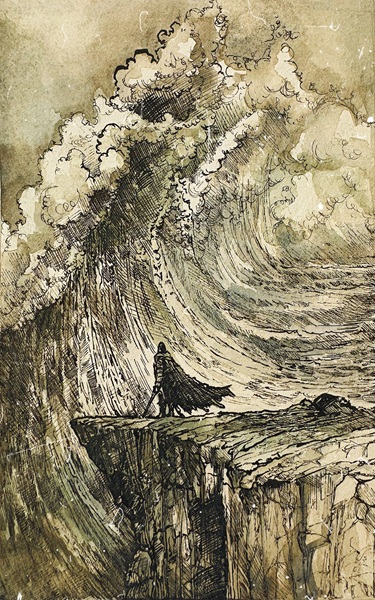
The Mountain
I could barely hear the Elder
Over the spittle gale flying
From the hag’s mouth of the wind.
And yet that day I received
A Divine Command.
There, on that slurry mountain,
That place of holy connunction, the Elder
Said,” Daze the Sea.”
At last, I exulted, to be tasked with
Something worthy of a Brother.
After a lifetime of being a worm
Sliding through the mud of Apprenticeship
To have earned a glance at the sky!
With deathly determination, I descended
Into the valleys. I didn’t get lost. I have never
Been lost. Though the night gods
Bathed my head with moonlight
And made me a wandering “fool”.
Or so said the villagers whose
Laughter was sharp as holly.
The Journey
Chelny erat! And so it was
In the Bliney Blue where the healing bloodwort grows
I saw that I was followed.
I laid a trap, and soon,
Leaping from the chulley brush,
I swept the skulking fellow’s feet
With my iron-shod staff.
There was no triumph in it.
‘Twas but the spoiled second son
of the Thousand-Teated Queen.
Radulas, a brother of my order,
Couldn’t be simply brained and left
For dead. We shared dinner
Instead. Parched red corn and pie-toad
Jerky. And a swallow from a Glarfon vial,
For which I forgave him much.
We retired to our own
Dreamworlds shortly thereafter.
I awoke to the terrified yips
Of a coven of crimson howlers.
They rushed past us by the light
Of our near-dead coals,
Seering panic in the dark.
I did not need to wake Radulas
As a pair of wolves ran over him.
And then I spotted our doom. “Get up!”
I roared. “Kill or die!”
A smokey orange cloud was rolling down
The path towards us. “Naphroggi!” I cried.
There was no time to run.
Inside the cloud were demoniac
Heads the size of apples gnashing at us.
With gollish hortal, I swiped at
Three of them and reduced them to
Pulp. And yet the snarling
Air fruit kept rolling down
By the hundreds. I called on the
Angels and fluid fury engulfed
Both Radulas and me! I kept most of
Those I could not crush off me
And those that affixed themselves to me
I bit and spit out as trained
By my thrice-blessed Weapons Master Joro.
Radulas seemed not so trained, and so
His back was covered with red-cheeked
Heads that gnawed and smiled and then
Began to hum The Hymn of Ashvoti.
The demonic choir was putting a wasp’s nest in
My brain, but, sealing myself in prayer,
I, the larger head, began to chew
And spit the enemy whilst Radulas
Split the air with his short swords,
Reinspired by my aid. Within minutes
The Naphroggi had withdrawn and
Flowed farther down the hill.
I confess we felt no righteous
Triumph, but hid ourselves like foxes
In a small outcropping of stone
To which we added pine boughs.
We were away of the morning,
Our wounds plastered over with bloodwort.
Trained as we were in silence
We only spoke when we took refreshment.
Six days it was until we saw Rottletown,
So we did have time to speak
Of the soul-murdering squalor
Of the Queen’s court. I began to understand
The desolation the boy grew in, as if
He’d sprung alive in a waste of
Fleshy wyrms. And it did melt
My heart, and I saw how the waves
Of fortune raise us and toss us
From heights to trough with laughing
Unconcern. I, the poor son of a blacksmith,
Had yet inherited a strong back and sound,
If rather dour, morals. He, raised in a mixture
Of brothel and pig stye, had only by
the most desperate of miracles, escaped its ruin.
And so, seeing this,
The foul envy in my heart
Which I had concealed as a thorny
And blustering rectitude
Vanished in the sharing of a poor meal.
We could not avoid passing through
The dead city of Rottletown, but as advised
We held our weapons close and
Kept our heads down as we ran.
We knew not the particular horror of the place,
But a deep and festering miasma lingered there
So that one’s animal spirits were stirred
To bold panic. We increased our pace.
With but a minute’s sprint before us,
Disaster struck. “Save me!” came the
Quavering voice of a girl. I looked
And saw a maid of perhaps seventeen years
In the doorway of a tavern.
“Don’t go!” I shouted at my friend
But it was too late. He had
Hared off to the pretty pleader. “No!”
I cried, but she already had him.
Pillow soft and oozing, she
Engulfed Radulas and then retracting
Like the white arm of a squid,
Disappeared. I admit in my horror
I vomited my breakfast, but
I had to flee, as several thick
White arms emerged and sought me.
I ran, full sick of grief and
Horror. A mile past the town
I stopped. I vomited again,
Then wandered into the brush to sleep.
The Sea
I arrived of an afternoon
And rested in the dunes above the shore.
A type of large, waddling rat
Made friends with me, or rather
Made friends with the corn I had.
I named him Radulas, sentimental act
I know, but good it was to speak to him
As the fire burned down and the last
Of the corn was eaten. I knew
On the morrow I would be tested
Unto death. In time I slept
And in the morning
I stomped through tidal pools,
Aghasting the crabs.
I scooped up handfuls of sea-spittle,
And made a splattering clap.
I kicked the rolling tide square
In its humectant ribs.
I strode into the waters and beat
The quiescent blue with ferocity.
All to no avail.
Eerie child-crone, she remained
Sinister, playful, implacable.
Alone on the beach, hearing
The monitory growls of the waves,
Aware of the stars whirling
Above in fiery certitude, (close enough
To be seen, too far to illume.)
I wondered if poison was what
The Elder meant.
There was enough poison in me, perhaps,
To bring a slow concussion to
The ocean’s thoughts, enough to
Stun a tempest and bring it
Low and sweet.
Hates and resentments, a host
Of biting flies, bred on carcasses of
Rotting desires, could be
Compounded in a tincture
To envenomate the sea.
This, I thought I could do.
I composed myself for tomorrow’s task,
Drifted into darkness,
And awoke in a dream.
And screamed, caught in the sea’s green lips,
Spit like a bullet of flesh to the sky
To plunge back into the maelstrom’s throat –
I screamed again, coughed out in a lashing squall
As a tongue made of wave
Wrapped around me until
I couldn’t move at all.
Utterly overpowered,
I hung there, like a peasant’s charm
Placed above a door that would never open.
I hung there, in my watery oubliette,
Facing the futility of my fate
When, in a rictus of expectant despair,
I felt the sea grow warm
And saw the sea’s mouth smile.
Bright fish like liquid gems moved above and below me
And dolphins laughed at me
And I, lifting my head, laughed, too.
And the sea, with impossible mercy
Whispered to my skin
The secret meaning of the words
The Elder taught me.
How good to be a fool, if in the end
One slim inlet of the ocean
Contests one’s shore!
An eternity later I woke down into the world
And resolved to tell the Elder
What I had learned, but
I would do so only
After taking a roundabout way home.
For only a wandering path
Taken with all the heart
(The sea told me)
Can lead us to the truth,
Or, if truth be told,
Lead us anywhere at all.
________________________________________
If my life were not so prosaic, my bio might be relating my struggles with the tumpinny skreechids, the evil Ents of the grasses. Instead of shepherding their charges, they lead them in violent rebellion against the rightful lord of the land. Were it not for the Whirling Blade of Righteous Order, with its capacity to turn skreechid armies into heaps of green-bleeding hay, the land would be lost.
Alas, my life is indeed prosaic, and few want to hear about mowing the grass.
However, I do have some hobbies that I find interesting, including martial arts, mead-making, gardening and walking an aged border collie.
Karolína Wellartová is a Czech artist, painter creating images predominantly with the wildlife themes, nature studies and the literary characters. She’s mostly inspired by the curious shapes and a materials from the nature, but the main source still comes from literature.
From a young age she tried to express herself and her observations on paper. Painting and drawing were always the most important thing for her and visiting the local art school helped her understand the new techniques and the science of the colour mediums. She’s the award winning artist for “Best Book Cover in 2015” in Czechia.
Her work has been published in American magazines such as Spirituality Health Magazine, International Wolf, Metaphorosis, Orion, and Heroic Fantasy Quarterly.
What can be said of The Bard? This: Long ago, the mists of time parted. An unheard-of figure emerged: a wildman; untamed and howling. His brute savagery was a marvel to all. He fled into the wilderness and passed beyond memory. During the commotion, the Bard also emerged. He also fled into the wilderness but he came back when he got hungry.
Advertisement