A VOICE OF HORNETS
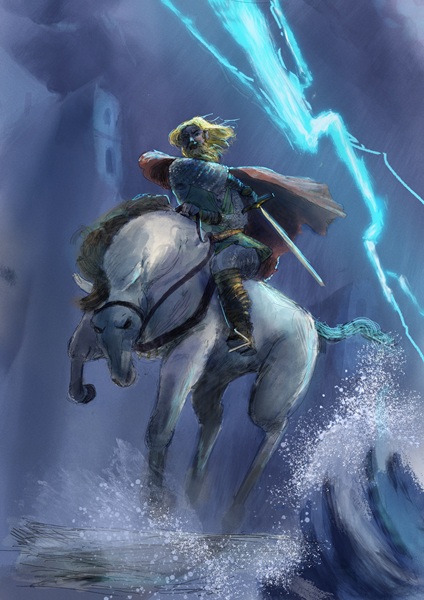
A VOICE OF HORNETS, by Bryan Babb, artwork by Andrea Alemanno
1
“What makes steel so different from iron?” Nicolo asked, looking covetously at the blade dangling from Sigurd’s hip. “We’ve got an ironworker here who shoes our horses and makes nails for the boats, but we’ve got to wait for traders from Naples if we want steel knives to scale the fish. Why can’t Hauberk make it?”
“Iron’s brittle.” Sigurd said, reclining in the shade of an oak tree on a hill overlooking Sapri. The fishing hamlet consisted of a handful of stone cottages, all clustered together on the terraced hillside in a stubborn brace against storm and sea. Even after three years, Sigurd had not grown used to the idea of men living in the sides of hills like a colony of ants. He looked back at the boy. “At least, the kind of iron your Hauberk makes. I wager it would do in a pinch a might better than nothing, but it’s like to crack against mail or shield. Steel is hard to make and expensive. A good smith can take iron and strip it of all its slag, burn away its impurities, and refine it into something new. Where iron breaks, steel bends.”
“So you want it to bend? What if it gets stuck that way? Surely it can still break.”
“A good sword is meant to slash and stab at all manner of armor and shield. A chipped edge won’t keep it from slicing through flesh and bone. Good steel can bend one way and snap back to its right place.” Sigurd paused as an ocean wind whipped through the leaves of the lonely oak and sent sparks of hot salt across his face. “But you’re not entirely wrong. One day, even the finest, toughest, steel sword will break with use.”
“But what if your sword bends and gets stuck before it breaks?”
Sigurd shrugged, letting the silence answer the boy’s question. The sky was still blue, but some of the clouds were bloated and looked near to bursting. The wind whipped through the tall grass, vowing a storm before sunset. Behind them, Piccolo grazed in pleasant obliviousness to the rising gale.
The boy gave a wide, gap-toothed smile, which lent his visage the eerie reminiscence of a skull. “Do you think yours will bend or break tonight?”
Sigurd grunted. “Don’t know. I’ve never tested it on a sea beast before. I don’t mean to, either. Swords are best at killing men. I’m going to use my lance first and my axe if I need to.”
“What about your shield?”
“Still thinking about it.” Sigurd said. The waves were crashing harder on the coast, the leaves on the tree jostling louder in the oncoming gale. Black clouds now gathered on the distant horizon. “On the one hand, it’ll help me last a lot longer if the beast is as strong as you people say. On the other, I may want to wield my lance with both hands. I’ll be better able to control the tip, for one, and if its scales are tough, I’ll need to be able to skewer with more force. Either way, I want this fight over quickly. Even if I force it ashore, I doubt it will give up easy.”
The Tyrrhenian Sea sprouted tufts of white foam as the gale grew in strength. The shadow of the fat surging clouds darkened the village and countryside, the early afternoon now appearing to be late evening. The boy looked out over the water and shuddered.
“He’ll be here tonight. It always looks like this when he comes. There’ll be no fishing for a week by the time he’s done eating.”
“Have you ever seen it?” Sigurd asked.
Sigurd recalled what little he knew of the beast. The alderman had told him of the monstrosity’s appearance when he answered Sapri’s call. He was in Naples, serving as the duke’s strong-arm. Greek coin flowed freely and spent well, and Sigurd was generously compensated for chasing off Lombards and Saracens. But his room above the inn was getting stale. He was growing sick of the savory-sweet taste of olive oil intruding upon the even simplest meal. On top of it all, Naples was split between the Latin and Greek manner of worship, meaning his faith in the Roman church was viewed as near heretical by half the city.
As he considered his passage out of the city while drinking in the inn where he lodged, he met Pietro. The door flung open, the haggard fisherman dwarfed in its frame.
“The people of Sapri need the charity of a Christian man with the strength of a bull.” The little man said. “We are tormented by a demon from the sea, who brings with him horrible maelstroms and devours our catch. Our people go hungry. We’ve no fish to sell nor eat. Our traps are always retrieved empty. Our nets are cast a thousand times each day and come up with naught but bones. Our men who braved the waters during the storm had their boats and bodies dragged beneath the waves. We need help!”
Such was his state that the owner was gearing to cast him back onto the streets, but some madness (or boredom) sent Sigurd to his feet, beckoning the man over before he could be cast back into the streets. Sigurd ordered him a pint of ale and a plate of roast chicken. No matter how embellished the man’s story might be, his meagre frame and taught skin did indicate there was some truth to the claim of famine.
“You’re a saint, Sir.” He said between mouthfuls of the greasy white poultry. His eyes were sunken deep into his head, but they still glinted with gratitude. “I was on the verge of giving up. I’ve called on every able-bodied man between here and home. Of the those that believed me, not one thought it worth his own skin to help.”
“I’m not a saint.” Sigurd said. “And I didn’t say I believed you, not necessarily. I’ve heard of no demon like the one you describe. All manner of filth lurks beneath the sea, tentacled beasts and sharks with a thousand fangs. It doesn’t make them demons.”
Pietro nodded, but Sigurd sensed impatience from the fisherman. No doubt he’d had this conversation before with other knights and men-at-arms.
“Well, even if it is some manner of natural beast, we can’t kill it, and Lord knows we’ve given it our best. It only shows up with vicious sea gales, the kinds of storms where you’re like to lose your ship regardless of whether there’s a demon in the water. And besides that, we’re not a village of warriors. When the Duke raises the levy, he expects fish from us, not fighters. Now we can’t give him either.”
Sigurd nodded, considering Pietro’s words. It would be a good mark on his soul to help these people, he thought. Ten years ago now had he and his kin set out on pilgrimage. In those years, he’d been a sword-for-hire, little better than a common mercenary. But he didn’t fight in this country for the wellbeing of his spirit, just for the thrill of battle and, of course, the coin.
He was inconsistent to Mass. He hadn’t confessed in some three months. Here, however, was an opportunity: An opportunity to get his soul perhaps in better standing with God. No promised payment, no expected reward. And he’d get to put his lance to use on a foe that had yet gone untested.
“My brother, Roger, killed a bear once.” Sigurd said, swirling the foamy remains of his ale in the wooden tankard. “Skewered it with a boar spear. He’s no lout, my brother. Roger’s been a squire since he was seven and a knight since fifteen. He said that it felt as if he’d picked a fight with a castle wall, such was the bear’s strength and the thickness of its hide. One swipe of its paw broke the back of one of his men-at-arms. God knows what skill or dumb luck caused that monster to fall onto Roger’s spear, but his hunt was success.”
Pietro nodded. “I know what I ask won’t be easy…”
Sigurd held up a hand, silencing the fisherman. “He’s always bragged about that story. No matter how big a man the rest of us may fell, none can say he was greater than a bear. I wonder what he’ll have to boast about after I tell him I killed a sea-devil.”
“Did you even hear me, Sir?” Nicolo asked. Sigurd looked up with a start. He’d been lost in the memory.
“Say it again lad, in case I haven’t.”
“I said,” the boy said, “That I’ve only seen its head. And just a little bit at that. It peeks out at us, not that anyone in my house has the stones to peek back. Besides me, that is. Anyways, it looked to me like a brain. It was pinkish gray and filled with little orange-”
“You’re too young to have seen brains.”
“Will you let me finish? Eyes. It was pinkish gray and filled with a bunch of little orange eyes. And that was just the top of the head. The rest of it was under the water, standing or swimming I couldn’t tell. Luckily, not one of those eyes met with mine. I don’t think it cares to be seen, seeing how it turns the water black whenever it comes to Sapri”
“How big was it?”
“Big. The water is deep out where it swam, deeper than if two men were stacked on one another. But it didn’t look to be treading water. And the head was at least as wide across as your sword.”
That was essentially in line with what everyone else in the village had to say about the thing, though the boy was the first to mention the eyes in its crown. Maybe that could be chalked up to Nicolo having an overactive imagination. Or maybe he was telling the truth.
“So he’s large, made of brains, and littered with molten eyes. I wish he was on dry land. It’d be easier to lance him atop Piccolo.”
The boy glanced back at the massive white destrier grazing in the shade of the tree, unbothered by the increasing volume of the waves on the shore and the howling winds. The horse cast a glance over at Sigurd, acknowledging him with a blink before returning to his meal. The damn beast would eat a meadow twice over if Sigurd let him, but considering his size and ferocity in battle, the horse more than earned his suppers.
“The asses and draft ponies scream if they aren’t stabled whenever the monster gets close.” The boy said. “Sometimes they scream in the stable, too. It’s awful.”
“Piccolo isn’t an ass or a draft pony.” Sigurd said. “He’s a war horse. Nothing scares him, not even monsters.”
“Has he seen one?”
“He saw an elephant once. Outside of Salerno, when the Saracens had the city under siege. God knows what devilry its masters had to employ to get it from Africa to Italy. Even Hannibal brought his over the alps. This beast was as tall as two Piccolos, but he ran at the tusks with a mind to trample its flat toes. I nearly had to dive from the saddle before he heeded the reins and veered away.”
Nicolo considered this with a tilt of his head. “It’s getting dark.”
Sigurd nodded, rising to his feet. “Best find your way someplace warm and dry.”
The boy rose too and began making his way down the hill in the storm’s encroaching shadow, his form a skeletal silhouette against the white roaring sea.
“Hold there,” Sigurd called. He whistled for Piccolo, who broke his meal and trotted over to his side. Sigurd reached into the saddle bag and pulled out a hunk of salted beef. He tossed it to the boy, who caught it with a look of surprise. “There’s more where that came from if you can do one more thing for me.”
“What’s that, Sir?”
“I’ll need a squire tonight.”
2
The late afternoon sky was hidden above a gray cloud bloated with storm. The wind was alive and howling between bolts of silver lightning and thunder claps that echoed the crashing of waves against the seawall. The people of Sapri had gathered in the in the meagre chapel at the hamlet’s edge, per Sigurd’s request to the Alderman. Only he and Nicolo were not huddled neath the altar to wait out the storm.
Sigurd stood in the stable, arms outstretched, with the boy and the horse. Piccolo dwarfed the rest of the underfed equines sharing his roof. Nicolo helped Sigurd tie together his scale hauberk from behind, lacing the strings through the loops with hands skilled at knots from a brief lifetime of fishing.
Once his scale was secure, Nicolo passed Sigurd his skull cap. The leather rested atop his half-shorn brown hair. Then, he handed him his helmet. The spangle helm had been fitted with a face plate that masked his features. Sigurd always appreciated the look of the helmet, although the faceplate tended to mat his beard with grease and oil. Once it was over his head and resting on the cap, he let out a long breath that echoed against the steel.
“The cloak now.”
The boy handed passed Sigurd his cloak, the fabric dyed red with madder root that matched the robin on his shield.
“Is this your sigil?” Niccolo asked as Sigurd pulled the cloak over his shoulders and in front of his mail, bracing for the storm.
“It is.”
“What family are you from?”
“The de Nevilles.”
“What’s that mean?”
“Of Normandy. And the bird on my shield is a rouge-gorge. He sits in a simple thorn tree. It signifies gentleness in adversity.”
“You’ll not be gentle tonight I bet.”
Sigurd knelt across from the boy. “No, I wager not. But it’s important for a knight to remember that no matter the blood and madness he faces in battle, he must not lose himself to it. He must face dreadful violence and return home as a gentleman. Some knights fail in this regard and become brutes and bullies. Our family uses this sigil to remind us that this isn’t what God calls us to do.”
“Good luck to you, Sir Sigurd the Norman.”
“Thank you, Nicolo. Now you mind the horses, boy. Make sure my big white friend doesn’t bring this place to ruin if he tries to bolt. Are you up to the task?”
The boy nodded. Sigurd stepped outside.
It couldn’t have been later than five o’clock. A fair day in early April should have lingered in fading golden light for another hour or two at least, but the village was cast in black shadow. The rain had not yet come, but the pressure in the air and the roar of the sea told Sigurd that it was near enough.
Chev-a-lier.
The voice was hornets in his head, a thought not his own. His ears rang from the inside out at the sudden jolt of the buzzing words. He looked back to the stable with a start, but the boy wasn’t to be seen. He shook his head and adjusted his helmet, hoping that it wasn’t squeezing his crown too hard. Then, he set off down Sapri’s only meager little pier towards the dinghy moored at the far end.
The boards of the half-rotten pier were stained black with some ichor whose origin Sigurd could not guess. He wondered if the planks would bear his weight in full battle regalia, but it was a risk he’d need to take, if only for a moment. Step by step he traversed the dock, his boots sinking in the wood gone soft and spongey with rot. When he arrived at the fishing boat, a small affair with a meager mast and tattered sail, he was pleased. Nicolo had done well by the look of it.
Hanging folded over from the mast’s crossbeam was a trawl net, its lines of heavy hemp threaded with stone and lead sinkers. The saltwater would make the hemp swell and tighten, which would be useful in ensnaring the beast’s grabbing limbs long enough for Sigurd to drag it ashore.
He only had Nicolo hang the net from the crossbeam. The rest of the work he’d done himself.
In the week he’d been in Sapri, he’d devised and built most of the net trap. He measured the distances of the pier and causeway to figure the ropes he’d need. The Alderman had supplied him with a rotted dinghy suitable only to use as bait. If the sea-devil was as eager to sink would-be hunters in storms as Sigurd hoped, then it may not notice whether its marked vessel had a pilot on board.
It might have been midnight for all the light he had, and Sigurd was grateful he’d done most of the knotting during brighter days. With what he could scrounge up, Sigurd had fashioned two lines in addition to the boat’s mooring rope. Three days prior, he’d crafted a lighter trip line and sturdy hauling line.
He ran the trip line through the mesh of the net. Then, he looped the haul line through a ring on the port gunwale to drag the dinghy back to the pier from ashore. The dinghy was moored off the side of the pier with a coiled pile of sodden rope connected to her stern. The mooring line and the haul line would both anchor the dinghy, but the haul line was clearly made of sterner stuff.
Like an elaborate fishing lure, the little boat could ride the gale out to the sea but would not be lost to the storm.
The work was tedious and the spray of salt foam didn’t help his progress, but the journey to and from Jerusalem had taught him how to knot in unenviable sea conditions. Still, Sigurd thought that this might be a fool’s errand as he secured each element of his rope trap. Netting a sea monster like carp.
The Norman’s plan was not overly complicated and relied essentially on the fundamentals of fishing, albeit at a greater scale. The dinghy was his bait and his lure, its mooring rope serving to keep the storm from carrying it out of sight and reach. A second line, the hauling rope, ran from the boat to the pavilion at the seawall’s edge. This would serve as his fishing line. Sigurd would use it to haul in the catch once the beast took the bait. The lighter trip line, woven through the trawl net, led back to Sigurd, the slack coiled over his shoulder. When the beast took the bait, Sigurd would pull the trip line from the pavilion, thus dropping the net over his quarry. Then he could use the haul line to pull the bait and beast back to the pier, provided the ropes held.
Once the trip line was tight in the mesh, he gave it a tug. The heavy net shifted and drooped, as if to slip the end of the crossbeam over the edge of the boat into the water. If pulled with enough force, Sigurd had no doubt it would do exactly that.
Satisfied, he tested the individual knots holding the yardage of both lines to ensure that they too would hold when he dropped the net from the shore. Years spent fishing with his father on the Norman coast had taught Sigurd the fundamentals of tying. His practice was evident in his work, and he did not fear for the strength of his trap.
He touched the net, feeling its barbs, weights, and sinkers under his mail mitten. Whoever had lashed together the mesh clearly expected an optimistic number of fish, hefted day in and out, full to bursting. It was heavy and strong. Unless the beast was the size of the Saracens’ elephant, Sigurd was confident that it would hold long enough. He uncoiled the mooring rope and shoved the dinghy’s aft end, watching as the meager vessel drifted out over the crashing waves. Once she had gained momentum, the sea had no trouble dragging her across its foamy surface until the mooring line was twisted and taut.
Sigurd took his two rope lengths and walked down the pier towards the boat maker’s pavilion on the edge of the seawall near the base of the pier. Under the pavilion, his lance and shield were propped against the carcass of a forgotten, half-made fishing vessel, now left to rot. Reaching the shelter, Sigurd tied the end of the haul line to one of the pavilion’s support beams and dropped the trip line into a coil at his feet.
If his lure was attacked, he’d only need to gather the trip line and give it a sharp tug in to drop the net. Then he would drag in the haul line to ensure boat and beast made it back to the pier. A simple enough task. After harboring his quarry, he would do what he did best: Improvise with his trade tools.
The knight studied his potential field of battle. The pier was no place to fight, narrow, rickety, and rotten. The seawall that separated the base of Sapri from the sea would make for a steadier arena. Four men could ride abreast across the cobblestone, but rain would make the surface slick and uncertain. Then there were the buildings on the opposite side of the causeway, ascending the ridge. He noted the stable where Piccolo and the other draft animals were locked away, abutting the causeway. While the slope would give him a high ground advantage, Sigurd did not like the idea of being forced to retreat so far from the initial site of battle.
Most importantly, he dared not lead the battle to the villagers’ hiding place in the chapel at the far end of Sapri, at the base of the ridge, a few hundred paces from the pier.
The town of Sapri made for a poor battlefield.
Sigurd picked up his shield and lance-of-war, testing their familiar weight. His gear was already damp from the waves. The oncoming storm promised to soak him to the bone, armor or no.
The Norman positioned himself behind the shield and practiced thrusting his lance-of-war. He let his hand move first to quicken the motion, then followed through with his body to lend it strength. Guiding the lance on foot was substantially easier than couching it under his arm atop Piccolo. He recalled the sound of the steel punching through the chain hauberk, tunic, and ribcage of a Saracen at Salerno. It was an auditory collision of scraping steel, ripping thread, and torn flesh. He’d felt the impact in his shoulder, but the sturdy haft of the lance absorbed the force without complaint. Piccolo trampled the living body of the skewered man as he barreled forward and Sigurd tore the lance from his chest.
It was a bad hit. You never wanted to go through that much armor when the gap between the Saracen’s helm and hauberk showed a strip of flesh at the base of the neck which would have made for a quicker, cleaner death. Such a strike also wouldn’t risk breaking his lance, which he was fond of and didn’t want to see snapped before his 30th year.
He tested a higher, more balanced thrust, guiding the steel head of the lance through a tight gap in the layered planks of the abandoned boat he shared the pavilion with. It passed through cleanly and was back in a ready position within a second. Sigurd exhaled. Had he been on foot, he’d no doubt he could’ve hit the Saracen in the neck.
The sea sprang to life with renewed rage as the sky emptied its water.
3
Sigurd knew not how long he sat under the pavilion, how much time he spent looking back and forth from the slack haul line to the dinghy, waiting for something to happen. He crossed himself for the third time, asking the Christ for serenity and patience. His heartbeat was even, his hands were steady, and his mind was mostly clear, save for one word.
Chev-a-lier.
It had been a voice cast from the buzzing of wasps. The word formed in his own mind, yet it still felt like a trespass. And the way it was spoken, or thought, was as if it were a foreign tongue outlining the syllables for the first time. He did not know the accent nor if the voice even attached any significant meaning to the word. But he was sure of one thing: That voice in his head was not his own.
The rain came in wet lurches, blasting under the pavilion with the fury of some pagan god. Pietro named the beast a demon. Nicolo seemed to hold the same view. Sigurd knew the stories. Demons slipped into your own body and soul, then overpowered your mind until you could only think their thoughts and speak with their tongue. His brother had seen the possessed. Roger had told him that while in Jerusalem there had been a man whose body was no longer his own. The man accosted him in three different voices, seamlessly changing accents and dialects, begging for help with some, promising blood in another.
Sigurd imagined himself in such a state, roaming the countryside covered in scabs, eyes bulging from his skull, cursing wildly in voices not his own. He imagined his teeth spilling one by one from his own head as he gnawed on trees and grinded stones.
Thunder boomed.
He crossed himself again.
Red lightning flashed beneath the black surface of the ocean.
Sigurd was upright in less than a second. It flashed again, the waves bursting with the bright shades of flame. First orange, then red, then yellow, red again, and orange once more. He peered out towards the sea, blocking the waves of pelting rain with his shield, transfixed by the impossible show of submerged luminescence dancing under water and silhouetting the dinghy from beneath her hull.
Chevalier! Sigurd pressed his hands against his temples. Something was reaching, feeling, stealing from his own head flashes of crystalized memory. Praying and fasting for days at a time as a squire. Kneeling before the duke in his family castle during his knighting. Riding the lists against his brothers. Killing his first man with a messy chop from his axe into the poor bastard’s forehead.
He’d no time to understand the images being extracted behind his eyes when the pavilion groaned, the pile of haul line uncoiling like a viper, lurching toward the sea. In a matter of seconds, the dinghy had been dragged well past the length of its mooring line, which must have snapped. Sigurd hoped the hauling rope would serve.
The boat’s shape was painted on the horizon against an impossible explosion of marine light and celestial shadow. Shaken from his dumbstruck wonder, Sigurd seized the coiled trip line, tossing the still-loose loose coil over his shoulder, and dashed forward to take hold of the haul line as it ripped through the air.
He threw all his weight and strength into tugging back the haul line, even as his mind thrummed and shuddered. If it snapped, he’d surely lose the boat and his catch. It wasn’t enough. The rope slid through his hands like a living thing. If not for his gauntlets, it would have stripped the skin from Sigurd’s palms as easily as one scrapes the scales from a fish.
The boat was now racing out to sea. Sigurd was sure his trap would fail as the last of the rope shot out of his grip, but the line suddenly went taut. Sigurd looked back to the rope’s end, where it was tied to the pavilion. Despite the shabby look of the pillar, it must have been sturdily built, just as the rope was proving to be strongly woven. It held fast, the wood beam bending ever so slightly.
The stingers struck his mind again in low malevolence. He saw his trek south across Frankia. Boarding the ship to the East. The walls of Jerusalem.
The groan of wood and the splash of cold rain brought him back to his senses. Sigurd knew the beam’s strength wouldn’t anchor the line for more than a moment. The length was at level with Sigurd’s waist, pulled so taut that one might have walked atop the rope to the dinghy. Relying on the pillar for a second longer, Sigurd released it and stripped his gauntlets. With dry hands he seized the hauling line again, endured the bite of the fraying hemp, dug his heels in, and pulled.
Sigurd was a strong man, but the hauling line might have been tied to a castle for all he could do to move it.
He didn’t need much, just an inch, just enough to take the stress off the pavilion so that he might use the trip line to drag the net over the mast, dropping it onto the shadow he could now see hugging the dinghy’s hull in flashes of pale red light. He dared not focus on the shape of the thing more than necessary for fear he would lose his nerve and let the boat float free. Yet the glimpses he caught showed a mass of feelers and something like a crustacean’s claw probing for the boat’s pilot. His stomach lurched at the implication of such appendages, and he wished he’d a free hand to cross himself.
He tilted back on his heels and pulled with every sinewy piece of his body. His forearms screamed with fire. His legs trembled like an old man’s. The rear of his head and neck sprang to life in a brilliant soreness that outlined the muscles of his back in a shock of white pain. And it was enough.
For a moment, the rope retracted back towards his waist. He gained perhaps half a foot of line. Holding the new slack with one hand, he shook the coiled trip line from his shoulder and caught it in the other. He pulled, watched the vague outline of the thinner rope slither towards him through the storm like a black snake.
His right bicep was going numb as it struggled to keep the haul line in place and he thought he heard something rip beneath the skin. He did not release his grip on either line. He pulled the trip rope further, further, across twenty feet or maybe twenty miles. Then he felt the line stiffen. He wrenched the trip line so fiercely he nearly fell back.
Through the dark storm, he could see the shape of the weighted net collapsing from the mast, falling half onto the boat and half into the water, ensnaring the writhing mass of limbs and whatever it was they were attached to beneath the waves. The instant it was entangled, he gained another foot of hauling line.
The heavy rope was ceding to him, the thing at the other end suddenly more concerned with untangling itself from the heavy mesh than dragging the boat under the waves. The buzzing that rattled his skull lessened and he seized the haul line with both hands. He pulled, hand over hand, feet and feet of slimy hemp, the newly gathered slack spilling into a growing tangle at his feet.
Chevalier! Chevalier! Chevalier!
The hornets sounded in his head, a voice of venom and rage. The word was now coherent. The demon had learned its pronunciation. It had to be a demon. The feelers, the claws; those might belong to some unthinkable beast. The voice, however, was a cold alien intelligence that probed the surface Sigurd’s mind just as its tentacles probed the hull of the boat.
“The Lord is my light and salvation,” Sigurd said. He pulled the boat another foot closer, his left-hand heaving over his right, then his right over his left. The prayerful Psalm wasn’t just for comfort. It was a shield against the presence besieging his consciousness. Demons must be able to read minds to take control of you from the inside out. He wouldn’t give it the satisfaction of hearing his inner self. He repeated the Psalm steadily, the buzzing of stinging flies scraping under his skull in a way that made his very mind shudder. He would only let it find the Psalm.
“When evildoers assail me to eat upon my flesh…”
-Chevalier trap chevalier false chevalier chevalier sea storm lance trap trap trap-
“My adversaries and foes, it is they who stumble…”
-Chevalier Sig-urd Sol-dier Horse Trav-eler Man Denev-ille-
Sigurd dragged the boat closer by the second, a mighty fisherman with a blasphemous catch. On each pull the writhing mass beneath the water’s glowing surface grew more alive, more real, harder to ignore. His animal-self told him to release the rope, to let the thing drift back to the sea, to seize Piccolo from the stables and bolt into the night. Instead, he pulled harder.
The lights flickered from the thing in all the colors of a high bonfire, now bouncing off the metal of his armor and the pavilion and the walls of the hovels and in every drop of evil rain in a cacophony of visual dread. Sigurd realized as the shape grew ever nearer that these lights were flashing from what he now took to be the amorphous head of the demon.
Its eyes.
They were flaming embers in the shadowy, bubbling mass. Nicolo had been right.
“My heart shall not fear…”
-I see you, Sigurd de Neville-
The boat slammed into the pier. Sigurd dropped the rope. The fleshy shape broke the surface of the water, the net snapping in some places as it heaved itself into the dinghy. Another roll and it tumbled gracelessly in a wet tangle far end of the pier.
Sigurd was paralyzed, a worthless statue of a knight. With a hideous snap, hooked pincers severed the mesh. With every second it grew closer to freeing itself. It regained its legs and rose to full height. The eye-pocked orb of its head rose up and up as it stood, asymmetrical limbs jutting from random joints in its segment middle. A dozen feelers writhed from the base of its misshapen head, where its mouth might have been, each tendril moving with a mind of its own, tasting salt and storm rain.
In the maelstrom’s darkness, Sigurd could not make out the finer details of its body nor the color of its skin. But he needed no light to see the two enormous draconic wings shake loose from its back and spread against the fevered sea gale.
Sigurd’s thoughts vanished and his body set itself to practiced work. His hands grabbed his lance and shield. He sprinted out from under the pavilion, using his shield to block the heretical light that blasted from its multitude of eyes. The rain carried an odor of sickness and grime, a nauseating scent that got stuck in his helmet. His legs thundered over the stones of the crumbling seawall. He vaguely heard horses screaming from the stable. He slid to his knees as he reached the beginning of the pier, his body fully behind the long kite shield, his lance a deadly deterrent between himself and the demon.
He could feel the gaze of the demon upon him, as one feels smoke from a fire or rancidity from a corpse. He wanted to close his eyes, but instead he fixed his gaze to a stone in the seawall beneath his feet. The pier creaked and splintered at the far end, sending a tremor down its length and jostling Sigurd. He braced his arm, hoping the demon would be enraged at the hooks and barbs still digging into its flesh. Rage led to mistakes. Sigurd could hope for nothing better than the demon charging blindly down the deck and impaling itself on his lance.
A second past, then another. And ten more after that.
Sigurd breathed in a deep heavy cadence, like Piccolo after a long fast gallop. The rain pounded in rough metallic echo around his metal-clad ears that did little to silence the dull drone and probe in his brain. His breath turned to steam through the holes in his faceplate. The gale now carried the odor of rot and fungus and mold across the pier. It was still there. He was certain.
I am going to kill you, Sigurd the Norman.
Its tendrils busily dragged the hooks and barbs from its flesh as Sigurd might pick food from his beard. It was enormous, easily twelve feet upright. Its salmon-colored body lacked symmetry, so that the fleshy rings of its pyramided head sat on uneven shoulder-like appendages. A series of claws, pincers, and antennae jutted randomly from its insectoid body. The wings, Sigurd now saw, were more like those of some enormous insect than a dragon. A fine gossamer filled the space between the wings’ fleshy spines. They seemed ill-suited to carry its bulk. The flashing of its eyes dimmed to a dull orange glow as they all rotated in the spongey mass of its head to meet with Sigurd. The stinging whispers in his head arose with voices made alive by something like excitement or curiosity.
With a dozen quick flutters of its grotesque wings, it raced down the deck, running on the top of its claws like some twisted bipedal insect, shredding the rotten pier with every step.
Sigurd saw the error in his plan as soon as the thing moved. He could not hope to stop such a thing with a braced lance, not without sacrificing his arm. Instead, he switched his grip on the haft, locked his eyes on the demon’s swaying head, and threw his weapon with all the force he could muster.
His aim was true. The lance sliced through the wind and rain with trained precision and found purchase in the layers of the demon’s bulbous head, piercing a space between two clusters of eyes. There was no explosion of gore, no wet squelching that Sigurd had learned to associate with the rending of flesh. Only a dry crunch and puff of pinkish dust, the same shade as its exoskeleton.
It didn’t slow the demon a step. The droning in Sigurd’s head maintained its steady onslaught, not even registering the lance skewering its crown, not even to mock him for trying.
Sigurd drew the hand-axe from his belt and retreated towards the village. The surge of panic in his chest was unlike anything he’d felt before, even when Piccolo had made to charge the Saracens’ elephant. He felt no thrill, no hunger for blood and battle. Sigurd had never been so afraid in his life.
The first village huts were not thirty yards from the pier, but as his boots slipped and skidded over the cobblestone walkway he felt it might have been a mile. Within seconds he was squeezing in the gap between the two hovels nearest the seawall, the wild fluttering of the thing’s wings drowning out the storm itself.
Sigurd knew this was his doom. What’s worse, he quickly realized that it would take only some small effort for the demon to shred the doors and roofs of the hovels, piecemeal. Even the stone chapel was like to offer sparse resistance. The people inside wouldn’t have a prayer. He might have asked God for forgiveness for his arrogance and recklessness, but the droning in his head was too loud for him to think about more than the next second’s survival.
-Sigurd the Norman worships a god who died-
Sigurd continued his mad dash through the layered terraces of rooves, gables, and walls, trying to ascend Sapri’s ridge and gain a vantage point from where to collect his thoughts and form something like a plan. There was no moon above. Only evil clouds and hissing rain. His foot slogged through a wet pocket of black mud and he fell to his belly. The head of his axe scraped his mail. He sprang up and kept running up the hill.
–Sigurd the Norman begs to a god that lied-
He was up behind Hauberk the Smith’s forge now, a quarter of the way up the ridge. The sound of buzzing in his brain was too loud now for him to even register the noise made by the demon’s movement. The axe in his hand was heavy, the wood of its haft slick under his bare hand. He vaguely had the idea that it might be enough to sever a tentacle, though he didn’t know how he’d get close enough to rend the demon’s flesh.
–Pray more, star-touched knight–
With a force of will only known to those who have been sentenced to death, Sigurd ceased his ascent of the ridge and turned to look out for the demon. There was nothing. It had been right behind him seconds ago. Now, no trace. Not even a track in the mud.
His heart hammered against the anvil of his chest as he crouched breathless, his eyes scanning the handful of stone huts beneath him. No lights flickered behind the windows and the shadows dominated Sapri. He could not see it beneath him.
Because it flies, you fool, Sigurd thought with a surge of dread.
It was maybe twenty feet over his head. Had there been any sunlight, its shadow would have totally encompassed his body. The instant he saw the dull glow of its ember eyes, it swooped down, the mass of feelers in its mouth making for his face, for his own eyes.
Sigurd leapt, fast enough so that it didn’t land on him face-to-face, but not soon enough to avoid a stray squirming appendage from suddenly smashing into his spine and sending him tumbling down the ridge he had just climbed. Mud and grass filled the gaps in his armor, his shield bending beneath his weight. He clung desperately to the axe, its head dragging a scar through the earth as he fell. It was the hardest he’d been hit in his life.
His helmet slammed into the flat stones of the seawall’s floor, creating a ringing in his ears that rivaled even the hornets in his head. He registered the sounds of screaming, human or beast though he could not tell. He realized that it might even be him.
No, that wasn’t right. He was groaning, not screaming. Which meant it had to be horses. He’d heard the screaming of horses before. When he had slammed into the mameluke cavalry at Salerno. He hated and relished the sound.
Piccolo. If naught else, he might at least save his horse.
Wings beat frantically behind him. He looked up, seeing the insectoid shadow of the demon flying down the ridge. It looked almost clumsy, the wind from the sea forcing it to work twice as hard to move its grotesque mass back towards Sigurd. More buzzing in his head. Louder, rocking his brain with concussive force.
Sigurd rose to his feet, his lower back already enveloped in the deep throb of an enormous forming bruise. Had it not been for his scale, he had no doubt his vertebrae would have been shattered. Not daring to look up a second time, he made for the stable.
His mind was slipping as he half ran, half crawled the fifty paces out and around towards the stable door. He couldn’t get his legs. Too much water. Too much noise.
Sigurd found himself at the stable gate, pulled himself aright on its handle, and burst through the door. The inside was ink dark but the chaos was apparent. The screams of the horses, the wild rolling of their eyes, the foaming of their mouths; they behaved as if their hall was burning and they along with it. Piccolo dwarfed the other draft ponies and asses, his place in the back stall much too cramped. He behaved no differently, his massive white frame bucking and kicking, threatening to kick down the gate of his stall and the rear wall of the stable simultaneously. The boy, Nicolo, was nowhere to be seen, either hidden in some dark corner or having made a wise retreat to his home.
“Horse!” Sigurd said, running to the great destrier. The sight of his only constant companion eased the tension in his brain and the horror fraying his soul. He placed a hand on his old friend’s nose, shushing and soothing while the manic buzzing of wings grew louder over the storm. “We’ve not much time, you great fool.” His voice, he realized, was shaking, quivering along with his hands as he tried to placate his mount.
Piccolo calmed at his master’s touch, but his terror was only shallowly buried beneath the years of trained courage, not unlike the state of his master.
It’d be easier to lance him atop Piccolo, Sigurd remembered telling Nicolo. His lance, though, was embedded quite uselessly in the head of the demon. The roof of the stable suddenly thundered as something enormous outside slammed its weight against it.
–Sigurd the Norman, no burial will he endure-
-Through the ancient moons, we both shall soar-
-And I will turn the Chevalier inside out-
Sigurd jammed his axe back into his belt. He flung open Piccolo’s stall and leapt onto the horse, the effort casting a lightning bolt of pain down his injured spine. He barely had time to register the mass of pink and black feelers that burrowed their way through the roof of the stable and now sat at his eye-level, reaching and flailing for his face with two dozen little minds. The pink tendrils pushed through Sigurd’s helmet, interlacing into the spaces in the plate and searching for his facial orifices. One found purchase in the crease of his lips. The another was moving around his beard in search of his nose. Two more slithered up his face, making for his eyes.
Like a mad dog, he bit down the tendril nearest his mouth, causing the salty taste of puss to overpower his palate. The texture was like new leather and he could not break it, but the other tendrils redirected their paths towards freeing the trapped appendage.
Seizing the moment, Sigurd tore his helmet and skull cap from his head, entangling the groping tentacles in the relinquished armor. He watched in blunt terror as the feelers lifted the steel back towards the gap in the ceiling and crumpled it with a sound like crunching bone.
Sigurd didn’t hesitate. He dug his heels into Piccolo. The horse reared before charging. He yanked free the sword at his belt as the pair lurched forward in blind madness and the ailing rage of survival. Piccolo barreled for the open doors. There was enough light for Sigurd to see the tendrils still grasping for his face. In the instant they passed the groping flesh, he hacked wildly with his sword.
This time, there was no dry crunch or puff of dust, but the spray of wet blood. From outside, there was a sound that Sigurd couldn’t hear but felt echo up through his chest to rattle his teeth. Piccolo seemed to hear it, though, and he put his head down and his ears back, whining in pain as they blasted through the stable doors onto the seawall.
I’ve hurt it, it screamed because I hurt it, he realized.
Sigurd spurred Piccolo down the causeway, putting distance between himself and the demon. The rain struck his bare face relentlessly, matting his hair to his head. He felt naked without his helm, but after seeing what the demon did to his most prized piece of armor, he doubted it would have made much difference.
After putting some 100 yards between himself and the stable, so that he now was at the edge of the causeway where it met the ridge, Sigurd urged Piccolo to an about face turn. The horse took some persuading, an especially sharp twist of the reins. The mount had more sense than its master, Sigurd thought. Despite their fear, horse and rider released control of their bodies to their years of training, both comforted by the other’s presence, and together stared down the long seawall.
The demon was already racing towards them, trying to gain its wings but unable to gain more than a few feet of air as the gale’s strength intensified. In a flash of lightning, real lightning and not the vile luminescence embedded in the creature’s head, Sigurd saw chapel at the opposite end of Sapri.
–I know where you’ve stored them all, Norman-
-Cowering behind their Psalms-
Sigurd felt hate for the demon. Real hate, unaccompanied by any of the minor snags or guilts that came from hating a fellow man. He hated it like murder. He hated it like sin.
There was a tactic he and his fellow Normans had put to work in battle called “the hammer and anvil.” The knights would charge repeatedly into the same target. Charge. Withdraw. Charge. Withdraw.
Charge.
Shield raised, Sigurd slammed his heels into Piccolo, commanding the destrier to gallop at the explosion of lights and limbs tearing its way towards the knight and his mount. Piccolo whinnied and dashed forward, splashing over the cobblestone, the wind at their backs, the rain blasting ahead of them. His lance would have been the superior tool in this moment, but it was still stuck skewering the demon’s crown. The sword would have to do.
In his mind, the hornets droned with a rage all their own, ablaze with wrath and insult. They spoke half in tongues that could only have their origin in Hell, but there was some which Sigurd comprehended.
–rend strip skin brain it flay it-
-Chevalier!-
He was now less than fifty yards from the demon, which was more than eager to close the distance. The rain and wind made the membrane of its wings pulsate like a sail in a maelstrom. Sigurd had an idea.
25 yards.
The Norman leaned to his left, the side where the thing would be in mere seconds. He saw one of the pincers jutting from its wasp-like torso on an elongated chitinous limb, its mottled pink color revealed in the flashes of light from its eyes and the white bolts bursting in the black clouds above. He would slice that limb as he rode past. He would sit high in the saddle, reach over, and sever the claw.
10 yards.
Sigurd raised his sword. The smell of rot and mold and fungus flooded his nostrils. A ropey tentacle reached for him.
Sigurd twisted, made to swing…
The claw he was aiming for retracted, folding on its multi-jointed limb, as if it had plucked the strategy from his thoughts as it had from his memories.
As it had when he first charged to the pier, Sigurd’s training took over. Without a thought, the knight dropped halfway from the saddle, his feet having never entered the stirrups. He ducked under the mass of feelers, his head passing through the space once occupied by the retracted pincer, the tip of his sword scraping the soaked cobbles. In the half-second he passed the demon, he lurched back up with all his strength, slashing his sword straight through the membrane of the demon’s left wing.
The stiff gossamer broke and crumbled like glass. On its upward arc, the tip of the sword caught and severed one of wing’s spines and split more of the chitin membranes.
Righting himself back in the saddle, he pressed his free hand and the hilt of his sword to Piccolo’s ears. Another blast of invisible, un-hearable, screaming vibrated the air, the rain, and Sigurd’s teeth. Piccolo’s mouth foamed, but he stayed on four legs, handling the impossible sound better than the first time.
The droning in Sigurd’s head did not manifest into words this time, but with his own ears he heard an explosion of guttural clicks and gurgles from the demon as it flapped its injured wing in frantic, independent of its partner. Dark fluid spilled from a place between its head and neck where he’d severed the feelers in the stable. He didn’t need the demon to be in his head to know that it was in pain and enraged.
A ray of bright hope penetrated the cruel night as Sigurd realized that this thing, whatever it was, wherever it came from, was no soldier. It had no martial instinct, no sense of the rhythm of battle. It had strength, malice, intelligence, and a keen hunter’s instinct, but its purpose was not war.
Sigurd wheeled about and charged again.
Piccolo seemed to sense his master’s confidence and lunged forward with murder thundering in his mighty legs. Sigurd purposely cleared his head of all tactical thought, granting the demon no thoughts for it to steal. The hornets droned with mindless anger.
Lights like flame burst from its eyes, illuminating Sapri in all the red shades of Hell. This time he would pass the thing on his right, his foe positioned between his sword-arm and the roaring sea. He had less ground to cover and less time to react, but he accepted the risk so to keep the momentum of advantage. The demon was still reeling from the blow to its wing as he passed. He drove the sword’s edge into the exoskeletal stalk of its abdomen. The blade bent as if he’d struck an oak tree before snapping back in line. His arm reverberated from the physical resistance and his shoulder moved in a way it shouldn’t.
The demon didn’t scream this time, instead lurching after Sigurd and Piccolo with blind fury. Sigurd kicked his heels into his steed with all his might and the horse lurched forward, but a hair too slow. He felt something, many somethings, snag his cloak. Suddenly he was in the air, watching for an instant as his horse drove riderless into the dark.
He slammed back-first onto the cobbles, his bare head crashing into a stone. The place where the demon had struck him on the ridge exploded with new pain. Sigurd saw stars that didn’t exist painted on the belly of the black clouds above. His sword clattered towards the edge of the seawall, nearly disappearing under the inky waves.
The thought of those feelers violating his eyes, nose, and mouth was too much to bear. He rolled to his right, away from the sea and his sword, and not a moment too soon. A pincer found purchase on the stones where he’d fallen. He rolled again and again while the insectoid limbs desperately tried to scoop him up like a doll. Something scraped his shield, something heavy and sharp brushed the back of his mail before slipping off. A clawed foot the size of a mule’s head crushed the ground next to his ear.
His right hand fumbled for his axe, loosing the weapon from his belt mid-roll. He hacked blindly through the air above him, in the direction of the pulsating scarlet light. The axe head cut through something soft and pink and wet and the shadowy limbs retreated long enough for him to get to his feet.
The Norman stood face to face with the demon, dwarfed against its enormous bulk. The blows he’d struck had only added to its physiological asymmetry. There were three feelers left at what he took to be its mouth, the rest an uneven series of bleeding stubs. One of its pincers was gone too, which Sigurd saw lying at his own feet. The sword blow to its abdomen shattered its skeletal armor. The wound was deep. It leaked the same black fluid as the severed tendrils.
It was the torso wound that lent him whatever chance of survival he still had. The demon teetered unevenly as it regarded Sigurd, its injured wing flapping mindlessly in the wind.
It didn’t whisper to his mind anymore. He couldn’t feel it in his head. Even the lights of its eyes dimmed. For the moment, his thoughts were his own. Even if it fell on him now and turned him to bony pulp, he would take some measure of comfort in there being no thoughts in his brain save his own.
It had retreated into itself and left only its indifferent corpus for Sigurd to study. His lance was still embedded in the gelatinous head, wobbling as it tried to regain control of its wings.
In a flash, three tentacles ripped the shield from Sigurd’s hand and sent it spinning toward the cottages. Sigurd released the shield on contact and leapt back, lest he be thrown with it. Another feeler made for his face. He swung his axe and warded it off.
The thing could have just fallen on him, rushed him, flattened him, but it didn’t. It was trying to preserve itself and its remaining limbs. Sigurd thought of a man trying to kill a snake with his bare hands without himself getting bit. There was hesitation, anxiety. True, the man could simply seize the snake and break it with his greater strength, but he’d likely suffer one or many bites. And a snake lunged where it could.
Without the demon out of his head, he formulated one last desperate attempt at a plan. Sigurd threw his axe at its head and charged forward.
There was a hard, colliding sound as the axe met with something solid.
Something wooden.
Sigurd dove just out of range of the demon’s limbs, praying to God and the entire Canon of Saints that nothing would arrest this crucial motion. The prayer was half-answered. A pincer pierced his calf, but entered and exited in a single clean motion, a desperate grasp more than a planned capture. He hardly noticed the hole punched in the back of his leg.
Knowing he only had an instant, Sigurd seized the lance his axe had knocked free of the thing’s fungal head.
Gripping the lance in both hands and embracing the blind rush of fury and rage and terror and battle, he bellowed and drove its metal tip deep into the open sword wound.
Instantly, he was wrapped in feelers. They slithered under his mail and over his face. A claw pierced his side. There was pressure. A rib cracked. His scale mail groaned. He used all the strength he had to push the lance forward, every inch into the demon’s flesh a victory in and of itself.
The Norman’s eyes bulged. Lacerations opened as the pressure pulled parts of his skin too tightly over his body. His left leg was totally encased in tentacle. Something deep in the muscle of his thigh crunched just as his helmet had. He pushed the ash shaft with all the force he had left. There was a popping sound as the spearpoint breached the far end of the chitin armor of its stalk-like torso and pierced the air.
There was a smell like the inside of a soaked wood coffin, all rot and death. He wrenched the lance one way and twisted it another, yanking back and forth, making the newly created gap in its body wide and filling the rancid wound with rain and sea foam. There was crunching on its outside and mashing within, the sounds of innards being rearranged with reckless disregard. His own shoulder was pushed further out of place. And then he fell.
Fading, Sigurd saw a symphony of lights, blues, yellows, greens, reds, whites, and some colors that he could not name nor ever remember, all exploding from the demon’s multiplicity of eyes. It tried in futile desperation to mend its own flesh. Yet the claws and pincers, once so precise, now made for poor surgeon’s tools. Shock or desperation made it stupid, and it dug away at itself further as it tried to remove the barbed head of the lance. Wet pulp fell to the cobblestone, steaming in the rain.
Soon, the hole in its middle had doubled in width. The lights from its ember eyes one-by-one turned the same sickly shade of yellow green.
The last thing Sigurd knew was its top half slowly sliding from its bottom half. Its legs spasmed and kicked in random directions as they lost connection to whatever source of intelligence directed their movements. There was a wet thud as its waterlogged head fell to the ground, still attached to the top half of its body.
The two combatants lay motionless under the dwindling fury of the storm.
4
“It’s a shame my bones aren’t as bendy as steel,” Sigurd said. Nicolo nodded.
Warm light filtered through the open windows of the stone chapel-turned-hospital. The priest, a skinny man with a long nose and odd sense of humor, was more than happy to convert the apse of the chapel into a sickroom for the injured knight. Only just able to walk on his broken leg, Sigurd had listened to enough Masses in the last month to more than make up for those he had missed.
Nicolo had been a frequent visitor in the weeks since the battle. The first three days following his victory, Sigurd had been enfevered, unconscious, half-mad. The people of Sapri had more than accommodated him, despite their own material destitution. He never once went hungry while under their care. Once he had awoken, there had been a stream of men and women thanking him, praying for him, and giving him advice on home remedies for a bruised body and broken bones. Pietro stopped by to leave him a (somewhat old and chewy) roast chicken.
According to the priest, who doubled as Sapri’s physician, Sigurd’s shoulder had been twisted free of its place and relocated further up his back. There were a series of bruises and holes punched through the meat and muscle of his lower leg. His femur was fractured.
Mercifully, his recovery was steady. The priest splinted his left leg, set his shoulder, and sutured shut as best he could the pincer wounds through his calf and the lower right side of his waist. It would be the better part of four months before he would be able to fight again, and likely six before he could battle on horseback. Still, none of the wounds showed signs of festering or infection. Even his fever broke before he regained consciousness.
“Will you tell me about it again?”
Sigurd let out an exaggerated groan. “One last time. I’m bound for Naples in the coming days. I’ll have accrued some debt for my room in the city while lounging here.”
The boy nodded with excitement. “One last time, then.”
Sigurd regaled him with his own curtailed version of events. He told him of the monster’s serpentine body, its thick hide, its many teeth. He told him of its bulbous head and flaming eyes, just as Nicolo had observed for himself. He made no mention of the independently reaching pincers and tendrils, nor the fungal nature of its head, its wasp wings, nor the segmented hide and oaken exoskeleton. Most deliberately he excluded any mention of the chaotic explosion of impossible colors from its eyes and the voice of hornets inside his head. He explained his injuries as resulting from a crushing blow delivered to him as he lanced the monster in a heroic charge.
The demon’s body no longer existed to contradict his story. The sea and rain had pounded its two fungal pieces into a rotted, pulpy, mass. The exoskeleton grew brittle, crumpling into pieces that scattered in the wind in loose floating flakes. The scent of rot and mold lingered for some time, but the disintegration of the corpse took less than twenty-four hours, according to all who saw it.
There was something ill about the place where it had died. Though no physical trace of its body remained, the air there was still. The wind seemed to blow around it but never through it. Men working the boatyard and pier noted a feeling a touch sick when they worked around the spoot. At night, some folk said that you could make out a ghostly shade of red light on the cobblestones like some sort of clear paint. The light had no source.
Nicolo’s eyes lit up with excitement but mercifully maintained their hazel shade. At the end of the story he was electric, mimicking with an invisible lance the thrust that Sigurd would have used to fell the marine terror. Sigurd laughed, which caused his rib to ache. He paid the dull throb no mind. “Now you tell me something,” he said.
“Yessir.”
“Have you been looking after my horse?”
“Yessir!”
“Oats every day?”
“And an apple yesterday.”
Sigurd smiled. It had taken the men and children of Sapri most of the day after the storm to find the massive destrier. Eventually, Nicolo had the idea to check under the tree where he and the knight had sat together in the hours before the battle. Piccolo had been there, contentedly devouring the grass of the field, free of even the slightest wound.
“Then on with you, boy. I need to rest.”
The boy ran from the chapel, no doubt excited to reenact the scenes from Sigurd’s story. As he left, a draft floated through the church, carrying with it the scent of salt and the raucous shouts of fishermen. It would be some time before Sapri was back on its own legs, but the fishing was good again. Sigurd could not guess why the demon had devoured the fish unless its sole purpose was to torture Sapri, inflicting upon them economic ruin and starvation. Something about its manner told Sigurd that it was more than intelligent enough to orchestrate such a malicious plot. Its demise, though, brought also the demise of the fish drought. Its crucial lifeline restored, Sigurd hoped the completeness of Sapri’s recovery would match his own.
By all measures, the Norman should have considered his victory total. No one was harmed during the battle, his horse was unscathed, and he felled a creature at least as strong as Roger’s bear. His only permanent loss was his helmet. Yet in his heart, he couldn’t help but sense that this triumph was not as all-encompassing as it appeared.
Sigurd came to Sapri with the intent to refresh his soul through charity. He thought his martial prowess might be used for more than riding with the local lords’ retinues and crushing rivals dictated by a contract of employment.
Sigurd the Norman begs to a god that lied.
Demons were liars. Even if he had not been able to read, this understanding of Scripture would have been near to his heart. But demons were supposed to take control of your body from within and trembled at the name of Christ. The thing in the sea had heard the Psalm in his head and it did not bend. It didn’t even seem to care. And its mastery of Frankish had come in seconds, unaccented and practical despite the evil construction of its voice. Would a demon know Frankish from the start? Would it need to learn the language? And its body was, upon reflection, eminently practical. The intelligent feelers, precise pincers, membranous wings, and fungoid head seemed to be for more than just ripping and tearing. He recalled its attempt to perform what had to be a sort of surgery upon its own flesh. Dying, soaked in salt and storm, and desperate as a trapped wolf, it had yet maintained enough awareness to try to mend the hole in its middle. It wasn’t like a man holding his guts in after being disemboweled. The movements were more sure than that. More practiced.
Scripture gave no description nor remedy for this sort of thing. And his time unconscious had come with dreams.
He had a vision of a multitude of whispering things like the one in the sea. He saw their wings flapping madly through a black void, the tangle of their bodies silhouetted against a band of stars. It might have been a vision from hell, but he could not help but wonder if instead he was witnessing a scene from the night sky.
They spoke to each other in flashes of light, their language in colors he couldn’t understand and couldn’t describe. He saw at the end of their view a common destination: A small blue marble, ever-so-distant, ever-so small, plated with spots of green.
In his head, hornets sang.
________________________________________
Bryan Babb is a law student, writer, and dad living in Knoxville, Tennessee. His stories explore
the intersection between cosmic and religious horror, often set against a historical backdrop. His
heroes tend to find themselves pitted against unfathomable blasphemies from beyond the abyss
while armed with little more than a bit of steel or a pinch of black powder. He completed his first
novel, The City Above, in 2020. When not writing or studying, Bryan can usually be found
practicing the fundamentals of rapier fencing, watching classic horror movies with his wife, or
inventing new ways to irritate his orange tabby, Duncan Idaho.
Andrea Alemanno is a compulsive illustrator who fills the line spacing, preferably at 300 dpi.
He’s from Italy and loves to move into a new city searching for inspiration. In every city, he constantly keeps drawing. Now, 3 decades later (and a little bit more), he is still drawing and learning something new everyday. He loves the traditional touch into a digital tools world so uses pencil, ink and digital colors to give life to his artwork. Sometimes he shares his knowledge with wannabe illustrators. His work has been selected for several awards and he’s currently working for Italian and international publishers.
Advertisement