CROSSING THE EYE OF SILENCE
CROSSING THE EYE OF SILENCE, by Dennis Mombauer, artwork by Miguel Santos, audio by Karen Menzel (oundtrack: Metaphysik by Kevin MacLeod)
The Eye of Silence stretched around them as an endless, ice-blue wasteland of water. Frost crackled in the air, turning Thekla’s breath to steam; otherwise, nothing moved.
It was the third day of the calm, the ninth day since their escape from Nalang-Tso had begun.
Thekla looked across the deck of the schooner to Yeshi and Norsen, her two companions. Yeshi ran her tongue over the tips of her filed teeth; Norsen stared stoically at the horizon. They were sun-flayed, their skin peeling like paperbark.
The engine at the stern stood as still as the limp mainsail of the Kelsaung, the schooner they had stolen from the frozen realm of Nalang-Tso. A tiny current plucked at the hull, barely enough to move them at a crawl.
“The thing is dead.” Norsen wiped his oil-smeared hands on his hips.
“Dead?”
“There’s a leak. The feed line is defective. Somewhere in here, it’s hard to see.”
“And what does that mean?” Thekla could hear her own words echoing through memory. She saw the crystal inside the open engine, glowing with a faint celadon hue. “Why doesn’t it work?”
“Without oil, the generator won’t start.” Norsen’s forehead glistened with sweat despite the clinking cold. “Without the generator, the motor doesn’t run. Without the motor, we don’t move. We are as dead as this ship.”
There was nothing for Thekla to hold on to. The horizon was flat and endless. No mountains, no hills, no monastery-fortress, not even grazing yak herds. Only water, water, and more water.
“No one survives the Eye of Silence. We aren’t sailors; we should have sailed along the coast.” Norsen shook his shaven skull and gripped the railing. “South, not north.”
“We discussed this.” Yeshi prowled restlessly over the planks before stopping at the bow. She was the youngest of them, small, athletic, and full of coiled energy. “The fleet of Nalang-Tso patrols the southern sea. We wouldn’t have gotten a day’s journey before being boarded. The Eye of Silence is the only way out of Nalang-Tso, you know that as well as I do. If we cross the pole and reach the other side, we are safe.”
“If.” At forty, Norsen was as old as Thekla and Yeshi combined, a heavy slab of a man. He had worked in the workshops of the monastery-fortress, procured the schooner, and refitted it. Without him, they would still be in Nalang-Tso.
Thekla breathed deeply, feeling the icy air pain her lungs. Their supplies were running low, and this region was notorious for calms that lasted weeks. If no miracle happened, they would die out here.
She shrugged, tuning out the argument. Even death was better than remaining in Nalang-Tso. Thousands of men and women in the uphill villages and cities would have given everything to trade places with her when she was chosen, but Thekla had never wanted the monastery-fortress. The monks had abducted her from her parents, and they had begun Thekla’s training: but Thekla did not want to be initiated into the mysteries of crystal and shadow. She did not want to lose her face or open the mouths in her palms.
“Look.” Yeshi’s hand shot out, and Thekla flinched involuntarily. “There. Look at that, and tell me what you think.”
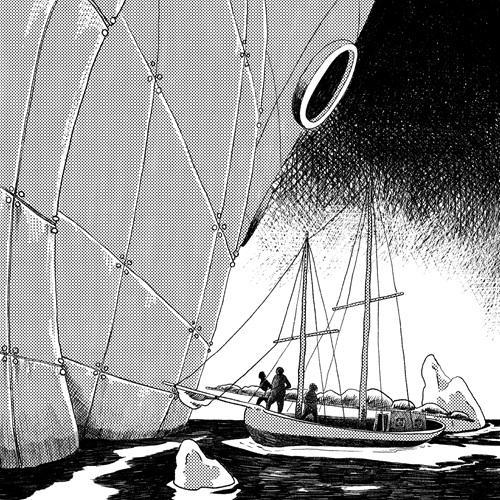
Something broke the icy monotony of the ocean before them, a dot in the far distance. A ship? They moved towards it slowly, carried forward by an almost imperceptible current. The dot grew bigger as they came closer, until there could be no more doubt as to what it was. A ship, yes, but not an ordinary one: mountain of steel and armored portholes towering darkly against the horizon.
#
Crossing the Eye of Silence
The cold water of the Eye of Silence licked against the hull of the colossal ship as they drifted closer. Thekla looked up at the sky, wondering if the current would carry them there before nightfall. The days grew longer the closer they got to the pole, but they were not endless.
“What kind of ship is that?”
Yeshi shrugged. “Not a warship, anyway. I was at the port of Jongnang once; the armored cruisers look different. On the other hand, only the fleet of Nalang-Tso has ships of this size. Norsen, does a ship like that have oil on board?”
“Yes, of course.” Norsen’s eyes lit up for the first time since the calm began. “In the engine room.”
They waited as the current pulled them closer, as if the towering vessel exerted a gravity all of its own. Blue reflection glowed on the waves, making it look as if the ship were enthroned on a shimmering ice floe. Above them, the sky gradually darkened.
“It’s massive.” The flank of the ship rose like a wall before them, but up close it revealed itself not as smooth, but as a patchwork of gun ports, protruding armor plates, and heavy iron rings.
“Here, hold this.” Norsen pressed a rope into her hand, and Thekla gripped it gratefully. They moored the Kelsaung to the side of the massive vessel, then Thekla craned her neck to look up. Yeshi breathed into her hands and rubbed them together. “I grew up in the rim mountains. We climbed icy peaks for fun when I was twelve. Wait here.”
#
Thekla heaved herself over the railing and gasped as she finally felt solid ground beneath her feet again. Behind her, the rope ladder dangled down to the Kelsaung, which drifted deep below against the ship’s flank.
“I don’t understand this.” Norsen stood at the railing like a mountain guide before the remains of a shattered bridge. Snowflakes drifted around him over the main deck, which stretched away in both directions. “Where is the crew? Why is no one here?”
“I don’t know.” Thekla placed a hand on her satchel of poisons and dried herbs, her only possession from Nalang-Tso besides her amulet. Like Yeshi and Norsen, she belonged to the Khadroma caste, but her father had been the healer and poison-mixer of Pelksa, their home village amidst the high plateaus.
He had always explained to her that there was only one truth—that of the body—, and that no thought, however sharp, could overcome illness or infirmity. How wrong he had been!
“Something must have happened.”
Gun platforms and retractable boarding bridges loomed dark through the haze; snowdrifts covered cargo hatches and rolled-up nets. The ship was so vast and the sea so calm that for the first time in days, Thekla felt no movement under her feet, no swaying or pitching.
She unclasped the amulet from her neck and held it with both hands, a tablet of silver sheet metal as large as her palm. The icy air suddenly tasted sharper and spicier; the snow kicked up and circled Thekla. She slid the dull opals at the edge of the tablet back and forth, watching a pale brightness spread between them.
“What is that?” Yeshi stared at her, taking a step closer. “What is it good for?”
“I’m measuring the ship.” Thekla could feel it in her chest and bones. There was a dull vibration shuddering through the vessel, just at the edge of perception. She examined her amulet again and watched the first lines of a mandala emerge. “This ship isn’t abandoned.”
For a moment they exchanged glances, three silent figures surrounded by steel and crystal-powered lanterns swaying along the railing. Beyond, the sea stretched unto the horizon: cold, blue, and impenetrable.
“What now?” Thekla looked around as Yeshi slipped off to scout the deck. “Norsen, how do we get to the engine room? You are a smith, you know these things.”
“A smith, not a sailor.” Norsen huffed. “But one need not be either to answer your question. The engine room is somewhere at the aft end; the screw ends at the motor. There must be direct access, a stair or ladder.”
Yeshi nodded as if she had just had the same idea. “At the aft end?”
“Somewhere at the back of the ship.” They watched Yeshi disappear in the distance between the superstructures. “This is the largest ship I have ever seen, but the basic mechanics must be the same.”
Yeshi came trotting back through the sporadically drifting snow. “There are doors, but they are barricaded and barred. Steel, absolutely nothing to be done. Is there another way in? Norsen?”
“Possibly…” Helplessness returned to the Norsen’s face for a moment. “Maybe from one of the lower levels?”
#
Thekla flinched as her skin stuck to the handrail and peeled away painfully. Her two companions climbed down ahead of her, following the steep spiral of the stairs as effortlessly as if they had walked the path a thousand times. The vibration—the noise?—was ever present in the back of her mind, just low enough to prevent her from locating it.
“Stay close behind me.” Yeshi reached the foot of the stairs and pulled out two crystal torches that flared blue. She moved forward in a crouch, muscles tensed, ready to attack at any moment.
Lanterns dangled from the ceiling, flooding the corridors with sterile brightness. For a moment, Thekla felt transported back to the monastery-fortress, where shadows were always in motion and mummified abbots stared down from alcoves.
Master Yongten had fixed her with his yellow eyes and dug effortlessly into her thoughts. The pain had made her skull resonate like a gong, and Thekla had fallen to her knees before him.
“You think of your freedom, of the time before you came here. Thekla, you don’t understand. There is no time before the monastery-fortress; there is no outside. This place is like a mandala; it has no beginning and no end. Born from the deep, grown in the void, returned to the deep.”
Thekla rubbed her eyes to bring herself back to the ship’s corridor, bare metal and clinking cold, illuminated at irregular intervals. This vessel was as inhospitable as the monastery-fortress.
The deeper they went, the more noises filled the corridor. Prayer wheels rattled erratically in wall niches, and Thekla saw that the bronze cylinders were covered in tiny script.
“What do the wheels pray for?” She was well familiar with prayers wheels from the monastery-fortress, and they always had a purpose. “Calm seas and safe passage?”
“Hmm.” Norsen brought one of the wheels to a clattering halt. He ran his finger over the characters and grunted. “Not passage. The prayer wheel asks for forgiveness.”
“This ship is endless.” Yeshi peered into a vertical shaft that opened before them, spanned by a catwalk. “Look at this.”
She dropped one of her torches into the depths, and Thekla watched the light race down the walls. Five stories, six, seven, eight. The ship must be massive, a labyrinth of claustrophobic corridors and halls.
“Do you hear that?” Thekla placed her foot on the catwalk and took a step forward. The shaft vibrated like a gigantic meditation bowl; the walkway held the humming tone and amplified it with every second until the air itself began to tremble.
Outside, it must be getting dark, but here in the ship’s bowels, time stood as still as the air.
“This isn’t a warship.” Yeshi followed a bend and stopped. “It’s .”
Thekla and Norsen peered around the corner. Narrow cells lined the corridor, each barred with welded iron rods. Thekla saw huddled bodies, thin arms and legs white with frost.
The prisoners were dead from exposure, but they had been alive recently. Thekla could still sense an echo behind the blind eyeballs, a dull humming trapped inside their skull cavities.
Norsen rattled one of the cell doors, then looked around. A key ring hung on the wall, and someone had left jugs of water on the floor, now frozen solid. “Why is no one here? The prisoners, yes, but what about the guards? What about the crew?”
“Not here.” Yeshi shrugged. “They shut everything down, locked the doors, and took off. These poor bastards died because they couldn’t get out of their cells. A pathetic death.”
Thekla touched her temple as another wave of memory overcame her.
Master Yongten’s yellow eyes filled her field of vision, flickering as erratically as the lamps in the fortress catacombs: “He-Who-Cannot-Be-Looked-Upon does not rest in a vault or inside a crystal. You can march out of this fortress, but you cannot leave him behind.”
“Thekla?” Yeshi’s words broke the spell of the yellow eyes. “Are these the people you sensed?”
Thekla pulled out her amulet and glanced briefly at the increasingly complex web of blue lines and circles. The opals shimmered with a pale brightness spreading along the pattern. “No. What I sensed is deeper in the ship, several decks below us.”
Yeshi leaned over the amulet. “More prisoners? Or is it the guards? I have no idea how you see anything there.”
“It is complicated. We were trained in the monastery to interpret these patterns.”
“Patterns, well.” Yeshi frowned and turned to Norsen. “Some cells are open and empty, but that doesn’t mean anything. Maybe they were empty from the start.”
“I can’t say.” Thekla tried to penetrate the mandala and untangle its lines, but everything blurred before her eyes.
“We should eat. We’ve been wandering these halls for hours; we are all exhausted.”
“Hours?” Thekla thought back briefly to the start of their descent.
Yeshi and Norsen gathered wool blankets from a side room and kindled a fire that illuminated the corridor. Yeshi fried strips of meat she had cut from the dead prisoners, a typical practice of the armies of Nalang-Tso.
Victory nourishes the soldier. Yeshi had noticed Thekla’s gaze and held out a fried strip of meat. “You look pale, Thekla. Eat.”
#
Beyond the portholes, stars glittered coldly in the blackness of the night sea, like impurities in a mirror of polished obsidian. Thekla tore herself away with difficulty and followed her companions through the corridors.
Out on the sea, she would have given anything to escape the water-wasteland with its terrifying monotony: yet in this maze of corridors, she almost wished herself back there.
The prayer wheels clattered in their niches; the footsteps of the three refugees echoed along the walls. The mandala on Thekla’s amulet grew more complex with every step, letting threads of light merge, knot, or spiral around each other.
“What’s that?” Yeshi shifted her weight and looked around. A snowdrift had formed under one of the open grates, glowing in the reflection of the lamps like a dome of tinted glass. “Footprints.”
Before Thekla could answer, something moved at the end of the hall. A figure scurried past, and Yeshi sprang forward as if from nowhere. She grabbed the figure by the shoulder and catapulted it to the ground.
“Yeshi!” Norsen took a step forward indecisively as Yeshi rolled over the floor with the stranger. Yeshi struck multiple times, then suddenly sat on the man’s chest, pinning him down.
“Don’t move.” Thekla pressed her elbow against the stranger’s throat and pushed him down. “Where’s the crew?”
“I don’t know.” The man wheezed as Yeshi increased the pressure. “Please, I was in my cell, I don’t know.”
“Cell? Yeshi, let him go.” Thekla studied the man as Yeshi withdrew her elbow. “What does that mean?”
“I was a prisoner.” The stranger coughed and rubbed his neck. “We were herded into the ship. Since then we haven’t seen daylight. I don’t know how long we were underway, but suddenly the ship stopped, and the guards all disappeared.”
Yeshi shook her head. “Then why are you running through the corridors? Who let you out?”
“I picked the lock. I’m good with mechanical things; it was just a matter of time.”
“How did you become a prisoner?”
“I deserted. The armies of Nalang-Tso called for me, and I ran. And then, they caught me.”
Thekla stared at the prisoner on the floor, then at the amulet in her hand. The mandala had become more complex; the soft shimmer of the opals had intensified. In the lines of blue light, Thekla could read the corridors, the maze of the prison hulk. The man before them was not the only one left alive.
“Okay.” Yeshi straightened up and patted dust from her clothes. “Let’s say that’s true. You must have heard something, some conversation among the guards, even a rumor.”
“Only very little, only on the fringe.”
Yeshi bared her filed teeth. “What did you hear? If you are useless to us, I might just as well break your neck.”
Thekla knew of the cruelty of the armies of Nalang-Tso; she had witnessed parts of the training in the monastery-fortress herself. But did Yeshi have to exert so much pressure?
“They talked of the Eye of Silence, of a price and a pact. Is that where we are? The guards spoke of it as the outermost border of Nalang-Tso.”
Thekla probed the man’s thoughts and saw marching soldiers with sickle-swords, heard the stomp of their boots on cold metal. Fear scurried like a shadow through the cell block; another prisoner whimpered. She felt numbness, felt the roll of waves and the ice grinding against the hull of the prison hulk. Were these the man’s memories?
“One of the other prisoners asked that too. The guards said that everything has a price, nothing is free. Then, they laughed.”
Yeshi bared her teeth and slapped the man, almost casually. “Nalang-Tso lies to the east, freedom to the west. If we find oil for our generator, we can escape the calm.”
“Oil?”
Norsen stomped toward him. “Do you know how to reach the engine room?”
“To the engine room…” The prisoner scrambled up, his neck swollen and blue. “My name is Kundun, and I thank you for my rescue. If I help you find your oil, will you take me with you?”
Norsen exchanged a glance with Yeshi and Thekla. Would a prisoner even know how to find the engine room? How could they trust this man they just met?
“First, you help us.” Yeshi slapped the man again, harder. “Then, we’ll see. Do you know the way, or not?”
“Yes.” Kundun winced. “Come, let me be your guide. I talked to a dead man, he had been there. If you want to see the engines, we have to cross the lower prison decks.”
#
In the depths of the prison hulk, the air became stuffy and stale, but also warmer. Thekla shuddered at the thought of the rolling waves underneath, at the emptiness of the horizon in all directions. This place was not made for humans, that much was clear.
They rushed through the corridors and passed under support struts humming with residual energy. Catwalks bridged bottomless connecting shafts, and the darkness seemed to sing beneath them.
“This piping makes no sense,” Norsen grumbled, running a hand along a bulkhead where five pipes twisted into a knot before disappearing into the floor. “These aren’t hydraulics. They aren’t fuel lines. What machine needs this much circulation?”
“Careful.” Yeshi stretched out her arms and signaled them to proceed carefully. “I hear noises in the distance, human noises.”
They reached another cell block, but it was different from the previous one. The prisoners did not lie frozen on their beds; they crouched alive against the walls or curled up under blankets.
One of the prisoners dragged himself to the cell door, clinging to the bars: “Let us out. We are freezing, we have no food and no water. Please, we are cold to the bone.”
“Why are you here?”
“The caught us. They came to our villages and they caught us, herded us, put us in chains.” The prayer wheels joined the whimpering and wailing of the prisoners in a cacophony Thekla could hardly bear.
“Did you break the law?” Thekla watched them crowd behind the bars, shivering in their rags. “Why did they imprison you?”
“We didn’t. Please, believe us, we did nothing wrong. They came and they caught us, and then they drove us across the mountains and over the hills, and finally to the coast and into the belly of this prison of steel. Will you help us?”
“You shouldn’t be here.” Another voice rose from the neighboring cell, so weak and brittle that Thekla only really heard it the second time. “You don’t belong here.”
“Who said that?” Yeshi spun around, suddenly holding a knife. “Who?”
“That was me.” All eyes turned to one of the cells and a bundle of old monk’s robes, a face protruding from underneath. Wrinkled, weathered, eyes milky in the lamplight falling through the bars. “Why are you here? I was a monk; I studied in Jongnang. I was initiated into the secrets of the mountains and the sea, into the darkness and the light beneath the waves. I recognize an initiated one.”
Norsen frowned. “And why are you here? How does one go from monk to prisoner?”
“I’m old; the years weigh on me. My time has come; I know my path. But you,” he turned to Thekla, “initiated one, you are young and free. You don’t belong here, neither you nor your companions. If you stay, you will die.” The old monk coughed, and something red glittered on the back of his hand. “The Eye of Silence, it is not of natural origin. No fleet can cross the Eye of Silence, no prisoner escape through it.”
“What are you talking about?” Yeshi stared at him with wide eyes. “Can you help us or not?”
“I can describe the way, but you must hurry. This ship has rested too long already; you don’t have much time left.”
Thekla could suddenly feel the movement of the sea, even through all the tween-decks and outer hulls.
“The Eye of Silence prevents anyone from escaping Nalang-Tso. The pole is an uninhabited wasteland, but without wind and without ports, no one can reach its other side. You will feel it yourself, just wait.” Lanterns swayed squeaking from protruding metal struts, bathing the monk’s face in cool brightness. “This place is as deeply rooted in us as the monastery-fortress; it is one and the same. You are trapped here as you are there; you are completely free here as you are there. The only difference between you and me is age; and that is also the only difference between the monastery-fortress and the Eye of Silence.”
Thekla had lost the thread, but in a strange way, it even made sense. The monastery and this ship had almost nothing in common, yet they still threatened to merge in her thoughts.
#
A hall opened before them, an enormous vault of oil-smeared walls and support struts. Floodlights were filtered through several levels of grates and catwalks, coating the floor in a thicket of light and shadow.
Thekla saw the enormous sarcophagi of the first abbots of the monastery-fortress, the howling well-shafts leading like open mouths beside them into the abyss.
She blinked. There were no sarcophagi, only the ship’s propulsion systems, towers of metal turbines and pumps at the other end of the room. But something wasn’t right with them, their edges were jagged like wounds, with parts and pieces sticking out or strewn across the floor.
“Norsen, where is the oil?” Thekla forced herself to see the engine room and not the monastery catacombs.
Norsen almost disappeared in the twilight of the engine room, tiny compared to the dimensions of the hall. “There must be a steel cabinet somewhere. Over there.”
“Excellent.” Yeshi followed him with quick steps, as if she were about to pounce.
“The engine is completely destroyed.” Norsen tapped against pipes and gears that either stood still or were twisted out of their sockets. “I’m no ship mechanic, but I don’t think this can be repaired.”
Somewhere a machine thumped, a last spark of life from the drive. “I still don’t understand.” Thekla listened to the humming tone of a meditation bowl. “Why did the crew leave the ship?”
“It doesn’t matter.” Yeshi danced restlessly from one foot to the other. “Is the cabinet open, Norsen?”
“Yes. The oil is here. Help me get the canister, quickly.”
The ship shuddered. For a moment, Thekla saw stone dust and debris raining down and heard the great gong of the monastery-fortress. What had happened? The floor trembled again under her feet; somewhere in the distance, overstretched metal groaned.
“What was that?” Yeshi looked around, ears pricked.
Metal shrieked, then a jolt went through the ship.
The eyes of Kundun, the deserter, were wide and white. “We ran aground. Just like the last transport. I knew it. The cargo never makes it.”
“How can we run aground in the middle of the ocean? On a ship that isn’t moving?”
Something changed in the atmosphere of the hall. The floor tilted to the side, the walls swayed. From deep below, a grating sound rose through the decks. Suddenly, a smell of salt and icy water hung in the air.
Thekla pulled out her amulet and stared at the mandala, whose blue lines arched and changed before her eyes.
The prayer wheels turned around Thekla; the vibrations of the shafts pulled her in all directions. She saw Yongten’s yellow eyes and the halls of the monastery-fortress; she saw the blades of crystal and the empty eye sockets of the mummified abbots.
The Eye of Silence hummed around the ship; the smooth water rippled and foamed. Something moved in the deep.
#
They ran down the corridor, Thekla in the lead, the others close behind. Somewhere in the distance, she heard the gurgling of water.
“This way.” She barely had time to consult the amulet with the mandala; she relied on her memory and directed the others. She passed an intersection and faltered when she saw the corridor on her right side, a ramp leading downward.
Water licked with dark tongues across the metal floor, hardly more than a puddle spreading with frantic heartbeats. A surge washed around a distant bend. Two tongues of water ran into each other and became one. A larger wave broke against the wall and ran foaming down the hall.
“Thekla, we have to move!”
“Yes.” She chose the corridor that emptied into a stairwell. The sight of the water almost paralyzed her; it reminded her of the vastness and depth of the sea and the fact that she couldn’t swim. “This way.”
The steps echoed metallically under their feet and vibrated as they rushed upward. What could have happened for water to penetrate the ship? Had they rammed an iceberg? But the current was far too weak, and the giant propellers stood still.
Norsen dragged the large oil canister with him. “Norsen, how long do you need to start the Kelsaung?”
“Not long.” The burly smith panted under the weight of the full canister. “I just have to refill the oil and crank the generator.”
“Good. I’ll get us to the upper deck; the rest is your job.” Thekla allowed herself a glimmer of hope. “We can make it. We can escape Nalang-Tso.”
“Thekla.” Yeshi grabbed her roughly by the arm and brought her to a halt. They had to be at the outer hull of the massive ship, as there were portholes in the wall to their right. “Look out the window.”
The sea around the prison hulk glowed, and this time it was not merely a reflection of its lamps. Deep in the darkness under the waves, something lit up. Thekla’s heartbeat accelerated.
“Where to now?” Norsen looked around helplessly as they reached the end of the hall and a locked door. He pulled at the wheel lock, but though his muscles bulged, it didn’t move at all. “Thekla, you know the way, right? You aren’t leading us astray?”
“This door is sealed.” Kundun’s voice dripped with fear, and Thekla couldn’t blame him.
Yeshi put away her knife and rubbed her hands together. “Norsen, Kundun, we try together. On three. One. Two. Three.” They pulled at the wheel and groaned, but without success. “Impossible. We aren’t getting through here.”
Thekla didn’t understand. Why were they standing before a locked door? She had walked this path a hundred times, from her chamber through the ambulatories to the inner courtyards of the monastery-fortress. The monastery-fortress? No! That was all wrong; they were not in the monastery-fortress. Master Yongten laughed his hoarse, rattling laugh in the distance, his yellowed fingers curved into claws.
“I thought that was the way. I… I must have been mistaken. My amulet showed me the way, but it was wrong.”
“We must go back down.” Yeshi wasted no time. “Stay close behind me.”
“I can guide us, I just have to study the map.” Thekla looked at the blue-glowing mandala, which almost blurred before her with its intertwined lines. She had seen this pattern before, hadn’t she?
“Enough!” Yeshi’s arm shot out and knocked the amulet from Thekla’s hand so that it landed clattering on the floor. “That’s just a disk of silver; there is nothing to read there! We have to get out of here!”
Norsen took a step and planted himself between Thekla and Yeshi, his muscular arms crossed over his chest. “Stop it. Thekla, do you know the way? Or is Yeshi right?”
Thekla stared at the amulet lying on the floor before her, a blank disk without light or lines. She picked it up, turned it, rubbed her hands over the opals embedded in the rim. Had she just imagined the mandala? Or had Yeshi destroyed it?
“We have no more time.” Yeshi stepped impatiently from one foot to the other, a bundle of aggressive energy. “This way is blocked, and if we want to get to the ship’s upper deck, we have to go back down first. To where the water is.”
“She’s right.” Kundun started moving behind Yeshi.
Thekla looked around, searching for an answer. What choice did they have? The howling of the prayer wheels swelled; the humming of the shafts whined in her ears. If she closed her eyes, she saw the monastery-fortress and smelled the incense drafting through the halls.
With quick steps, Thekla caught up to her companions and hurried down the stairs.
#
The water was now more than ankle-deep and rushed through the entire length of the corridor. The splashing steps of the four fugitives wandered as echoes along the walls, just as their gasping breaths filled the air.
They ran back to the cell block they had passed earlier. The water was higher here, swirling around the legs of the prisoners who still clung to the bars of their cells.
“Help us! The water is rising! Don’t leave us!”
But something else was rising with the water.
A prisoner staggered out of his open cell ran off through the flood. Behind him, stepping from the shadows of the cell, was a figure that made Thekla freeze.
It stood there with pale skin and black armor growing up its body like a coral reef, extending with bony outgrowths over the forehead. Translucent webbing spanned between long fingers; yellow eyes glowed in the twilight of the corridor.
“What the hell is that?” Kundun backed away, pressing himself against the cold metal wall.
Thekla stared. The figure’s eyes were familiar. They were the same shape, the same milky-yellow as the old monk’s. But the monk was gone. In his place stood a creature of coral and bone.
“We can sense you,” the creature said. Its voice was wet, gurgling, as if its throat were filled with seawater. “We know who you are. You are here too early, but we can help you.”
“Help me?” Thekla had no idea what the creature was talking about.
“We need to reach the upper deck.” Yeshi ignored Thekla’s questions and the stranger’s words. She stepped forward, knife raised. “We don’t want trouble.”
“You have a strong will. We can use you. And you,” the stranger turned back to Thekla, “you are one of us.”
“What?” How could this figure claim such a thing? And with such self-assurance, as if it were the most ordinary thing in the world.
“Your soul is scarred. You are trapped in your memory. Nalang-Tso won’t let you leave.” The figure wound through the shadows like a snake. “We can loosen your chains. Come with us. A miracle waits for you. You’ll see how it all begins. From blood comes a core of crystal, from crystal grows flesh.”
As the creature spoke, its face shifted. A plate of black chitin cracked and fell from its cheek, revealing raw, pulsating muscle underneath that hardened into fresh coral. Its fingers elongated, the nails dropping into the water with soft plips, replaced by sharp, translucent spurs.
“The children are large and hungry,” the creature gurgled. “In a few months, another ship will come, quite similar to this one. A mobile shrine. A litter of steel to carry the food to the deep. The children will board and begin their journey into the void, into the realm of stone and prayer wheels. They’ll grow there, they’ll learn, and then they’ll return to their home, the cold-glowing deep.”
Nausea overcame Thekla; she leaned against a wall. “That makes no sense. I was born in Pelksa, high in the mountains; I grew up with my father and mother.”
“You don’t understand.” The creature’s eyes glowed just as yellow as Master Yongten’s; they drilled deep into Thekla’s soul. “You never lived in that place. You have no father; there is no village healer. Your memory is not real, merely a dream. You were born here, in the Eye of Silence. You were hatched, you grew and were collected in a ship with sanctified tanks, a litter of crystal and steel. Before the monastery-fortress, you had no life; in the monastery-fortress, you were a candidate. Today, you reach the next stage of your journey, whether you want to or not.”
The creature unhinged its jaws to reveal rows of needle-sharp teeth. “He-Who-Cannot-Be-Looked-Upon does not wait in a temple. He waits in the trench.”
“I become one of you? If I come with you, will I be covered in these things? Why should I want that? Why should I believe you?”
“The coral waits for the bone,” the creature said. “The water remembers the shape of your lungs better than the air does.”
“I have spent enough years in the shadow.” The corridors of the monastery-fortress and the corridors of the prison hulk merged again, a sea of blue haze and shadow. “I want no more of it. I wanted to leave Nalang-Tso, and I don’t want to trade it for some ocean abyss.”
“You’ve crossed the shadows. The light in the deep waits for you. There, where towers screw themselves up from the trenches of the deep sea, where pools of white stone reflect into one another. Not even the stars are as blinding as the realm beneath the Eye of Silence.”
“No.” Thekla looked around for an exit, peering down the cell block in both directions. “Not me.”
#
Yeshi didn’t wait. With a reckless shout, she lunged, driving her knife toward the creature’s chest.
“Yeshi, no!” Thekla screamed.
The creature didn’t even flinch. It caught Yeshi’s wrist mid-air with a sound like snapping dry wood. It lifted Yeshi without effort, her feet kicking uselessly above the water.
“You attack the inevitable,” the creature said, almost sadly. “You strike at the tide.”
It squeezed. Yeshi screamed as the coral spurs on the creature’s hand drove through her arm. Then, with a fluid motion, it slammed her against the bulkhead. Thekla heard the sickening crack of bone on metal. Yeshi slid down the wall and vanished into the rising black water.
“Run!” Norsen bellowed, shoving Thekla toward the stairs.
Thekla didn’t look back. She scrambled up the metal steps, slipping on slime and water, her breath coming in ragged gasps. Norsen and Kundun were right behind her.
They burst onto the upper deck into a storm of ice and wind. The ship was listing heavily now, the stern already swallowed by the sea.
“Thekla!” Kundun shouted over the roar of the wind. “The boat! We have to jump!”
They ran to the railing. The Kelsaung bobbed violently below, tethered to the sinking giant.
“Jump!” Norsen yelled.
Thekla leaped. The cold air rushed past her, and then the shocking, freezing impact of the water. She went under, deep into the dark.
She opened her eyes in the stinging salt. Below her, the massive prison hulk drifted down into the abyss, illuminated by the bioluminescent glow of thousands of creatures rising to meet it. It was a city of lights down there, a spiral of towers and impossible geometries.
And then, the amulet floated past her face. It had torn loose in the fall. As it sank, the opals flared with a blinding blue light. The mandala upon it shifted, resolving into a clear, sharp map. It didn’t show the ship. It showed the trench below. It showed the path home.
Thekla stared at it. She saw the route to the city of light. She saw the place where she belonged.
She reached out her hand.
Then she closed her fist and turned away. She kicked upward, toward the brutal, empty cold of the surface.
She broke the water, gasping for air that burned her lungs. Norsen hauled her into the boat. Kundun was already there, shivering violently.
“What about Yeshi?” Norsen asked, his voice hollow.
“She’s gone,” Thekla rasped. “Start the engine.”
Norsen worked the motor until it sputtered, coughed, and roared to life. They sped away from the suction of the dying ship, riding the waves toward the empty horizon.
#
The Eye of Silence opened before them. The monotonous blue gave way to turquoise waves and drifting clouds. For the first time in a long while, the sun brought warmth and drove away the frost that sat deep in their bones.
“What will you do when we arrive?” Kundun dipped a hand in the water and watched it draw a line through the sea. Schools of fish flitted beneath the surface. Soon, land would come into sight, the coast of a new world.
Thekla stared across the sea. The sun felt hot and abrasive on her skin. The air tasted thin and dry.
She looked ahead at the unknown coast. It was not home. It never would be. She was a creature of the void between worlds now, a survivor of a silence she could never truly leave.
Land was in sight, and for the first time in her life, it would not be the land of Nalang-Tso.
________________________________________
Dennis Mombauer lives in Colombo, Sri Lanka, where he works
for a non-profit think tank on climate change (https://www.slycantrust.org/). As a writer, he has
more than 100 short story publications in various magazines and anthologies in English, German,
and in translation. His English debut novella “The House of Drought” was published in 2022 by
Stelliform Press and became a finalist for the World Fantasy Award in 2023. His novel “The
Fertile Clay” is scheduled for publication with JournalStone Publishing in 2026.
Miguel Santos is a freelance illustrator and maker of Comics living in Portugal. His artwork has appeared in numerous issues of Heroic Fantasy Quarterly, as well as in the Heroic Fantasy Quarterly Best-of Volume 2. More of his work can be seen at his online portfolio and his instagram.
Karen Menzel earned an MFA in Creative Writing: Popular Fiction from the University of Southern Maine. She teaches and mentors students at Iowa State University and Western Technical College. She serves as the Assistant Editor of the Pseuodopod Horror Podcast Magazine. She is the 2016 recipient of the Horror Writers Association Mary Wollstonecraft Shelley Scholarship. Her poems, short stories and novellas appear in more than 40 publications and her first novel, SWIFT FOR THE SUN, debuted from Dreamspinner Press in 2017.
Advertisement