AIN’T NO HONOR
AIN’T NO HONOR, by James D. Mills, artwork by Miguel Santos
Outside, men snarled and cursed and loosed their swords, blades singing as they scraped free of their scabbards. Cramped and cramping in the privy behind the farmhouse, Tarmun the Roach had just loosed his bowels, his sweaty shoulders pressed against the walls of a dark, malodorous wooden box that was far too similar to a coffin.
The Valentines had found him, but his guts had yet to dismiss him. He had known last night’s pork was spent; Quick Jon insisted it was fine. Like always, the bloody fools he found himself fighting beside heeded not his counsel. Neither did he, for that matter, which is what had landed him in this mess in the first.
Tarmun caught the woody scent of burning thatch. The shouting grew louder, more furious, as did the crash of steel ringing through the night. Thank the Mother for his ears, even amid the tumult he heard the guileful footsteps padding up to the outhouse.
The Valentines meant to butcher him with his pants down. A nasty way to go, but with a name like his could he expect anything else?
“Ain’t no bloody honor in this world…” Tarmun whispered, his gut still groaning as he rose. Leaning on his greatsword like a walking stick, he struggled to yank his foot free of his trousers, mussed up in a pile on the dirt floor. His iron-clad boot tore the linen pant leg on its way out, like swallowing the gristle of a bloodshot cut of mutton.
His attackers formed a ring round the privy, only the faintest jingle of chainmail, the crank of a distant crossbow, gave away their presence. Any other man might have fallen for their ambush, dead before he knew to find his feet.
Not Tarmun, thank the Mother for his ears, he would die standing.
Tarmun held no resentment toward the Valentines’ sick trickery; he had himself committed countless unsavory acts in the interest of staying alive. He had been fleeing his black reputation since the day he stepped foot in the Far South, and bastards everywhere sought to claim King Lazlo’s bounty. An equally black reckoning was bound to find him eventually.
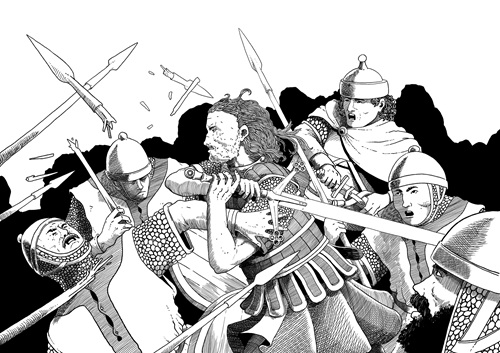
Rusty hinges sighed as a soldier wrapped his fingers round the cracked door handle. Tarmun roared, kicked the door free and knocked the soldier on his back. Tarmun leapt on the door, squishing the poor bastard beneath his boulder-like bulk.
Brandishing his greatsword, Redquill, near as long as Tarmun was tall, he was confronted by five spearmen, all lightly armored with dented iron helms, rusted chain shirts, and tattered tabards sporting the black and crimson standard of the Golden City of Valencia. Their hands quivered round the hafts of their weapons as they exchanged worried glances.
“Don’t just stand there!” barked a red-faced officer standing seven paces back. He wore a gilded breastplate, its mirror finish scintillating in the glow of the burning farmhouse. “Kill the bloody bastard!”
Tarmun the Roach had made it through worse odds, but not by much.
A unified flurry of thrusting iron closed in on Tarmun. He veered his blade in a wide arc, batting away the spears, then heaved it overhead and wove it into a continuous, deadly oscillation. He lunged, carried by the momentum of his blade and freed the right most spearman of his legs.
Crimson sprayed as the soldier squealed, falling into rubrous mud.
The leftmost spearman drove his point into Tarmun’s side. Snatched by the layered plates lining his brigandine, it left only a shallow wound. Following his lead, the whole crew began thrusting in alternating succession at Tarmun’s naked thighs. He dropped his defensive spin low, close enough to shave raised hairs off his shins. For every blow thwarted, another found its prickling mark, piling flesh wound after flesh wound, all of which threatened a delayed death in a week’s time—assuming he would live to see tomorrow.
Tarmun raised his blade to its apex, feigning a rightward slash, reversing to cleave the left man’s collarbone. He bellowed, his deep northern baritone shaking the earth as he sent his boot—and billowing trousers, flying from his ankle—into the center spearman’s chest, splintering sternum and expelling all the wind from his lungs as if Tarmun had sat on the wheezing billows of a crumbling smithy.
He drove his blade through the man’s belly and threw him down, dead on his back. Eyes wide, anticipation coursing through Tarmun’s boiling veins, all worry of stomach cramps and soiled pork behind him. He flung Redquill to the side with crazed abandon, opening a bloody crevasse in the space between the fourth spearman’s shoulder and neck.
The last man stared and backed away, his bottom lip trembling. Dropping his spear, he turned tail and fled for the woods beyond the farm’s edge, leaving the officer cursing in his wake.
“If you want something done…” the officer said, hefting a massive arbalest, leveling the loaded quarrel at Tarmun’s chest.
Tarmun charged, blade forward.
Trigger clicked and bowstring thwacked.
Two paces away from cutting the noble prick in two, the quarrel slammed into Tarmun’s shoulder. Staggering for but a heartbeat, he fixed his mad gaze upon the officer, daring him to reload or draw his rapier.
He could have stuck Tarmun good, right then and there—and that would have been that. The prick could have gone home, claimed Lazlo’s bounty and lived in leisure for the rest of his days. Instead, he threw the arbalest into the mud and spun round to follow his subordinates into the fields.
Reputation is a hell of a thing.
Tarmun pointed his chin to the black, smoke-filled sky and let out a guttural laugh, then wheezed, blood spraying from the back of his throat. He fell on his back, slick mud licking his bare legs and exposed manhood.
Inky tendrils encroached upon his periphery, and the shadows cast by the evening seemed to quiver as if rapt onlookers trembled with glee at the sight of his death. His consciousness began to fade as his blood seeped into the loam beneath his heaving form. The earth drank of him, and a warm breeze chittered like a fell cachinnation from a line of rustling trees beyond the farm.
Head spinning, fatigued awareness at the edge of an empty dream, the last thing Tarmun saw was a shadowed form bent over him, laying cold fingers upon his lacerated thighs. He cried out as probing touch congealed to piercing grip and searing agony lanced through his tingling extremities…
* * *
Tarmun woke to groping hands and probing fingers exploring his waist, skittering up his sore ribs. He forced open his aching eyes against the light of the High Noon. A shadowed form hunched over him, swaying against the strobing rays. Howling, Tarmun twisted his shoulder and sent his left fist into his assailant’s chest.
“Ach—damn!” coughed a shrill, accented voice. “Easy, soldier! Didn’t know you were still with us.”
“I’m alive…” Tarmun said, grimacing as he struggled to sit up. The quarrel still protruded from his dominant shoulder. The dried, fouling blood beneath his brigandine crackled as his wounds reopened, weeping anew. Aside from excruciating pulses radiating to his fingertips, his arm was numb. “You were rifling through my pockets.”
The looter dropped Tarmun’s bourse and smiled meekly, showing a crooked, incomplete array of yellowed teeth. His tawny complexion marked him as hailing from Idraan, the far southern City of Another World, whose sorcerous arrival atop the ancient imperial capital leveled the Baltairan Empire in an instant. His face was splotched with patchy muck resembling tree bark, and he wore tattered rags beneath a crimson habit, sleeves battered and torn.
“I already told you, syr. Didn’t know you lived.”
“I’m no knight.” Tarmun glanced at his bum arm.
“Need to get that seen to, syr-not-syr. A cadre of Valentine healers just passed through this morn. We might catch them—”
“No. Not Valentines. Price on my head.” Tarmun groaned, reclaiming his sore feet.
Looking toward his exposed crotch, the looter’s eyes glittered; his expression fell from rakish ease to one of concern. He thrust out his hand, hesitated, then offered his other one.
“I see. Name’s Ebir. I’m happy to see you to safety.”
“Happy to see me to the Gilded Dungeons, more like. I’ll manage on mine own.”
Eye still affixed below the belt, Ebir said, “Not in your sorry state, you’re not.”
“Hell you lookin’ at?”
“Nothing, nothing!”
Tarmun ventured a glance southward. Blood rilled down his legs, pain radiating and pulsing, centralized on a circular patch of flesh missing above his knee. “You did this? Branded me a slave, did you?”
“No—not me!” Ebir yelped, nimbly strafing away from Tarmun’s clumsy swipes. “This be the mark of the Walking God… ‘tis a fell omen, soldier. I insist you accompany back to my brothers’ camp. We walk in His footsteps, now.”
Tarmun had a mind to crush the spindly bastard’s skull, if only he could get hold of him. Alas, he had no chance in his sorry state—at once, Tarmun was beset by a spell of vertigo and nearly fell right back on his ass. Ebir steadied him, handing him a Valentine spear to lean upon.
The farm was a ruin, corpses in every direction; Valentines and Wystrans alike. The house had been reduced to naught but scorched timber and a great pile of ashes, as was the vast field of wheat that would have fed his company for the battles to come.
“Any sign of my kinsmen?”
“Yours was the only body I found spared by the flames.” Ebir pointed to the horizon. “I did find a trail of heavy bootprints headed the other way. But soldier, I beg you come with me.”
“I must regroup with my troupe…” Tarmun patted the ground at his right side, then glared at the priest. “Where’s my sword?”
Ebir made a show of swinging his head around and shrugged. “What’s it look like?”
“A greatsword, taller than you. Forged in the fires of Castle Morose and sharp enough to shave you bald.”
“If what you say is true, one of my brothers likely nicked it ere you woke. Castle steel is a most precious prize for those of my brotherhood.”
“Suppose I’m coming with you, after all,” Tarmun sighed, rubbing his aching eyes. “T’was me Da’s blade. Can’t be losing it to a gaggle of carpetbaggers. You can tell me of this Walking God on the way—a strange bloody God he must be.”
“Good! We’ve made camp not far from here… though, you might wish to don your trousers.”
Tarmun looked down, cursed, and painfully fumbled into his pants.
* * *
They trudged through the humid plains. The terrain was barren and trees were sparse, scattered with the thin boles of poplars, red maples and the occasional solitary neems with their rounded tops. Tarmun’s northern blood boiled in the southerly sun, bearing down through the meager canopy. The sky blazed pale cerulean, vibrant ochre broiling beneath the surface.
“When we arrive at the camp, my brothers will determine what’s to become of you.” Ebir said sometime into their trek. “I have not the experience, nor the wisdom, to speculate upon the Walking God’s intent.”
“Am I your prisoner, then?”
“I gave you a spear, did I not? No matter where you wander, The Walking God shall find you—the brand upon your leg is a troublesome thing, a trail you can neither prolong nor escape. T’was fate which lead me to you—so I’m your best chance of survival.”
Tarmun winced through a hot flash, sweat bursting across his body, the brand smoldering like an ember left smoldering in furs. He yearned to again behold the glittering snows powdering the Wyse, desired above all else to return to his mountain home in the Shins, where he might live out his days in peaceful solitude. Mayhap he would take a wife, should a willing woman one day appear to him.
“Never once have I sought to escape fate.”
A half-hearted smile danced across Ebir’s face. “That attitude shall serve you well, friend. I see now why you Wystrans pollute our lands like pests in a gutter.”
“Aye.” Tarmun shook his head. “That we do.”
His war was far from over; the Valentines still sought to throttle the lifeblood from the heart of his people. Cull them, bow them like the most stubborn dogwood. Wystrans were meant to stand tall, and like dogwood, would rather break than bend.
Until the Valentines acknowledged Wystra’s legitimacy, Tarmun would remain in the southern climes, with all its sunkissed flesh and unholy furnace heat. Three years had it been since he marched out of the gates of Castle Morose. He had long since accepted he might die beneath this blasted sun, had grown comfortable with the nightmares of his bloated corpse cooking on sandstone, picked to pieces by vultures whilst hungry, cuckolded crows watched on.
But Tarmun the Roach had not earned his name by accident, nor his black reputation. How many battles had he fought since marching south? How many times had he emerged battered and torn from the carrion fields to fight another day?
Too many. And this one might well be his last.
He ventured a glance at his shoulder, stuck with a massive quarrel meant to pierce the thickest mail, and winced at the wave of dull pain shimmering through his sword-arm, hanging slack at his side.
Tightening his grip round the haft of his salvaged spear, Tarmun took heart that he still possessed a sharp edge—he could still take matters in his own hands, if need be. And would that not be a tale for the skalds! The Bleeding Roach, ended finally by his own hand. He barked a laugh and shook his head, a swill sloshing between his eyes.
The day wore on, and after far too many hours the sun gradually began to meander toward the horizon, wavering with mirage. Shadows crept from the trees, stretching and distorting with every minute passed. Darkness took its time to swallow the land, as if Dusk had placed them on her divine tongue and had yet to seal her lips.
A baleful wail resounded in the distance, ripping through the air like spent, blunted razors. Tarmun slipped down a rocky incline and snapped his spear as he thrust it into a root to slow his fall. Evening birdsong ceased. Even the wind had lost its breath. Tarmun cursed, sitting upright as Ebir deftly descended the hill.
“What was that?”
“Dark spirits, soldier,” Ebir murmured, his eyes feverish. “Drawn to the waking world by the slaughter. Come, we must reach camp ere nightfall.”
Tarmun shivered, no stranger to the uncanny happenings of unseen realms. “You know this for truth?”
“Aye. Few scavengers in these plains interested in charred meat. Nor am I surprised at the underworld’s stirrings given the Walking God’s presence—His blatant interference.”
They continued onward, the evening sun making an oven of the plains. Tarmun struggled to breathe the heady air, swatting at ceaseless bloodflies with his working hand. A haze spilled upon him, and he found every step a teetering challenge. Even as the day cooled to night, he was drenched in sweat and consumed by unquenchable thirst. Cresting a hill, the jagged silhouette of the camp finally came into view.
The carpetbaggers had erected a haphazard shantytown in a clearing of bowed, brown grasses that crunched underfoot. Leaning tents of stitched-together canvas sacks and torn standards cloistered together with no particular pattern, their scrap wood frames groaning against the meager of winds. Piles of weapons, armor, rations—anything an army might need—were arranged in chaotic groups beneath a makeshift awning, sorted by some eccentric parameter known only to the fervid mind of a battlefield looter. A shiver rolled down Tarmun spine as he spied familiar bearded axes and pattern-welded swords, notched with use—his kinsmen’s runic initials carved into the blades. Quick Jon’s massive long axe lay among them; had he survived the blaze?
Men dressed in the same crimson habits as Ebir gathered round a bonfire fueled by fractured wagon wheels and snapped spear shafts. Their faces were gaunt, features sunken to the point their cheek bones jutted farther than their noses. They spoke in hushed, rapid tones.
“Brothers!” Ebir raised his arms. “I’ve brought a man awaiting trial—The Walking God has marked him for death.”
They turned and regarded Tarmun as one, then retreated into a secretive huddle, incomprehensible whispers crescendoed as conversation morphed to discourse.
“Marked me for death?” Tarmun laughed. “I was already rotting when you found me!”
“Quiet, soldier. Let them discuss.”
Finally, the men emerged to greet Ebir, not daring to cast a glance at Tarmun. The oldest of the red-robed priests stood back, and now that he was on his own, Tarmun saw he leaned upon Redquill.
“The northman bears the mark,” declared the old man. “His presence shall bring us naught but grief. Whether it be Valentines or dark spirits encroaching upon us.”
“I’ve walked with him,” Ebir said. “He should be allowed to face his trial on his own feet.”
“You are a fool!”
“Just return my sword,” Tarmun pointed at the old man, who knitted his brow and tightened his hold on Redquill’s hilt, “and I’ll be on my way.”
“I shan’t give you tar, invader. You have been judged—now, be gone!”
Tarmun seethed, sucking in a nauseating breath through flared nostrils. Ebir and his cohorts argued for a time in their native tongue.
“This man seeks only blood!” cried one of the priests, leveling an accusatory finger at Tarmun.
“Is it not our duty,” Ebir snapped his head to his doubtful compatriots. “To salvage all that’s wasted in battle? Supplies and gear, yes, but lives as well! Have you forgotten the Verse? Blessed are those who fall in service to another or by the motives of an enemy. Follow me and heal the wounded, for they have followed me to my sister’s bridge and returned. The dead and dying shall bear my mark to their graves.”
“He is the enemy!” said another. “Gods in Hell, brother! The Walking God never intended the Verse to become dogma.”
Ebir scoffed. “When has decency become dogma?”
“If you judge him worthy of our backing,” the old man said, a smirk peeled across his pockmarked cheeks. “He may prove it by taking up his precious blade.”
“Gladly,” Tarmun said, reaching out with his good hand.
“Father Risaad,” Ebir pleaded, his words flowing from his mouth with the desperation of a flooded river. “This man is battered enough as is! We can sort out specifics in the morning, once we’ve removed the bolt—”
“Do you not know who you’ve brought into our fold?” Father Risaad said. “This is the Bleeding Roach, who savages our people and our Valentine allies! He has led raid after raid on our villages, razed and pillaged our homes, burned our fields! I offer too much clemency as is—claim your sword, Roach!”
The old man kicked the flat of Redquill’s blade, leveling it outward to offer Tarmun the hilts. Head swimming, shoulder pulsing, and sickening waves washing down his spine, Tarmun stood tall before the old man, taking Redquill in his good hand.
Father Risaad did not relinquish his hold. “Claim it both hands.”
Tarmun’s sniffed, flared nostrils burning. The tendons of his jaw cramped as he hoisted his dead arm, which fell upon the grip of his sword like a limp, sodden rope.
Ebir shrank away, cowering as if Tarmun had stumbled upon some ritualistic offense. The other priests drifted from Tarmun and Father Risaad, glaring at one another with mutual loathing so bitter, so fetid, that even a vulture would turn up its beak, leaving it for the crows.
“I invoke khatam almawt!” Ebir cried, waving his arms. “This man shall die on his feet, as the Walking God decrees—we shall not turn him away!”
“You fool!” Father Risaad growled, releasing Redquill. “You doomed us all!”
Tarmun stumbled against the weight of his father’s greatsword, thrown off kilter by the nauseating agony churning in his sore guts. He fell on his back, Redquill clattered to the ground beside him.
“Lo, my brothers!” Ebir stood over him. “This man is under my protection. When he is well enough, he shall face the Walking God’s judgement!”
The brand twisted and cramped; a bilious wave disgorged upon Tarmun, shredding his senses. He writhed in the dirt as the white clouds obscuring his vision slowly turned black.
Head lolling to the side, he swore he saw shadowed children watching him from the surrounding trees.
* * *
Tarmun never recalled his dreams, but he always remembered his nightmares. The miasmic storm brewing behind his eyes would long linger in the back of his mind. In an instant he was back in the Shins the day his elder brother taught him how to fish through the ice. Then, the night the ice cracked, when his brother drowned in the frozen pond.
The shudder of a launching catapult threw him back to the first days of the Warrior Queen’s rebellion, the stinging stench of burning fields and charred flesh. The ripping peel of smoke down his nostrils.
He blinked and found himself sitting round a bonfire with a bonnie Wystran lass in his arms, her golden tresses brushing against his arm. Across him were his old friends, Snorri Morn, who had been broader and taller than even Tarmun; and Black Odhun, who was a hair smaller than Snorri and always resented him for it. Both snogged their lassies, rough hands caressing their lower backs, plump ivory flesh peeking from beneath their woolen tunics.
Snorri and Odhun went on to marry. Tarmun turned; there was naught but a blurry shadow sitting beside him. He remembered only the sensation of her gentle touch, the silken swell of her breasts. Naught else which mattered.
Snorri Morn smirked, showing all his yellowed teeth. “What’s wrong, Roach? Too much to drink?”
Snorri’s face twisted and dispersed, ink diluting in a cup of water.
A hard slap awakened Tarmun with a start. Instinct carried him forward out of his supine position. Chance placed an oaken beam above his bedroll. The crushing pain when he smashed forehead into it persuaded him to lay back down.
The floorboards beneath him groused with passing trails. He was in the back of a covered wagon. His wounds were dressed, the arbalest bolt removed and laying in two pieces in a bloody platter on the floor.
“Roach,” said a familiar, indignant voice somewhere beside him. “Drink. Now.”
Tarmun rolled his head towards the speaker; he could hardly keep his eyes open enough to see Father Risaad sitting by his side.
“Wh—ach…” Tarmun choked, then cleared his throat, spitting up a glob of bile and blood to mingle on the covers. “Why?”
“The Walking God demands you die on your feet,” the old man’s umber eyes flicked from Tarmun’s head to his toes. “You are not on your feet.”
He spat a laugh. A splintering agony webbing across his shoulder. “Morgana’s tits… will the Great Mother ever let me die?”
“Fear not, Tarmun the Roach. Your death is written.”
“Consider me swaddled with assurance.”
Father Risaad handed him a waterskin. Tarmun pulled it to his chest and let cool drops fall onto his tongue.
“Your fever has broken,” the old man said, scowling as if he had just delivered horrific tidings. “Your wounds are cleansed, save for the Walking God’s brand, which shall fester until He deems you worthy of healing.”
“Tell me one thing,” Tarmun said. The old man raised a brow. “What are you people all about? I should have lain still and let Ebir rob me.”
“It is in His scripture, penned by the man before He ascended. Nothing in battle goes to waste… not even you invaders, no matter my disdain. It is for the Walking God to decide how you may yet be of use—if it all.”
“Do you relish the Valentine yoke? Surely your people must tire of subjugation.”
Father Risaad blew hot air through his nose. “A lesser evil, surely. ‘Tis the yoke of war that my weary bones strain beneath—the shackles of grief.”
Memories flickered behind the northman’s eyes. Friends come and gone, bloodied in the mud. Quick Jon, who surely lay dead and burned, debilitated by the same cramps which had nearly taken Tarmun. “Who?”
The old man clenched his fist, rubbing a plain silver ring with his thumb. “My sons. All three perished fending off your raids. You did not even have the decency to take them on the same night, but three nights, weeks apart.”
“What were their names?”
Rheumy eyes inflamed, Father Risaad squinted amid the moseying smoke of incense. Surely, like memories flashed before his mind’s eye. “Coro. Dal. Haru. Good boys. So much yet to give to this world.”
“Aye.” Tarmun said, staring up at the wagon’s ceiling, swirling with mirage amid the stuffy cabin. “I am sorry, Risaad. I take no pride in stripping a man of his sons.”
The old man met Tarmun’s eyes, held his gaze for a long time. He nodded. “One week till we arrive in Idraan, Tarmun the Roach. Then you face death standing.”
With that, the old man left him with his thoughts and his dreams in waiting; the names of the boys who died fighting his kin echoing in his head.
* * *
Days and nights knitted together, then frayed apart in countless incoherent strands. Tarmun opened his eyes to fiery blades of light slicing between the gaps of planks. He blinked and found himself entombed by perfect dark. In the day, he would sweat and sweat till the bedroll was soaked with his stench; at night he woke covered in a crust of weeping hoarfrost.
His head broiled and froze. Bloodflies buzzed overhead, diving to feed and dotting the matrix of scabbed punctures he collected during his hapless fight back at the farm, now ashes. Somehow, he still smelled those charred timbers smoldering, the bodies trapped within. He was still light-headed from inhaling smoke. He heard echoes of haunting cries, not just on last farm, but every farm, field, and town he had set ablaze in the name of freedom.
How many bones lay amid the skeletons of those ravaged homes? He never had the heart to bury them. Not even to search for them.
Red-robed priests came and went, but Father Risaad never returned. Ebir visited most often, as he seemed to possess a macabre fascination for Tarmun’s travels, which disgusted his brothers. Not that Tarmun returned the gesture, mostly grunting as Ebir regaled his own life’s story, answering in as few words as possible when asked of his own mountain home, which was so strange to these Idraani, who hailed farther south than even the southerly Valentines.
In the dead of night, as the priestly caravan encamped on the side of the road, he lay awake, his head devoid of all thought, all emotion. The camp lay still, as did the bats and crickets, who seemed to have forgotten their nightly duties.
“You are marked for death.”
Startled, Tarmun lifted himself to a sitting position, careful to spare his bruised forehead another blow on the beam. A man—a warrior—clad in layered leather armor adorned with beads of myriad colors, leaned forward on the stool, his hands relaxed between his spread legs. A sheathed scimitar hanged on his belt, forged of quicksilver, glittering by the sliver of moonlight peeking through the top of the tent.
“And now you are fated to face that death standing—shielded by the invocation of khatam almawt.”
“Aye…” Tarmun eyed his intruder. “Who are you?”
The warrior snickered, fluoresced a swashbuckling grin. “The Walking God, of course. Who else?”
An incredulous laugh gasped from Tarmun’s aching throat. “You look more man than god. Yet you’re this warrior-prophet who these blood-crazed bastards’ worship?”
“The very same. Though, I fancy myself more of a philosopher than a prophet. I’ve come to deliver a warning, Tarmun the Roach, son of Varel the Veracious, who hails from the highlands in the Withershins.”
Tarmun blinked. “Gods in hell—”
“And up above, as the phrase goes. Yes, the Walking God still walks, and sometimes he deigns to speak, too. Now listen close and listen well. I shall not repeat myself.”
The warrior breathed deep and cocked his head slightly to the side, his silver eyes scintillating like hoary embers in the shadows.
“Dark spirits haunt these lands, drawn to the waking world from the very depths of Pandemonium by the wonton slaughter that took place in Hasheed’s fields… by the brand that I etched into your flesh as you neared death. I come to you, Tarmun the Roach, because you are exactly as your foes claim: a bleeding roach. Ambushed whilst squatting over a hole, outnumbered and half-armored, yet still you walked away to fight another day…
“I know you have not read my Verse. If you had, you’d know my compassion lies with the hapless. Those thrust into conflict by their betters and forced to die in their place. But Tarmun does not die—he is a roach! So be a roach, my son! Survive this night of dishonor, vanquish the demons who seek to defile my followers, face the trial of khatam almawt—and I shall erase from you my mark!”
As his voice pitched and warbled, the air surrounding the Walking God coruscated, twisting and warping; then sagged like viscous fog carpeting the floors of a poppy burner.
Tarmun winced, his ears popping as they might if he had just fallen down a mountain and landed on a longhouse-sized bed of wool. When he opened his eyes the inky shadows fled for the orange, guttering light of the bonfire and the Walking God was gone.
Outside, men snarled and cursed. They loosed their swords, blades singing as they scraped free of their scabbards. Tarmun rose from the bedroll and found his feet easily. His guts churned with sick; he had yet to heal fully but he had been given a charge, and meant to see it through.
He shouldered through out of the wagon and into the chilly night. The unfamiliar camp was in disarray. At the far edge, near the tree line, red-robed priests clustered in a tight formation wielding a motley arrangement of scavenged armaments, both of northern and southern design.
A ring of roiling shadows encroached on the priests. A chittering din of wet lips suffused the air as a swarm of chatty crickets. The brand upon his leg curdled and compressed, spiked with enraging agony as if a pestle ground shards of glass into ravaged flesh.
Tarmun the Roach rose before the silver glow of the moon, taking up his father’s sword in both his hands. His dominant arm remained weak, but he had regained its use. Tarmun lifted his chin and roared a guttural battle cry into the clear night sky.
Meeting his voice was a lugubrious dirge. The crows paused their deliberations. Even the wind stilled and the shadows flooded over the priests, undulating like the plucked strings of a harp. Without a sound, a dark ape-like figure manifested and pulled down a man by the crimson hem of his holy garment; the silence was shattered by the tearing of flesh, the snapping of bones—the priest’s shrieking death knell.
More creatures scuttled into the field, some small as children, others massive as pygmy trolls of the Tröllaskagi, across the North Sea. They barreled into the priests, driving them to the ground where they rent meat from bones with the grace of babes tossing food. The foul creatures cackled like starving hyenas as they tossed aside lean limbs and filled their bony hands with fatty livers and coils of dripping intestines.
Rooted in place, Tarmun lost his breath, and with it, his courage. They were sickening to behold; top heavy with massive arms, slick, shining flesh an iridescent indigo as if they were incubated in underworld oils. Faces festooned with jutting cheekbones and gaping mouths parted by thick yellowed tusks jutting from beastly jaws. He had made it through some nasty situations—but none so dire as this. He recalled the fermented twinge pulsing like vinegar in his veins before a battle, a sign he was primed for combat, yet the smoldering brand upon his leg sapped from him his warrior’s fire. Wounded and left for dead, he was no better than a bag of bones outside an abandoned crypt.
A glint of silver in the distance caught Tarmun’s eye. The Walking God stood back in the camp, leaning on the ramshackle wagon, overladen with battlefield spoils. He nodded, his hard face cut with his rakish grin.
Be a roach—t’was the Walking God’s command. Tarmun sucked in a seething breath inflating his ragged lungs like an old smithy’s billows. He charged through the field, unfeeling of the burs digging into his bare soles, the wind slicing at the lattice of scabbed and cracking wounds across his entire form.
Ebir and Father Risaad fought back-to-back behind a line of their mulched brothers. Ebir brought down Quick Jon’s battered long axe upon one of the demons—Risaad wove a great, curved blade in masterful arcs, rending chthonic flesh in twain with singular, decisive strokes.
The demons cackled and swarmed, stacking atop one another as ants cresting mountainous piles of detritus. Tarmun collided with the writhing mound; they fell in a giggling wave atop the remaining two men, screaming amid a sea of grabbing hands, wholly disassembling them in an instant.
Tarmun lashed killing cut after mutilating sweep. Guttural, wheezing growls ground out of this throat, thrumming through his diaphragm, into his arms, and into Redquill’s razor blade. Darkling forms parted and joined, leaving behind the devoured remains of Ebir and Risaad.
The sea parted revealing a boneyard painted red, glistening amber by the light of a cruel, gibbous moon. The dwarfish monsters cackled, skittered to form an inky wall round Tarmun. His brand twinged as if squeezed by a torniquet—blood streamed down his calf and into the sodden field. The earth trembled, runnels of dirt spurned in a star shape centralized on the priests’ picked-clean bones.
Tarmun panted, chest heaving, withdrawing his blooded blade to reclaim a duelist’s stance. A hulking figure spawned of creeping vines of congealed blood, crying out as a babe borne of slaughter. Its entire form hued with carrion brown, it drew a long blade forged of spilled iron, brandishing it in the same stance.
The shadow bore Tarmun’s face, save for a missing eye; its other shining with rubrous fire.
It sniffed the air, then leveled its wild, smoldering eye on Tarmun—it bounded after him, sword raised high. Tarmun bared his teeth, crouched, and stepped into the demon’s charge. With a backhand slash, he parried the demon’s savage blow, turned his blade upon his foe’s and peeled a cutlet from the side of its head.
Bind broken, both combatants leapt back, began circling, casting mirrored feints. The Roach’s shadow mocked the techniques Tarmun spent his youth mastering, lacing his Morosian swordsmanship with facetious flair, unbecoming of the Warrior Queen’s soldiers.
Enraged by the affront, Tarmun dashed with a foreword thrust; his foe strafed, driving its pommel painfully into his back. The Roach roared, and flung a clumsy backwards slash, caught squelching in an iron grip.
The shadow slammed its forehead into Tarmun’s nose, shattering thrice-shattered bones.
Seething guffaws disgorged from a facsimile of flesh. The bloody bastard was mocking him. Tarmun exhaled, his rage exhausting from bubbling blood pooling in grove of his upper lip. He needed a level head, if he sought to defeat himself.
The writhing wall spewed hellish gasses, compressing inward. The shadow dashed, assailing him with circular cuts, dipping high and low. Tarmun leapt aside, catching an overhead slice, leaping away from a low ankle-biter.
As the demons pressed in, his corrupted echo overwhelming his failing strength, Tarmun was encompassed with otherworldly agony. The gaping hole left by the Valentine quarrel, the lacerations webbing his legs, The Walking God’s damning brand above his knee; a lifetime of scars from a lifetime of battles—his awareness retreated inward for an instant.
A man without honor, without conviction, without aught to fight for never lasted long on campaign. Grubby fingers grabbed at him, pulling free flesh. Images of his mountain home flashed before his eyes.
The shadow leapt, falling upon the Roach as a tenebrous guillotine. Three years in the Far South, what was he holding onto? He let his blade fall. Snorri and Odhun with their wives; the lonesome roads he had marched; amorphous lassies without futures…
Redquill thrummed as the polished steel tore through Chthonic flesh. His shadow slid from crotch to shoulders down the blade as cavalry charges into planted pikes, a strident squeal rattling outward as it evaporated in cloud of crimson mist.
The rest of the horde surged over him, a legion of round glowing eyes, never blinking, always starving. They closed in as one.
The Roach’s blood boiled as he threw slash after slash, every strike flinging wide to cleave a semi-circle around him.
Some fell dead in their tracks. Others sliced through with utter abandon and no sense for pain. Tiny probing hands and massive groping fingers grabbed for him and pulled, ripping free patches of flesh, cracking ribs.
He howled in pain and ecstasy, taken by the tide of otherworldly battle. In wars of men, one fought for his life, his home, those standing beside him. Every cut carved a name: Quick Jon, immolated by the Valentine’s blaze, his axe gripped in Ebir’s dead hands; the piss-poor Valentine footmen, liberated of their legs by Redquill’s razor edge. Risaad, his sons slaughtered at Tarmun’s command. This night, beneath the scrutiny of a fickle god, the Roach fought for his very soul, the souls of all those who fell beside him and upon his blade.
And that was far more intoxicating than even the most potent of spirits.
He kicked a squat demon in the face, crushing its skull whilst its tusk punctured his heel. He brought down Redquill in a silver streak, laughing as another beast split in twain.
Covered in the slick crimson of his own blood and the orange ichor bursting from his demoniac enemies, Tarmun swept his blade in great arcs, low and high, ever rotating so the enemy never gazed his back for long.
Tarmun knew not how long the battle persisted. Minutes or hours, he was on the Walking God’s time. When finally he let his blade clatter to the ground, heaved on his bleeding hands and skinned knees, he had expected to lose his manhood to the troll-like grip of a demon.
But nothing of the sort came to pass. He raised his head, panting, chest burning with the effort of breathing, and saw naught but shadowed bodies littering the grounds. Above, the moon glittered and winked.
The Walking God, and his brand, was gone.
By morning, Tarmun the Roach had bandaged his new array of wounds with honey and linens, then began work to bury the dead. He had not the strength to dig a single grave for each man, but he had done so for Father Risaad and Ebir, who both had seen through his hard walls and gazed at whatever lay within, even if he could never himself understand what that was. From each of them he cut a strip of their habits, tying them to his belt.
How many more would fall before he was called home? How many more blades would draw scars upon the canvas of his flesh? Such questions churned in his mind as he filled the pit, covering a cadre of corpses with dry earth. A night a day had passed by the time he patted flat the grave-soil, and again the sun lulled in the bloodstained horizon. The crows only snickered that night, not willing to draw the ire of the man who had burned a pile of fiendish monsters that had climbed up from the very depths of Pandemonium.
He slept sound and dreamless that night and ate well the next morning. Donning scavenged arming clothes, weathered boots and sections of dented plate and broken mail, Tarmun gazed once more at the twin grave markers in the center of the field, then ventured out by Great Mother Dawn’s mourning light, the remembered image of the Warrior Queen’s austere face which had driven him so far into a war without end.
Alone and without any direct commands, Tarmun returned to burned down farm, sifting through the ashes for remains. He found the frail man whom he thought the Walking God had called Hasheed, and a dozen others—taller, with a warrior’s build; not every one of his kinsmen—and buried them, too.
Locating the surviving Wystrans’ tracks headed towards the desert spawned by Idraan’s sorcerous arrival, now centuries passed, Tarmun the Roach did the only thing he thought the divine warrior who had branded him might suggest.
He walked, ever onward.
________________________________________
James D. Mills is Editor-in-Chief of The Arcanist: Fantasy Publishing, where he edits Mordschlag Sword and Sorcery Magazine. His short fiction has been featured by Michael A. Stackpole’s Chain Story Project and in Wyvern Magazine. He is author of three Weird Dark Fantasy books: Ashen Rider, SOIL, and A Ghost at Kolonade. He is also producer and co-host of the Rogues in the House Podcast.
Miguel Santos is a freelance illustrator and maker of Comics living in Portugal. His artwork has appeared in numerous issues of Heroic Fantasy Quarterly, as well as in the Heroic Fantasy Quarterly Best-of Volume 2. More of his work can be seen at his online portfolio and his instagram.
Advertisement