BRIDE-PRICE PAYED TWICE
BRIDE-PRICE PAYED TWICE, A TALE OF THE AZATLÁN, by Gregory Mele
My grandson is in trouble again, eh?
Pele complaining you spend too much time staring out to sea, dreaming? Pah! Then he should not have named you Akkelu. I named your father Pele, after the great Akkelu’s father, and he saw fit to therefore name you after our greatest hero; he gets what he gets in tempting the gods. Your father’s a good man but takes after his mother; a good woman with a great heart, but not a restless one.
Mihowaka are a sea-faring folk, Akkelu, and those who would dare Tankaroa Sea-Lord’s domain must be tireless as the marlin, fierce as the shark, and clever as the whale if he would survive. And you know what all those great creatures are, my boy? Restless! To live in the sea is to be forever in motion; so why should we, the Sea Folk who hunt Tankaroa’s greatest children for our cookpots, be any different?
Come sit with an old man and I’ll fill your head with more of the stories Pele would rather you not hear.
1. HENARE’S TALE
My father named me Manaaki, which means “one who constrains,” but constraint has always eluded me, and so when I was first blooded, I took Akke for my name. You see a shriveled thing now, but I had muscles supple as an eel’s and a burning desire to lead our people’s canoes against the soft folk of the Long Coast.
Alas, I was strong, swift and well-trained, but what I was not, was well-born. My people were free-folk and warriors, but not rikki; we did not rule, and old Aotwana-rikki was a small man who had smaller dreams.
One of the fiercest and most powerful chiefs of that time was Kereopa the Mighty: a great, thick-bearded giant of a man, a terrible warrior and a man whose desires were his only law. He towered over other men, and his great taiheta—of which this story concerns—reached nearly to his armpit and was forever to hand, its mahogany stained dark by the blood of a hundred foes.
Kereopa was aggressive, ambitious and welcomed to his side young warriors who were the same. So, I packed a satchel, took my own taiheta and set out for Oomokena, the small, fortified steading which Kereopa ruled.
“You wish to join my crew?” the great rikki barked, as he stared down at me contemptuously, “Are you willing to travel far and fight against any and all against whom I point my spear?”
I said it was so, and the big warrior backhanded me so hard I was sent sprawling before he and all his men who laughed and stomped their feet.
“Good! Then let no man—even Kereopa—strike you so again without making blood answer! Now up and let’s feed those scrawny arms.”
And just like that I was Kereopa’s warrior and a part of one of the boldest—and reckless—crews to raid the Altkalli Sea. Over the next year I trained hard, rowed in his canoe, first blooded my axe and taiheta in another man, and parted a woman’s thighs for the first time.
Those were good days, fondly remembered.
One day, as I walked with the rikki from the meetinghouse down through the fortress toward the quay, we spied Henare the Snake sitting outside his hut, hard at work finishing a new weapon. Old, bent, crippled, and incredibly wrinkled, Henare looked up from his work of polishing a green-stone taiheta he was making. A crafty gleam shone in his one good eye as he beheld us.
“Ho, Great Rikki! Kereopa the Strong! Kereopa the Mighty! Come and see what Henare has made!”
Amused, my chief turned and strode to where the weapon-maker sat polishing the stone.
“Yes, old cripple?” he snarled. “What do you have for me?”
Henare the Snake indicated the nearly completed jade head.
“Look here, a weapon fit for the legendary Akkelu himself!” he said with the pride of a master craftsman.
Kereopa inspected it critically, with the shrewd scrutiny of another master craftsman, which he was, albeit no weapon-maker but a user of them instead. I could see now that it was shaped like a demonic face, surmounted by the limbs of the great octopus, six of its tentacles curling out and back to fashion to the long, mahogany haft, which slowly flared out into a broad wooden blade at the opposite end. The remaining two tentacles held the weapon’s long thrusting point, shaped to appear like the demon’s lolling tongue, to the haft.
“Let me handle it,” Kereopa commanded.
“Not yet,” Henare objected. “It will be too heavy for its size. No warrior could wield it for very long. In steady fighting it would soon tire the strongest arm.”
“Liar,” laughed my chief. “It would not tire my arms to use it, were an entire war-band standing against me!”
“Perhaps, but then not all men are as Kereopa,” old Henare said with a smile.
“True,” Kereopa agreed toothily. “Well, finish it, old one, and when the boy here and I return from fishing, we’ll see if it tires these arms. Come, Akke!” And with that we strode off.
The sun was already beginning to turn to its descent when we again stood over the old weapon-maker.
“The taiheta,” Kereopa demanded, shortly.
Henare shrugged, as if the discussion before had been nothing, and gestured with his head to where the finished weapon lay against his doorpost. Kereopa closed his huge fist about the thick, tough mahogany handle, and the smile that curled his tattooed lips transformed his face into that of Tū the War God Himself! There was a ferocious, covetous…arousal…as he lifted and swung and leapt with the weapon, that was not entirely mortal. I stepped back in awe and with no little fear.
“Truly, Old Snake, you have made a weapon worthy of me!”
“Can Kereopa pay its price?”
The rikki turned on him, eyes wild in his ink-dark face. “Fool! I am Kereopa the Mighty! Whatever the price, I will pay it.”
“Then it shall be yours, great chief—when it has been paid for,” the crippled old man nodded. “For neither you, O Kereopa, nor any other in this steading shall own that taiheta until my price is paid in full.”
“No?” Kereopa sneered. “I hold it now, Henare the Snake. If the price be so great, what prevents me from blooding your masterwork on that old skull of yours?”
Henare gazed at him impassively.
“Only that you would be Kereopa the Accursed forever more. Do you think I work with mortal hands alone? With every stroke, as I shaped the stone, and gave the tentacled one life, I breathed a charm, a curse, on the head of him who should possess that taiheta unearned. My blood, my spirit, is imbued in it as are the spirits I invoked. Strike me down if you will, to your regret!”
Was it so? Was that mighty weapon truly alive with mana? Who is to say, but the weapons of Henare were like nothing I have ever handled before or since, and the taiheta was his finest creation. But Kereopa believed, and hearing these words, he leaned the weapon reverently against the door frame and squatted down by the crippled old artisan.
“No, Henare,” he laughed, “I but tease—you know how I am! Kereopa is no thief nor killer of old men! Name me the price I must pay, and it is done.”
The old man smiled ruefully but there was such a darkness in his face that I felt a coldness pass down my spine—perhaps my guardian spirits trying to warn me of what was to come,
“Very well, my rikki, but to understand requires a long tale I must tell.”
“Well,” grunted Kereopa, dropping down beside Henare, and gesturing for me to do the same. “I have time, and while the gods did not bless me with patience, I’ll make do, so long as it ends with my ownership of that weapon.”
The tale he told was a chilling one, but not so chilling as what was to come.
***
Henare settled himself more comfortably on his twisted legs. For a long moment the gnarled old cripple sat silently. “There was a time in your boyhood when Henare was tall and straight and a warrior of the tribe, even as you are now.”
“A war-chief for a while,” Kereopa nodded, “if I recall aright. Second to the rikki.”
“True, enough. And now, I am Henare the Twisted; a broken, misshapen thing, that wobbles on crutches or is carried about in a basket by better men.”
I considered this and put a hand on the old one’s shoulder in pity.
“Yet a maker of weapons and—a dealer in Tū’s own magic.”
“Pah!” Henare shrugged free of my hand. “Broken and pathetic! But in those days of which I speak, I was young, strong and the foremost in war. I hunted Brother Shark, for Sister Marlin was too delicate prey, and even Brother Orca knew fear when I led a canoe! I traveled across our island of Nuimoto, visiting other tribes and strange sights did I see.
“One summer I journeyed south and east, to Nuimoto’s heart; the Holy Country, where the Step-Mountain of the Old Ones lies. Into a country of hills I came, more temperate than on the coast, robed in forests of pine and fast running waters flowing out of the hills. Oh, a very fair country, Kereopa, but inhabited by a race of devils wearing the semblance of men.
“For as I slept one night on the banks of a small stream, unaware that enemies were nigh, I was observed by watchful—hateful—eyes. When I awoke it was to a spear across my throat, another’s point in my loins, and a ring of their warriors standing about me so that there was no fight to be had.
“Bound, naked, gagged, like any slave, my captors marched me into the hills across a high bridge and past a waterfall whose beauty was such I could have wept, had I the eye to see beauty in that moment. Of course, my eyes were focused only on means of escape. Had I known what lay ahead, I would have found way to enjoy what the gods had made, even in that dark time.
“My captors did not live in a proper steading; instead, they dwelt behind a high stone wall, so ancient, its stones so cunningly fitted they could only have come from the Old Ones. Where age had played havoc with this wall, they had raised a wooden palisade, such as we Mihowaka build, which further told me it was not my captors who’d raised those stones. There was only one gateway, with a wooden gate of lashed saplings three times the height of a man. I noted as I was led past, the gate and palisade gleamed with palm oil. No man was climbing them.
“Within the walls, my captors’ houses were little different than ours, though everything seemed as if arranged by a foreign hand; nothing was where a proper village would be ordered. There was a meetinghouse, yet it was in the village center, not at its end, and its walls were plain stone, not carved wood. It was there they bore me and threw me into a room whose floor was made of the strangest thing: carefully cut and fitted slates.
“For a day and a night, I lay there, bound hand and foot; soiled and hungry, too, although I was filled with rage. Yet now I am old and can be honest without shame: that night when I heard the warriors and their women at their…celebrations…I knew more fear than rage.
“Finally, on the second morning, they decided to bathe and feed me, and they sent a pair of their warriors, their faces tattooless, beardless, their skin paler than ours, and their teeth filed to perfect points and painted red. But it was not the warriors who made my eyes widen, but she whom they admitted.
“Tall she was and even paler than the warriors—like sea foam, not coppery as our women—full-breasted, strong, yet shapely in body and limbs. Her eyes were green as the sea, but her lips as scarlet as the blood that pumps from a death-wound; and her hair was like nothing I have seen ever since: the red-brown of the chechen-tree, streaked with orange like the flickering flames a hearth fire. It fell in thick coils about her hips.
“Food, drink, hunger, captivity, apprehension—all were forgotten in the face of desire; her I wanted, and her I would have; aye, though afterward I died ten deaths of torture before I were finally slain.
“With one powerful surge I sprang to my feet, though my arms were still bound at wrist and elbow. The beauty did not flinch, nor did she show the slightest fear. Her scarlet lips smiled with approval, and she laid one finger on her lip, in a token of silence. Setting down the vessels of food and drink, she came close, so that, had I not been bound, I might have grasped her.
“’Listen now,’ she whispered—for their language is very like to ours, and I could understand her well enough—‘for your plight has captured my heart. Long has it been since any from outside the Valley were brought within.’
“I asked her who she was, how she could look so odd; paler even than the Naakali of distant Azatlán. She told me that her strange tribe, the Mohai, were descended from the Old Ones who had ruled Nuimoto for long generations before we Mihowaka. When their great stone villages were sacked by our ancestors, most had fled and journeyed to the Long Coast—if she resembled the Naakali, it was because they were the descendants of these exiles. But another tribe of the Old Ones had retreated inland, here to the Valley, to the protection of their darkest gods, including Wabanex, the Goddess-Who-Eats-Human-Hearts. Here, they had dwelt and over the generations changed, grown more feral and bestial. Now and again, however, a child born was born with the purest traits of the old blood within them, and these were sworn to the service of the gods.
“’I am Anakaona, one of such purity and thus sworn to serve Wabanex. I am here to prepare you to provide the Wabanex’s Sons with their sacrificial meal!’
“’The Sons of Wabanex?’ I asked in bewilderment.
“’You might know them as Maero: The Wild Folk. Once they were of our people, but over the long years they grew more like Wabanex than like men, including their preference for raw flesh. Now Maero and Mohai have split the Valley between us: we dwell here within the walls of our ancestor’s fortress and rule by light of the Sun, the Maero dwell high in the hills and cliffs about the Valley and rule this land by night. It is to them you will be given.”
My legs shook and my bowels trembled. To die in battle was one thing, but dying as helpless sacrifice to savage ogres who ate human hearts was no good death. Then I caught myself and steadied my voice.
“’When and how do I die?’
“’Three moons hence,’ Anakaona said sadly. ‘We make offerings to Wabanex on the longest and shortest days and when day and night are in balance—the last time was but half a moon before you came. You will be fettered by one ankle atop the wall, hung from the arms of great Wabanex’s statue. As a warrior, you will be armed however you wish so you may fight when the Maero come. But even should you live until dawn, you are doomed. For then you have been found to be beloved by the great Wabanex Herself, and your heart will be cut from your living breast, and your liver from your belly. And then…,’ her voice trailed away.
“’Go on,’ I said.
“’Then the tribe will cook and eat your flesh so your strength might be ours.’
“’Then there is no hope,’ I whispered through dry lips.
“’None,’ Anakaona replied, eyes downcast. Then she left me to ponder my fate.
“In my heart I swore that if I might not escape neither Wabanex’s hungry maw nor those of Her children at least I would mock Her… And oh how I did, Kereopa-rikki!
“Each day thereafter Anakaona came bringing food and drink, for part of her service to Wabanex lay in feeding the goddess’s victim so, that he might be a more fitting prize for Her children.
“Anakaona never tarried long during the daylight hours, when the warriors were with her, but eventually she began to visit me in the dead of night, when none suspected. Eventually, I took her in my arms and knew that if the cruel goddess Wabanex would have my heart, at least I had claimed that of her priestess.
“In my anger, I never considered the woman—what dangers she took, what vengeance her tribe would visit upon her for lying with Wabanex’s chosen victim. But I have had years to think about it now. For we were discovered one night. Despite all her imagined caution, Anakaona had drawn the suspicions of an elder, her counterpart in the service of the gods. He watched her slipping in and out at night and decided to confront her with a hand of those file-toothed warriors at his back.
“There is no denying a tangle of naked limbs, and they tore us apart, beat me down with their spear butts and carried Anakaona away. The next day I was dragged from the meeting house, my eyes blinded by a sun I had not stood beneath in months, and the old man pronounced our dooms.
“’This man is no longer fit offering for Wabanex,” he cried out loudly, looking about those strange, long faces. ‘Instead, let him be dealt with thus: let his limbs be broken with clubs and then be driven crawling from our walls while each and all, from the youngest child to the oldest woman, cast stones at him. If he dies, it is as the goddess wills; if he lives, then let him be at the mercy of the Maero to do with as they choose. But should he crawl back here, then let his living flesh be burned to ashes.
“’As to Anakaona, blessed she was with the face of Ancient Days, and she has rewarded Wabanex and Tū’s gifts by soiling her womb with unworthy seed!’ I gasped because I had not known my lover was carrying my child.
“‘But Chosen of Wabanex she was, and Chosen she shall remain till the child’s body begin blooming into adulthood. Then if a girl, she shall take her mother’s place as Chosen, while a boy shall be sacrificed to Wabanex by her own hand! And then this witch, who preferred the caresses of a savage to the favor of the gods shall be bound at Wabanex’s feet and stoned by all the Mohai until dead. I have spoken.’
“And so it was done.”
***
It was a horrible tale, and my mouth looked much like yours, grandson, by the time the telling reached its tragic end. The old man’s one good eye had glazed over as he spoke, looking back into that terrible past, but now he came to the present and looked at my chieftain, his mouth a small thin line.
“So, behold Henare the Broken One! ‘Snake’ they name me, because I crawled one day back into your father’s steading. Shattered and maimed, shaking with fever and covered in mud and my own filth, I do not know how I came from that cursed valley—I swear I recall climbing its walls and being carried across the hills in strong arms—but somehow, as if trapped in a dream that would never end, I went on and on, feeding on small creatures and bugs, anything I could catch on my belly and stuff raw into my mouth.
“Eventually, I was found and tended for a time by a family of slaves, but when the fever passed and my arms were strong, I started crawling once more.
“Somehow, I came home, and all through that nightmare—and the nightmare that has been my life these twenty-two years since, my spirit has burned with but one desire: vengeance!
“This is the price of the taiheta, O Kereopa the Mighty, Rikki-Amongst-Rikki. It is yours if you will bring war upon the Mohai; not raid but war: slaying every man, woman and child, save only Anakaona if she lives, and her—my—our—child! Bring them here to me….”
Kereopa nodded briefly as if in a trance, eyes ablaze as if he had a fever himself as he realized what he was being asked. Then his eyes cleared, and his smile grew wide in his tattooed face
“My warriors follow where I lead. But I take the taiheta with me.”
“No!” Henare snarled, “I have said the weapon must be earned, lest its spirit’s curse—”
“It will be earned! And what better price than blooding it on the skulls of these Mohai who twisted your limbs, eh Snake? Kereopa has never lied: it will be done.”
For a long while Henare stared at Kereopa. Then he nodded, apparently satisfied at what he read in the eyes of our chieftain, for it was true: Kereopa was not a wise man, nor a kind one, but he was ever a truthful one.
“So be it. By Aō in the Sky and Tankaroa Sea-Lord let it be said that Henare’s taiheta shall earn its purchase price clenched in Kereopa’s blood-soaked fist!”
“Ha!” my chieftain cried, slapping his thigh as he rose, his triumphant bellow, startling the entire steading. As I was with beside him and thus first to know what this was about, I seized my chance to gain glory.
“Kereopa-rikki,” I cried, beating my breast with my left hand, trying to ignore that the other held no spear or taiheta, but just a line of fish. “Here is the first to join your war-party!”
The giant chief laughed, a hearty, roaring bellow, for in those days I was still young, and unproven. “Akke, you have the heart of a warrior—I saw that when first you stood at my gate. Now, you shall prove if you have the arm and eye of one as well!”
2. THE RAID
The next night the old men sat in a circle, thumping on the snakeskin-headed war-drums, and the old women in a larger outer circle banged and clattered cymbals, while every warrior of Kereopa’s steading danced the war-dance, waving and brandishing their weapons.
When the bonfire burned low, each warrior tossed his weapon on to a pile, uniting us in our pledge to fall upon these Mohai and bring them down into death. Kereopa, as leader, tossed his newly acquired jade-headed taiheta atop the rest, so that when the weapons were lifted, his would be first, even as he was first in command.
At dawn’s first light we set out, a journey of many days into the heart of Nuimoto, and through land held by rival tribes. We were forced to skirt valleys and forest tapu but Kereopa was a good leader and cunning; never once was our war-party seen by any wandering hunter or enemy scout from the morning we set out until we sighted the narrow defile leading into the Valley of Wabanex.
Led by a vengeful old man’s memories, Henare’s recollections proved better than any scout or living guide and in time we came upon the Mohai village within its ancient stone walls. From old Henare we knew the gate and wooden palisade were kept greased and because the Mohai feared attack by night, they kept extra guards on the wall once the sun had set, so we prepared accordingly. We attacked, not in the dark of night, but in the hour when night was falling and the sky only dimmed by shadow.
At Kereopa’s command two skilled spear-throwers had spent more than an hour crawling close to the palisade. Dwellers in a hidden valley who only feared the night, there were but two men guarding the gateway. Our war cries were the last things they heard as they lay dying, pinioned to the palisade they had failed to guard.
Forcing the gate, we swept in past the stone walls and fell with murderous intent on the strange men of the Valley. Our taihetas and spears slew those few who sat about the communal fire before they could rise to their feet, then we were bursting into homes to shatter skulls and pierce chests of tattooless warriors where they lay resting on their sleeping mats. It was the savagery of a hawk plunging on unsuspecting prey, and there was neither mercy nor measure in our hearts.
But we could not slay everyone before the call to arms went out. Like a swarm of angry hornets, the Mohai swarmed from their huts to give battle! They were not numerous; I doubt there more than two hundred of their tribe in total, counting women and babes, and so our war-party of thirty and five, catching them unprepared as we did were more than enough for the bloody-handed work we intended.
The Mohai were just as Henare had described: tall and lean, pale-skinned and green-eyed, with sharpened teeth and a madness about them like nothing I had ever seen before, nor would after. Taiheta, axe and spear clashed, knives slashed flesh, strong hands crushed throats, teeth even bit fingers from hands and tore a nose from its face before that mad and savage battle was ended. Somewhere in the madness, Kereopa’s feet were swept from him by a lanky giant whirling a long staff, but the gods saw fit to place me nearby and I grasped the back of his long, braided hair and drove the paddle-shaped blade of my hand-axe into his spine, just below the skull.
Kereopa was already back on his feet again, the carvings in the jade tongue of Henare’s taiheta thick with blood. Our eyes met, and he boomed:
“A good day it was when Bloody-Handed Tū brought you to my steading! I see and remember: your blood and Kereopa’s shall be one when this fighting ends, and the pick of the treasure yours!”
Powerful words, eh grandson?
Well, if I’d fought with War-God’s own mad fury before, now I was like a shark surrounded by blood. I’d recount the deeds I did—they must have been many, for we were outnumbered—but it is lost in the red haze of battle and the murk of an old man’s memory. All I recall is that when it was over, I was weak in my bones, and bleeding from a dozen pricks and one fearsome tear in my scalp, the scar of which you can still see.
Kereopa had made a pledge to Henare, and as he himself had declared, he was no liar. Wounded or whole, those of Wabanex’s people who survived the fighting were dragged before the idol of their own goddess and their skulls staved in, one after the other, no matter young or old; all save a few strong-bodied women who were kept as beasts of burden to carry loot for their captors on their homeward journey. Kereopa vowed Henare could pronounce their doom when the trip ended.
From these women, Kereopa learned that Anakaona had been slain a few years previously; stoned, just as she’d been condemned in Henare’s telling. But she had left a daughter, Tínima, who was now Chosen of Wabanex.
None wished to speak where this Chosen One might be found until Kereopa dragged one of the men to the bonfire and hurled him within. Then, as the shrieking thing that once been a man crawled out, accompanied by the stench of burned meat, the rikki asked the captive women which of them would like to enter the flame first. It was then they explained that the House of Wabanex had several hidden places beneath its stones….
It was I who found her, grandson. She was not so otherworldly as her dam—her skin less pale, her hair more a chestnut brown than the color of flames; but her eyes were green as the stone tongue of Henare’s taiheta. She was tall, proud, fierce—afraid. How could she not be? I could think of nothing more to say than these words:
“We have come in the name of Henare, who loved Anakaona and placed within her a daughter, to avenge her and bring the child to her father.” She was uncertain, disbelieving, and I could only let my weapon fall and take one knee, hand extended, as if she were a rikki’s daughter. In later days, Tínima would tell me she had taken my hand because, though covered in blood, I seemed too young and too soft-eyed to lie.
I led Tínima by the hand from the House of Wabanex, and did she let go of me, when we stood before Kereopa the Mighty. He looked from the girl to I and laughed.
“I wonder who is the captive, and who the captor, eh Akke?”
Perhaps he wondered but holding her long-fingered hand in my own, I did not.
3. NIGHT OF THE MAERO
Henare the Snake heard the welcoming tumult of our returned war-party and smiled as we entered the steading with the Mohai slave-women bearing our loot. Kereopa’s right hand grasped the great taiheta, while his left he clamped on Tínima’s shoulder.
“Taiheta and purchase-price, Henare the Snake. Kereopa keeps his word!”
“The taiheta is paid for and is yours! So long as you hold it in battle, none will overcome you,” but then the old man’s eyes were all for Tínima.
“Girl, you are my daughter. When I was young, your mother—” he was too overcome to say more, for words failed him.
The young Mohai girl, tears in her eyes, chewed her lip nervously.
“My mother, before they stoned her to death, told me a tale of a captive, Henare who was crippled by the tribe because of her, and there left to live or die as Wabanex chose. Are you in truth that same Henare?”
The old cripple could only nod. Tínima flung herself impulsively on her knees beside him and drew his old head to her young breast, smoothing his grey locks with her slim, soft hands.
“Come, Akke, this is a time for a man and his daughter,” Kereopa told me, taking my weapon arm in his giant hand. “Leave your suit for another time.”
Frowning, my youth’s blood wanted to press my case, but my man’s mind nodded, understanding. A reunion such as this came first. Desire could wait.
***
Tínima was the most beautiful woman the tribe had ever beheld, and in the days to come many warriors pressed their suit to old Henare, promising bride-prices that might rival a rikki’s daughter. I had Kereopa’s support but not his wealth and paced the sandy beach with a face like the storm, wondering how many of our own people I should have to fight. young men who sought her from old Henare.
I need not have worried: so overwhelmed to have the child of which he’d but dreamed brought to him, so overcome by seeing so much of her mother in her form, Henare could deny Tínima nothing. So, no matter how many bushels of cassava or how many slaves he was offered, he always made the same reply:
“Her heart and her desire are all for Akke. That is the end to it.”
Thus, in due time the day came when before all Kereopa’s steading, Henare tied Tínima and my capes together crying out for Aō, Tū, Tankaroa and all the many gods to bear witness of our bond. There was such feasting: grilled tuna and fried plantains, drinking sweet palm wine and thick cassava cakes drizzled in honey; old men smoked tobacco while the young performed wrestling matches and the unmarried women danced on the beach.
Some reasoned that as Tínima was the loveliest, and Kereopa the mightiest, she should have wed the great chief rather than a youthful warrior who was a virtual exile from his own clan with no fortune or land. Bold with drunkenness, they suggested this to my chieftain, but he threw back his great head and roared with laughter.
“My blood-brother fought the Mohai like a shark among tuna and saved my own life in the mix! Were it not for Akke and you’d ne’er seen Kereopa or girl again!”
Then, because he had been drinking since midday and was quite drunk himself, he was suddenly inspired by a wild idea.
“Henare,” he shouted, “you wanted me to have your daughter for bride? Well, Tínima goes to Akke’s house. So, why not wed your chief to your other child?”
“My other child?” Henare asked in confusion. “I have no child other than Tínima.”
Kereopa held up the jade-tongued taiheta.
“Here is the child you made!” he bellowed, holding the weapon aloft. “All has come to pass because Henare bore this child—for Kereopa. And does she have a more beautiful face?” He asked gesturing to the snarling demon. “Here is the daughter of Henare I shall wed!”
Laughing, the warriors demanded Henare “bless the bride and groom” and so he took a flaxen cord and bound the taiheta to Kereopa’s wrist with all the needful words and curses. Then Kereopa brandished the weapon high in air above his head, the jade tongue glinting in the firelight.
“Behold Kereopa’s bride!” he bellowed. “May she warm my bed unto the end.”
And she did, for the end was fast approaching.
***
That night we learned why the Mohai had soaked the gate of their great walls with oil.
I cannot say if they had been waiting for hours to attack, as we had done with the Mohai, many moons earlier. Perhaps they had been there for days, waiting and watching for their opportunity.
Who can say what is in the mind of a monster?
They fell on the steading after the moon had fallen, when only the stars and the last of the wedding bonfire fought against the shadows. As nimbly as monkeys the Maero climbed, long fingers and iron nails biting into the skinned wood, bare feet cupping the scrapped poles as they climbed, and easily leaped over the spiked tops. Then they were in and among us and began to kill, just as we had the Mohai over a year before. To slaughter, to take our women as captives, and to…feed.
I was tangled in Tínima’s naked arms, our marriage consummated but hours before and was still more than a little drunk when the screaming began. Staggering to my feet, I grabbed my paddle-axe and knife, told my new bride to remain hidden in the hut, and rushed out to see what had befallen us.
The sky was lit with starlight, and it revealed a war-band of creatures not men, but perhaps so once long ago, and made far more horrible for that faded kinship we still shared. Tall, long limbed, their pale skin almost glowed moon white in the starlight, where it was not concealed by the long, black hair that grew past their waists, and thickly over their shoulders, chests and grew in long stripes down their arms. More than a head taller than the tallest Mihowaka, many Maero fought with tooth and claw, and needed no better weapon, but some carried crudely fashioned spears and what I first mistook to be greenstone axes, only later, when the night of slaughter was ended, to learn was bronze, such as the Old Ones used, turned green from antiquity.
When one is a warrior, he dances for Bloody-Handed Tū whenever and wherever the need arises and against any foe, no matter how strange; so although fat on feasting and drunk on palm-wine, our men did their best to give battle. As always Kereopa-rikki was first in the fray, the mighty taiheta he had drunkenly named his bride whirling about his head, seeking to shatter limbs and sweep legs, its jade tongue thrusting at throats and groins. Four of the Maero lay dead about him, at least as many more were circling. I was about to try fighting through to him, when I spied Old Henare, now my father-in-law, being dragged from his home by two of the monsters.
Leaving my blood-brother to manage for himself, I charged the creatures that held Henare, and the first’s head was shattered by my paddle-axe before he ever knew he was in danger. The second was quicker, however, and sprang clear of my backswing, then lashed out with a kick that caught me in the chest and sent me sprawling. I rolled back and to my feet but could tell that ribs were broken as pain-stars made constellations before my eyes. Taking my axe back up in both hands I charged, feinted to the head, and cut low into a wiry leg, just above the knee.
The limb shattered and sprayed blood, red as my own, as it came half-free—then I was knocked forward, again sprawling, axe thrown from my hands, iron claws digging gouges in my skin; you can still see their scars along my back today. I drove an elbow down into a bearded, white-skinned face that was not quite a man’s, yet still more than a beast’s, and felt the nose shatter. I hit again, and again, as the Maero’s massive hands closed about my arm and tried to tear it from the root.
I heard a pop and swooned as my shoulder dislocated, but my last blow crushed the reed of my oppressor’s throat, and he was suddenly, futilely concerned with breathing; I was able to roll clear of his thrashing form. Overwhelmed in pain, I vomited but forced myself up on my good arm to see what was happening about me.
Monsters stalked the steading, embroiled in combat with our warriors, but of Kereopa the Mighty, there was naught…then I saw that he was down, unmoving, the great taiheta lying a man’s length away. I tried to push up, to run to him, and fell in my own puke, agony filling me like fire in my crippled shoulder as I rolled on the ground.
Turning my head, I saw Henare still lived, but he was on his knees, his throat clenched in the over-long fingers of a Maero who was tall even for his kind, and on whose head sat a green patinaed helm shaped like a nautilus, the strange plates at his breast had spots that still gleamed bronze in spots through the verdigris of age. Live or dead, Kereopa was forgotten as I began crawling toward my father-in-law.
“Did think, Snake,” the ogrish creature grunted as if its throat struggled with the Mihowakan tongue, “I spare you long ago…carry you safe…for love?”
The long claws tightened in the old man’s throat, the thick horned nail drawing blood. The monster made a coughing sound I only later realized was a laugh. “No! Maero send you back, send you with heart…of hate! Wait, wait long until you do as we…could not. Kill the Mohai! Is tapu—forbidden!” Again, came that strange coughing laugh. “But not…for you!”
Henare struggled weakly, futilely. “Tínima…”
“Reward! You meet daughter. Now…she come home to Maero with…grandfather!” The clawed hand squeezed, and the old man’s body thrashed in agony.
It was more than I could take. Still spitting blood from torn lips, I changed my path, crawling now toward the long dark shape of Kereopa’s mighty green-stone taiheta, Henare’s masterwork, where it lay forgotten on the grass.
My ribs were broken, my shoulder loose in its socket, I had no idea how I would fight, but somehow, somehow…
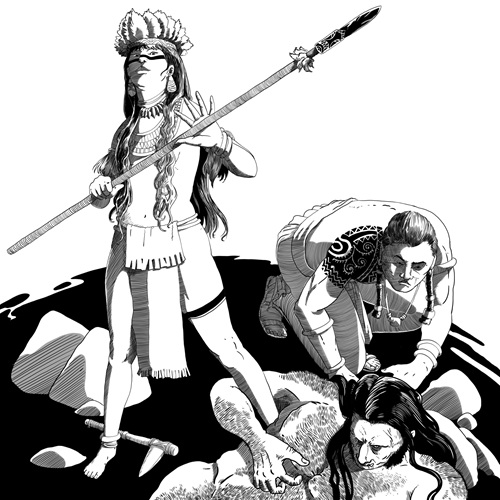
A lithe shape, still naked but for her bride’s necklaces and bracelets, leaped nimbly over me. Snatching up the taiheta in two hands she struck, a war goddess in the flickering light of the dying bonfires. She plunged that greenstone tongue straight into the Maero chief’s spine, where the thick neck disappeared into broad shoulders. Howling, the ogre rose, hands reaching back reflexively to pull at the weapon spearing him, but Tínima held on, pulled up onto her toes, leaning her weight down on the mahogany shaft. Then, whatever vertebrae or sinew had denied the long jade tongue gave way and the point sank through to its root. The creature’s head lulled back and howled, but his knees at once buckled and together they crashed to the ground.
Doggedly, I crawled to my bride, her naked skin spattered in the ogre’s blood. I reached her side just in time to see that we were not alone. A ragged circle of glinting green eyes shone wolfishly in the night, the remaining members of the Maero warband beholding their rikki’s fall. My eyes looked about that circle and I prepared to sell my life as well my broken limbs might.
But with their chieftain slain, slain by his own—their own—kin, it was as if the fight had gone out of those monstrous once-men. One, not the tallest or mightiest looking, I could not say what gave him authority, came forward as I climbed to my feet and helped Tínima pull her father’s masterwork from the slain Maero chief. Brandishing it, we did not offer battle, just held our ground—for where could we go?
But the ogre ignored us, bent and lifted his slain rikki onto his shoulders. Looking at the ring of others his glimmering wolf-eyes moved over each, a thick tongue licked blood-spattered lips nervously, then he gestured with his head inland, towards the forest and hills. Towards the Valley of Wabanex. One after another, they followed, neither walking nor running, so much as loping after their new leader into the cover of night.
***
Thus did my nuptials end in death, and Henare’s vengeance ended in a long-delayed and blood-soaked retribution for the breaking of tapu in claiming the priestess Anakaona for his own.
So many were lost. Henare was dead, his throat crushed by the Maero rikki. Long did Tínima weep for the father she had known for so little time. We found Kereopa with his stomach torn wide, his guts thrown more than a stride in any direction from him. Of the rest of our warriors, two in three were slain. When the burying and the burning were done, seeing that Kereopa’s steading would not stand, I led the survivors here, back to my home, and even old Aotwana-rikki was willing to count me as a war-chief and acknowledge me as both Kereopa and Henare’s heirs. From that day forward, I was wed to both of the old Snake’s daughters: whose claim was better?
But you have heard my story now, grandson, and you are old enough that your mind must understand the implications in what the Maero chief claimed. Were Tínima, my beloved bride, and Anakaona, her mother, its—his—kin? The Maero were moon-skinned, pale as Anakaona was said to be pale, pale as the legends of the Old Ones who ruled Nuimoto from their stone halls until Akkelu burned their great steading and swept them into the sea.
Tínima is gone now, and I doubt I am many days behind. It is best if you know the whole tale, strange as it is. It is best that you know that the blood that pounds in your veins is ancient, but some measure of it comes of a more savage line than that of the fiercest Mihowakan brave.
But if Tínima knew, we never spoke of it, and besides the night she sprang into battle to strike down the Maero chief, I ne’er saw her act with wild fury again. So, I held my tongue.
What was there to say and how to say it, grandson? How could I tell her that she slew her own grandsire, that her father might be avenged?
________________________________________
Gregory D. Mele has had a passion for sword & sorcery and historical fiction for most of his life.
An early love of dinosaurs led him to dragons, and from dragons…well, the rest should be
obvious. From Robin Hood to Conan, Elric to Aragorn, Captain Blood to King Arthur, if there
were swords being swung, he was probably reading it. He lives with his family in suburban
Chicago. His previous work for Heroic Fantasy Quarterly set in Azatlán includes: Servant of the
Black Wind (#39), Kamazotz (#41), Heart of Vengeance (#44), Old Ghosts (#48), Father of
Rivers (#50), the Path of Two-Entwined (#53), Death on the Turquoise Road (#60), and Fountain
of Hatteos.
Advertisement